

Claim Status Tools vs. Phone Calls: Finding Lost Payments Faster
Compare claim status checks done by hand, through a portal or IVR, and fully electronic, in minutes and dollars, and see when a call or portal gives more current information.
CAQH Insights reports figures for generalist medical providers. One claim status inquiry takes about 21 and a half minutes (21.41) when done by hand. It takes about 11 and a half minutes (11.56) when partly electronic, through a web portal or automated phone menu. It takes about 5 and three-quarters minutes (5.78) when fully electronic. CAQH CORE reports that several industry stakeholders said calling a health plan, or using a health plan provider portal, often gives more current information than the claim status transaction does.
Time and Cost of a Status Check by Channel
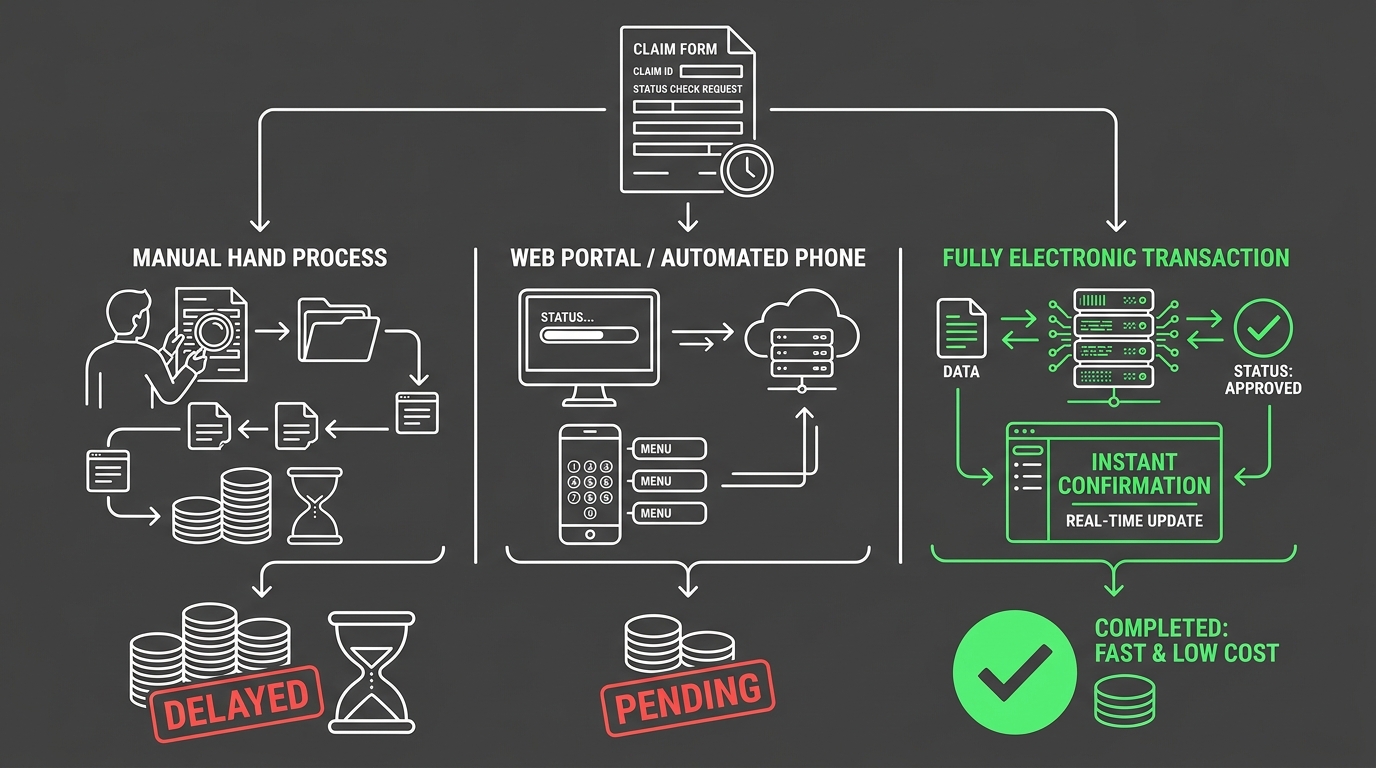
You can check a claim’s status three ways: by hand, through a web portal or automated phone menu, or as a fully electronic transaction. CAQH Insights measured the time and cost of each for generalist medical providers in its Administrative Transaction Costs by Provider Specialty brief. The table below shows the time and cost for each channel.
| Channel | Time (minutes) | Cost |
|---|---|---|
| Manual | 21.41 | $11.00 |
| Partial | 11.56 | $6.20 |
| Electronic | 5.78 | $3.15 |
Done by hand, one inquiry takes about 21 and a half minutes (21.41) and costs $11.00. Partly electronic means a web portal or an automated phone menu. That takes about 11 and a half minutes (11.56) and costs $6.20. Fully electronic takes about 5 and three-quarters minutes (5.78) and costs $3.15.
The same CAQH Insights table lists more figures. By hand, the times are 15.63, 24.39, 15.61, 28.20 and 22.59 minutes, and the costs are $7.85, $15.99, $10.59, $18.35 and $15.04. Partly electronic, the times are 5.78, 12.11, 3.33, 13.04 and 7.43 minutes, and the costs are $3.05, $7.40, $2.00, $8.10 and $4.79. Fully electronic, the times are 8.78 and 5.61 minutes, and the costs are $5.40 and $3.31.
Specialists ($15.99) and behavioralists ($18.35) pay more than generalists for a by-hand inquiry. CAQH Insights also says that, on average, specialists reported spending 24 minutes and behavioralists 28 minutes on a manual claim status inquiry. That’s nearly half an hour, compared with 21 minutes for generalists.
The 2023 CAQH Index Report is clear about what its cost figures leave out. They count only the work time needed to do the transaction. The time and cost of gathering information for it, or of following up, aren’t included.
When a Call or Portal Gives Better Answers Than the Electronic Transaction
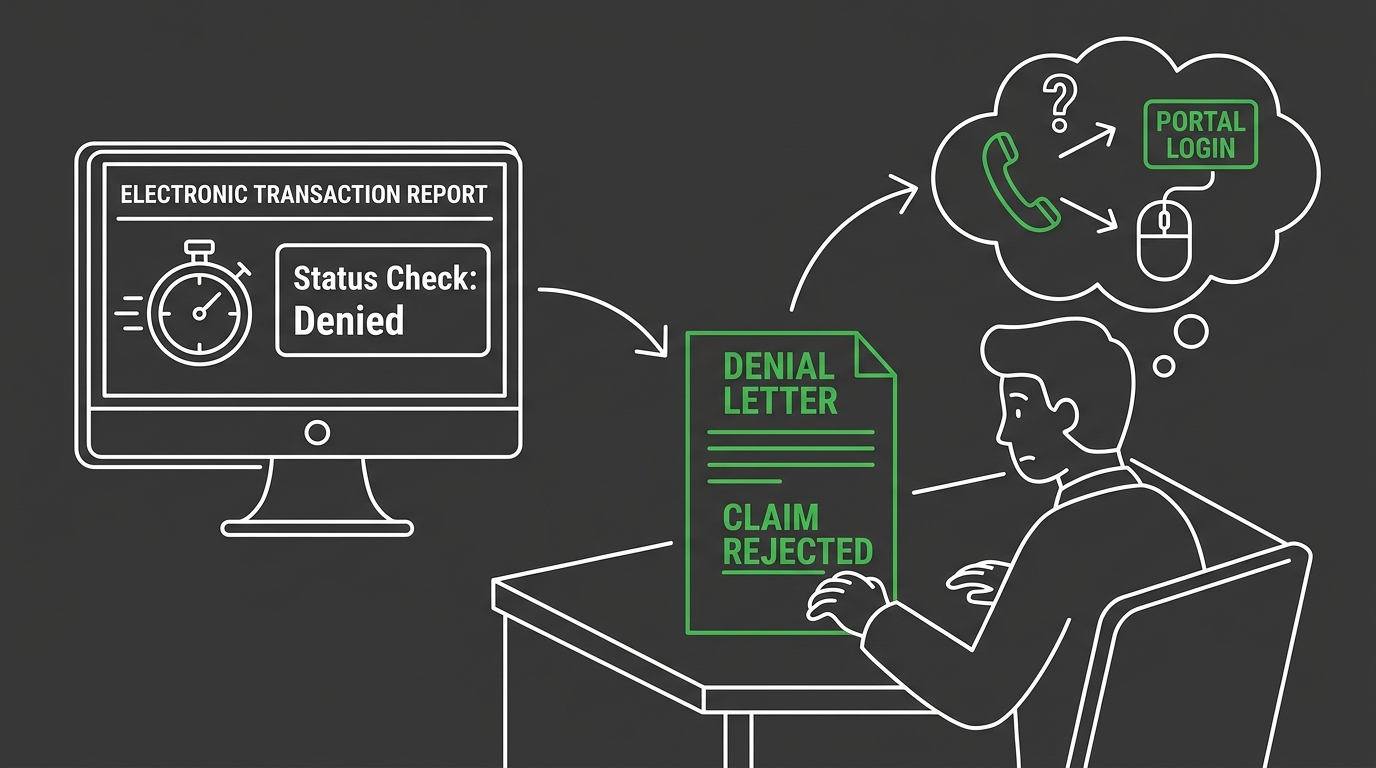
CAQH CORE covers the limits of the electronic check in The Claim Status Transaction. Several people in the industry said that calling a health plan, or using its website for providers, often gives you newer information than the electronic claim status check does.
People in the industry also want claim status answers to be more specific. Right now, you have to call health plan representatives or visit the health plan’s website to get things explained.
Finding the claim can be a problem too. Search criteria, meaning the details used to look up a claim, differ between health plans. CAQH CORE says this is potentially causing failed inquiries. In a failed inquiry, the health plan can’t find the claim or sends back multiple claims.
There are often discrepancies between what a health plan reports in a claim status inquiry and what it reports on the remittance advice, which is the payment explanation.
I don’t let an electronic check have the last word on an unclear status. I treat electronic health record (EHR) software as the thing that gets claims out the door, not as a full billing operation. I put human judgment on denials, appeals and unpaid balances, because I don’t trust a tool to handle them well by itself. When a status looks wrong, I pick up the phone. If a claim shows no record of receipt, What to Ask a Payer Rep When a Claim Shows No Record of Receipt lists the questions to ask.
Why Checking Status Before the Remittance Pays Off
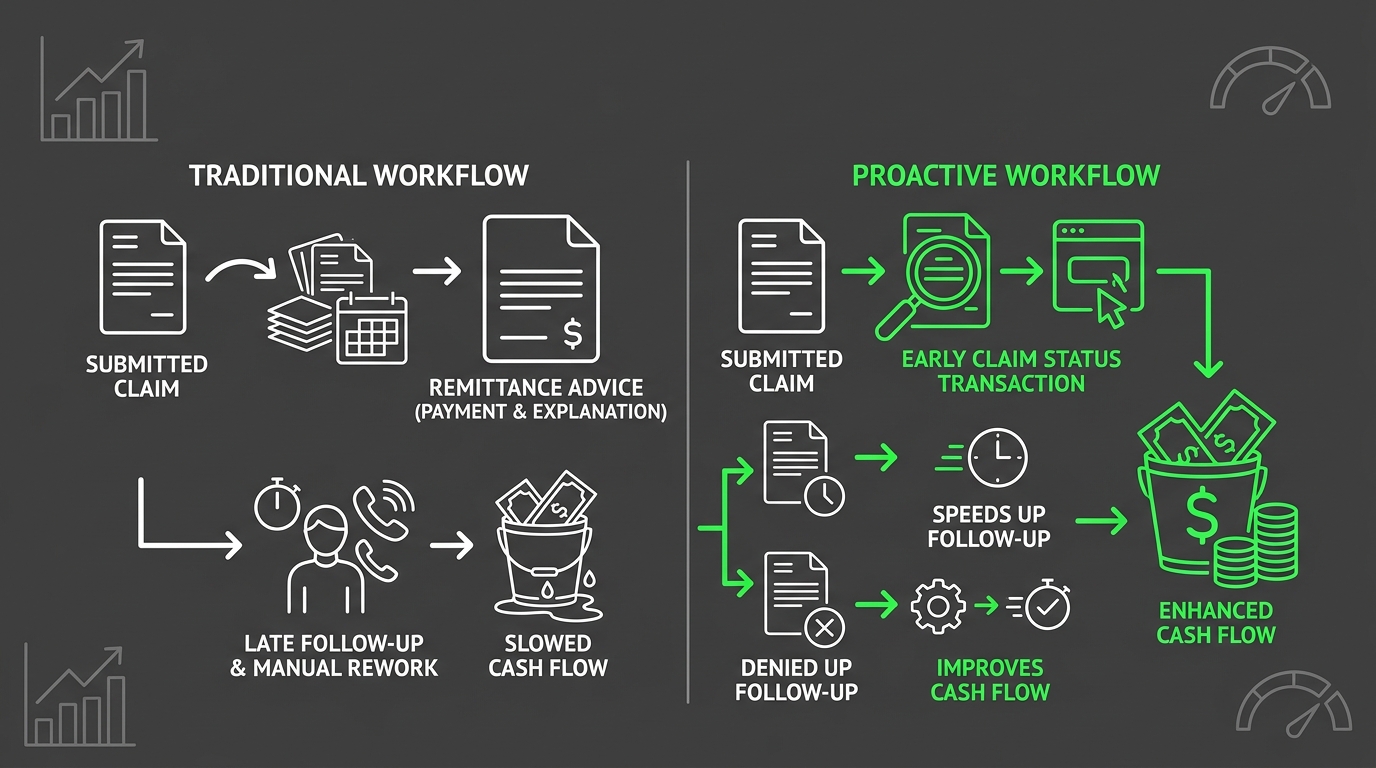
In The Claim Status Transaction, CAQH CORE says that knowing a claim’s status before the remittance advice (the payment explanation) arrives speeds up your follow-up and improves your cash flow. It does this by moving claims rework to within days of submission, rather than weeks.
CAQH CORE also says that tying payments to claims as soon as the information is available makes your accounting practices stronger. This uses situationally required data, such as the check number.
If a payment doesn’t show up, How to Locate a Missing Chiropractic Payment From a Commercial Payer walks you through the search.
Medicare Portals and IVRs: What They Confirm Before You Call
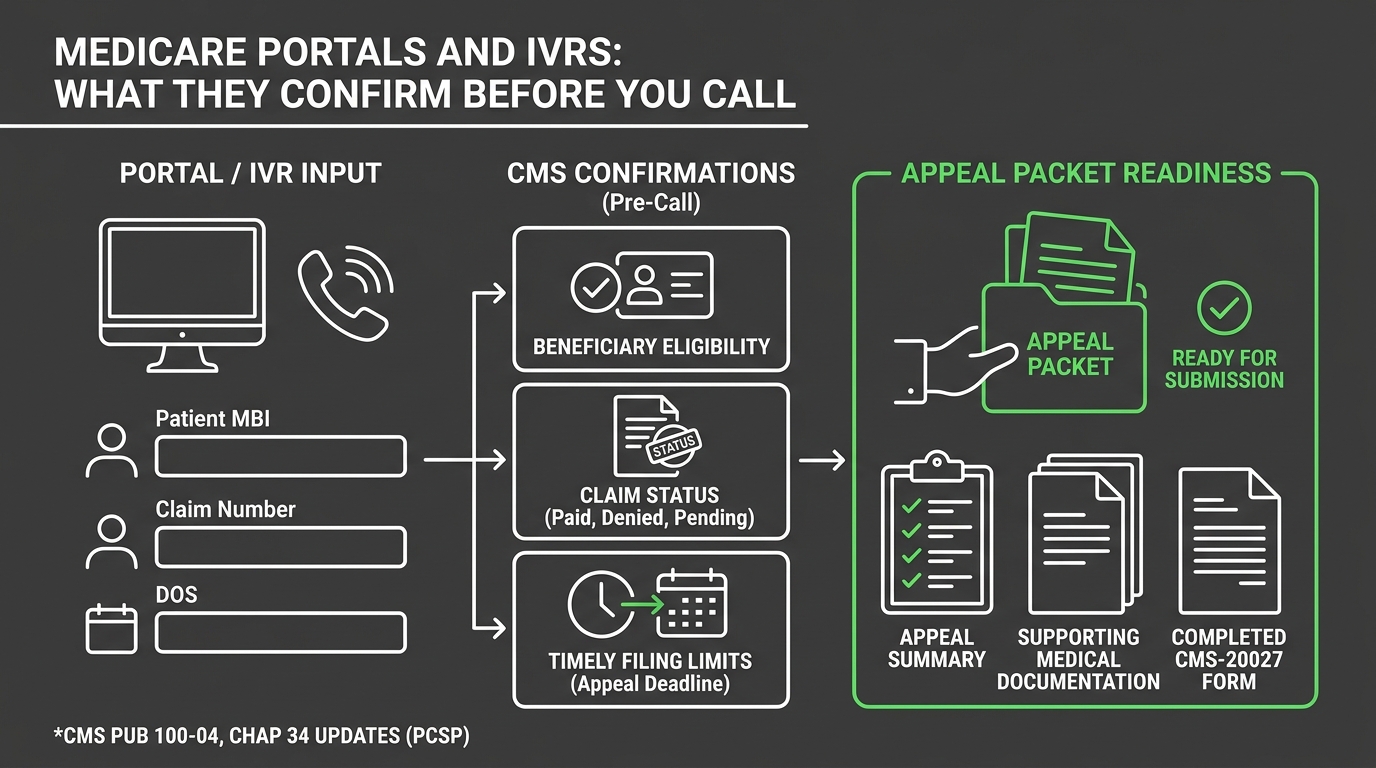
The Centers for Medicare & Medicaid Services (CMS) addresses this in Transmittal 13683 – Updates to Pub 100-09 Chapter 6 (PCSP). As part of their full training plan, Medicare Administrative Contractors (MACs) must actively encourage new providers to sign up for the MAC’s secure website.
Here is what three contractors say about their own tools.
Noridian JE Part B: Portal First, Then the Phone
For eligibility and claim status, Noridian’s Provider Contact Center – JE Part B page says to start with the Noridian Medicare Portal (NMP). The page also says CMS requires the use of self-service tools when available. Noridian’s customer service representatives may direct you back to these options when appropriate.
Plan your call time. Noridian’s contact centers have been experiencing peak call volumes from 9 a.m. to 12 p.m. Pacific time, which may increase your wait time.
Most Noridian contact center services make you prove who you are, so have your identifying information ready before you call.
On Noridian’s automated phone menu, the general inquiries choice covers claim status, financials, recoupment (money taken back), patient status and remark codes.
CGS Jurisdiction 15: What the IVR Confirms and What It Won’t
The J15 Part B IVR User Guide from CGS Administrators, LLC describes the interactive voice response (IVR) system. It’s a self-service option. You get answers to Medicare questions through an automated phone system, without speaking to a customer service representative.
Providers must use the IVR to get the information in the guide. Customer service representatives are also required to refer callers to the IVR for applicable questions.
For a processed claim, the IVR gives you:
- the date(s) of service
- the claim number (Internal Control Number, or ICN)
- the submitted or billed amount
- the allowed amounts
- the amount applied to the deductible
- the electronic funds transfer (EFT) or check number
- the payment amount
- the payment issue date, which is the Medicare remittance notice date
For a pending claim, more details will be available only after the remittance date.
The IVR won’t release payment information for unassigned claims.
Its financial information option releases the number of claims on the Payment Floor and the total expected payment amount.
WPS Jurisdictions 5 and 8: IVR Detail and Representative Limits
The Part B IVR Operating Guide from WPS Government Health Administrators lays out what the IVR does and what representatives do.
Customer service representatives are still available for claim-specific and complex inquiries. However, they can only help with things that are not available in the IVR. Provider phone representatives are not meant to answer questions the IVR can answer. They shall refer callers to the IVR.
The claim status option gives you:
- the status of the claim (denied, paid, or pending)
- the amount submitted
- the allowed amount
- the amount applied to the deductible
- the amount paid
- the paid date
- the check number
For denied claims, you will hear the ANSI reason and remark codes, the patient liability, and more information about the denial if it is available.
The IVR requires callers to give a valid NPI, PTAN and TIN combination when asking for anything other than a general question. A customer service representative will not be able to help you without this information.
The provider summary gives you the number of pending claims and their dollar amount. It also gives you the total number of approved-to-pay claims and their total dollar amount.
The Staff Time Behind Status Checks, and Who Carries It
The Centers for Medicare & Medicaid Services (CMS) says that, according to one study, the average physician spends a total of 3 weeks a year on billing and insurance-related tasks.
CAQH Insights says smaller practices are less likely to use automated workflows, which are steps done by computer, for office and billing tasks.
At Bushido Billing, people carry that work. Our billing process is led by people, not run by automation alone. Our U.S.-based chiropractic billing specialists help you collect more, stress less, and get back to patient care. You can see how the work is done on our Medical Billing Services page.
So when you hand your billing to us, a person leads it. Automation doesn’t run it alone.
Frequently Asked Questions
What counts as a partially electronic status check versus a fully manual one?
In its industry index, CAQH counts transactions done through web portals and interactive voice response (IVR) systems, which are automated phone menus, as partially electronic. Transactions that need human interaction from start to finish, such as telephone, mail, fax and email, count as fully manual.
How many questions can one call to Noridian cover?
Three. Noridian’s customer service representatives can help with three inquiries per call for each pair of provider numbers (NPI and PTAN).
Do more denials mean more status checks?
According to CAQH Insights, yes. An industry report says more claim denials go along with more claim status questions. Because of that, using the electronic standard may matter more in the future for saving money.
How much time does moving status checks to fully electronic save?
CAQH CORE points to three numbers for moving claim status checks from partly or fully manual to fully electronic. A medical provider saves about 17 minutes on average. A dental provider saves about 14 minutes on average. Together, the medical and dental industries could save about $3.7 billion a year.
Book a Call With Bushido Billing
I run routine status checks through electronic tools and portals, and I call on the unclear and denied claims. Knowing which one to use on a given claim is the skill, and I’d trust it to a chiropractic specialist over a biller who covers every specialty. I hold that chiropractic has its own demands, and I don’t expect a generalist to meet them consistently.
I count success one way: money that lands in the practice’s account. I judge billing by payment recovered, not by claims sent or statuses checked. Our U.S.-based chiropractic billing specialists help you collect more, stress less, and get back to patient care. Our process is human-led, not automation-only. We do full-service insurance billing, clean up unpaid insurance claims, and fix and appeal denied claims for chiropractic and allied health practices across the United States.
Ready to talk with our team? Book a Call