

How Do State-Specific Credentialing Delegation Rules Affect Multi-State Chiropractic Groups?
How state credentialing delegation rules affect multi-state chiropractic groups, from NCQA standards to payer-specific compliance and revenue impact.
State-specific credentialing delegation rules decide two things for a multi-state chiropractic group: how fast a provider can start billing in each state, and how much administrative work the group takes on to prove it stays compliant. Delegation lets a payer hand credentialing verification duties to the group or a contracted entity instead of processing every provider application on its own. Each state writes its own legal framework for what that delegation must contain, and payers stack their own contract requirements on top of those state rules. A delegation agreement usually has to spell out the criteria used to evaluate providers, a schedule for pre-delegation and ongoing audits, a monitoring process, and clear terms for ending the arrangement when performance standards fall short. Payers keep ultimate responsibility for verifying certain credentials directly with the licensing agency that issued them, no matter what delegation arrangement is in place. A delegated agreement never fully removes a payer's duty to confirm license validity through the original source. For a group working across several states, this builds a layered compliance structure rather than one uniform process. One state's delegation standards can differ in meaningful ways from another's, which calls for separate documentation, separate audit schedules, and separate monitoring protocols for providers licensed in different jurisdictions. A provider's ability to see patients and generate billable revenue in a new state depends directly on how quickly and accurately that state's specific delegation requirements get satisfied. Delays or errors in meeting any single state's requirements can halt claims processing for providers there, even while providers in other states keep billing without interruption.
What Credentialing Delegation Actually Means Once a Chiropractic Group Crosses State Lines
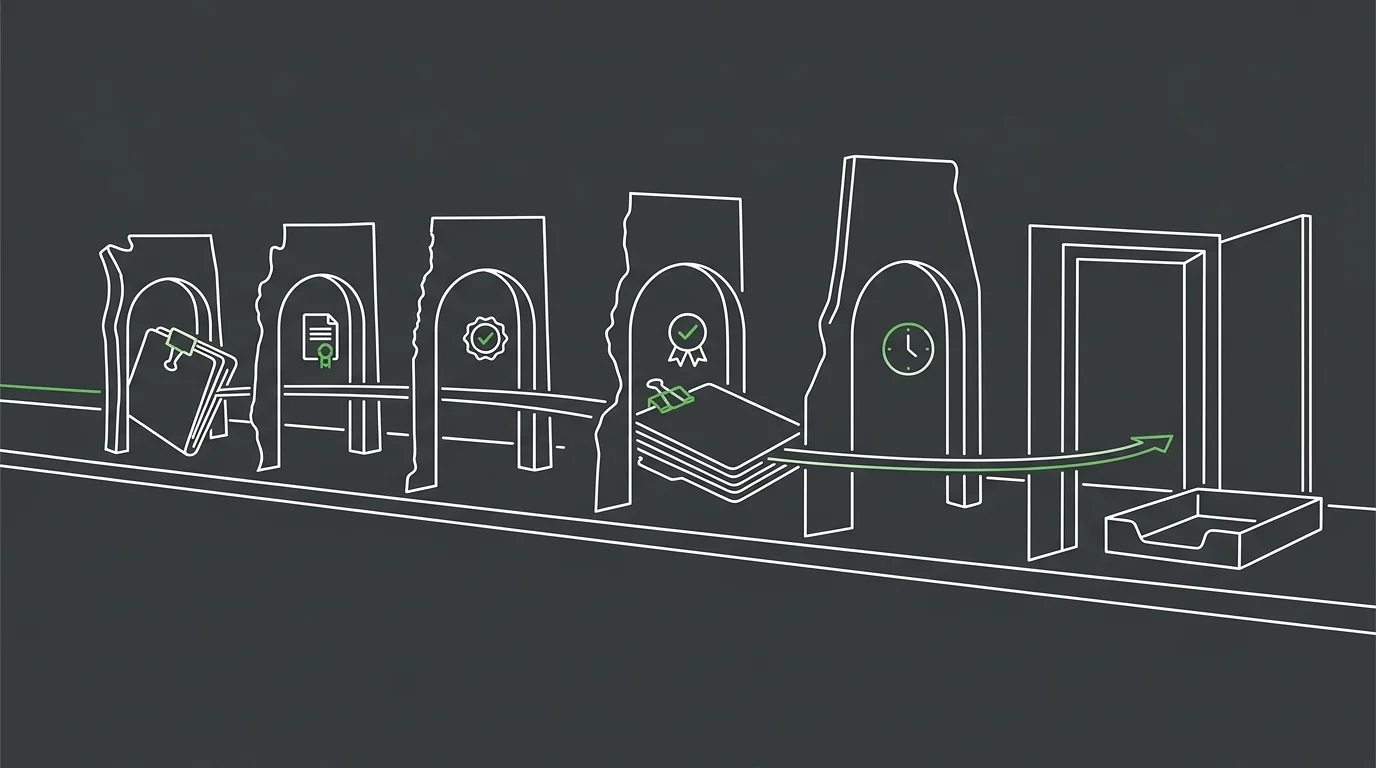
A gateway is only useful if it opens the same way every time. Cross a state line, and credentialing delegation stops doing that.
For multi-state chiropractic groups, that patchwork of delegation rules is the wall between where they are and the growth they're after. Clearing one state's gateway buys nothing at the next one.
The Two Layers Every Delegation Agreement Has to Satisfy
Every delegation agreement answers to two authorities at the same time. One is the payer's own delegation policy. The other is the state's legal framework for how that delegation has to run.
Satisfying one does not satisfy the other. A group can meet a payer's checklist and still miss a state's specific requirement, and a passage that misses either layer has not actually cleared the gateway. For more on how the underlying mechanics connect to cash flow, see the the full credentialing and CAQH revenue picture.
Why State Lines Multiply the Definition Instead of Simplifying It
Add a second state and the group does not double its paperwork. It multiplies its definitions.
Each jurisdiction sets its own audit schedule, its own monitoring expectations, its own termination standards. None of it lines up on its own. A process built for one state rarely carries over clean to the next.
Why Treating Delegation As a Speed Metric Breaks Down Across State Lines
Speed is the metric everyone reaches for first. Faster enrollment means faster billing, so delegation gets sold as a shortcut.
But delegated credentialing promises faster provider enrollment, and its value is directly tied to rigorous, state-by-state compliance. Speed without that compliance is not a gain. It is a delay waiting to happen.
The Checklist Approach to Delegation and Where It Stalls
Most groups build a checklist and assume it travels. Verify the license, confirm malpractice coverage, submit the payer packet, move on.
Here's where it stalls: a payer's delegation policy and a state's legal framework are two different things, and the gap between them is where revenue-halting delays live. A checklist built for one state's framework doesn't account for another state's separate demands. That gap surfaces later, in What Are the Retroactive Billing and Effective Date, when a provider's start date doesn't match what the payer will actually pay for.
The NCQA Standard That Every Delegation Agreement Gets Measured Against
NCQA sets the reference point most payers measure delegation against. A group that understands that baseline can build one structure instead of guessing state by state. That baseline does not replace a state's own legal framework. It sits alongside it.
| Structural Requirement | What It Establishes | Who Verifies It |
|---|---|---|
| Delegation Agreement | The written contract defining what functions are delegated and the terms the delegate must meet | The payer, in partnership with the group or contracted entity accepting delegated duties |
| Delegation Criteria | The specific standards a provider must meet before the group can verify credentials on the payer's behalf | The group's credentialing team, built against the payer's stated requirements |
| Pre-Delegation and Annual Audits | Whether the group's verification process actually performs the way the agreement describes it | The payer, through a scheduled review before delegation begins and at recurring intervals after |
| Monitoring Plan | Ongoing oversight confirming credentialing quality holds steady between formal audits | The payer, supported by documentation the group is contractually required to produce |
| Termination Procedure | The conditions and process for ending the delegation arrangement over non-performance | The payer, exercising the authority reserved regardless of how the delegation agreement is structured |
The Four Structural Requirements a Delegation Agreement Must Contain
The structure is consistent even when state rules are not. Texas networks that delegate credentialing functions to other entities must have a delegation agreement, a defined process for developing delegation criteria, a monitoring plan, and a procedure for terminating the arrangement over non-performance. Miss one, and the whole agreement reads as incomplete no matter how fast it moves providers.
How Pre-Delegation and Annual Audits Fit Into the Structure
Audits are where the skeleton gets tested. A pre-delegation audit confirms the group can actually perform the criteria it wrote down, before a payer trusts it with live verification. The U.S. Code documents that networks that delegate credentialing functions to other entities must have a delegation agreement, a process for developing delegation criteria and performing pre-delegation and annual audits, a monitoring plan, and a procedure for termination of the delegation agreement for non-performance. Across several states, that same pressure shows up on the enrollment side, covered in How Do Multi-Location Chiropractic Groups Manage Payer Panel Closures and Enrollment.
Where a Delegation Agreement Actually Fails

The standard is not where agreements collapse. The failure shows up in the gap between what the standard requires and what a centralized system actually tracks.
Simple verification isn't a strategy. A delegation strategy that works runs one centralized system for disparate payer requirements and state laws, not a separate binder for each state. Skip that, and medical billing services stay cut off from the credentialing work behind them, so chiropractic billing support turns into its own fire to put out instead of part of the same structure.
How Government Payer Rules Change the Delegation Calculation
NCQA standards are the industry baseline. Medicare Advantage is a different animal entirely.
Government payer rules do not bend to a payer's own delegation policy. They sit above it.
| Payer Type | Delegation Allowed | Direct Verification Requirement |
|---|---|---|
| Commercial Payer (NCQA-Aligned) | Permitted under a formal delegation agreement meeting NCQA structural standards | Payer relies on the delegated entity's verification process, subject to pre-delegation and annual audits |
| Medicare Advantage | Delegation permitted for administrative workflow, but does not replace the verification duty | Medicare Advantage Organization must independently verify credentials directly with the issuing licensing agency |
| State-Regulated Network (e.g. Texas-Type Framework) | Permitted where the delegation agreement includes defined criteria, audits, monitoring, and termination terms | State framework requirements apply in addition to any payer-specific verification layer |
Why Medicare Advantage Verification Bypasses Delegation Entirely
Delegation can speed up commercial credentialing. It cannot substitute for the government payer's own verification duty.
Work available through CMS indicates must verify provider credentials directly with the licensing agency responsible for issuing licenses, and retain ultimate responsibility to assure that the credentials of all network providers are verified even when credentialing is delegated to another entity.
A group can build the most efficient delegation system in the industry, and Medicare Advantage still checks the license itself. That single fact changes how a multi-state group should plan its Medicare Advantage timeline.
Building a System That Manages Delegation Across Every State a Group Operates In
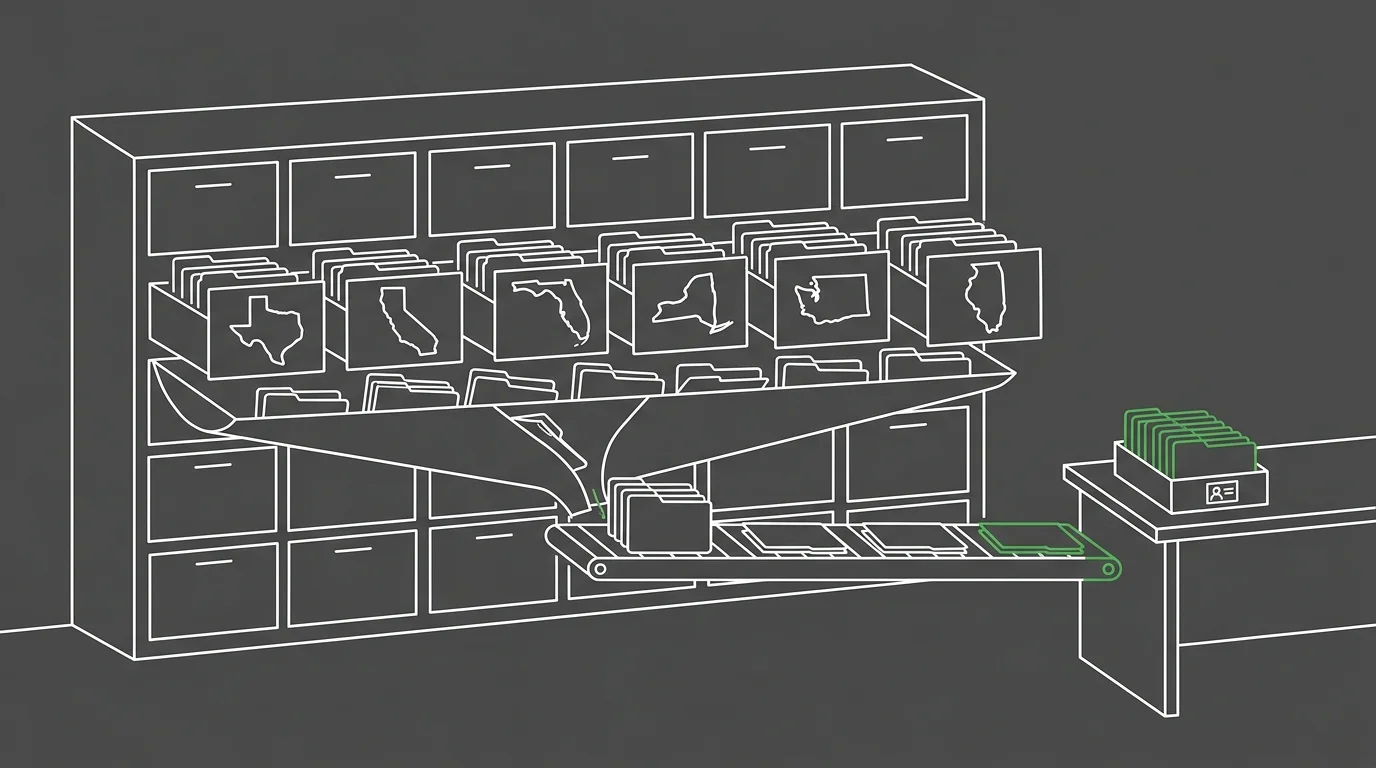
Compliance is the gate. Architecture is what walks a group through it, over and over, in every state, without rebuilding the process from scratch each time.
Treat each state as its own separate project, and a group never scales past a handful of them.
| Sequence Step | Operational Action | Depends On |
|---|---|---|
| State Licensure Verification | Confirm the provider's license is active and valid in the state where the group intends to bill | Nothing upstream — this is the first gate in the sequence and every later step assumes it is already closed |
| Delegation Agreement Review | Match the payer's contractual delegation terms against that specific state's legal requirements for delegated criteria, audits, and monitoring | Confirmed state licensure, since no delegation agreement can verify a license that does not yet exist |
| Pre-Delegation Audit | Demonstrate that the group's credentialing process actually performs the criteria written into the delegation agreement | A completed delegation agreement review for that state and payer |
| CAQH Profile Synchronization | Keep provider data current across every state and payer pulling from the same profile | Ongoing, but must be current before payer activation in any new state |
| Payer Activation | Open billing access once the state's licensure and the payer's contractual terms are both satisfied | A passed pre-delegation audit and a synchronized CAQH profile |
| Annual Monitoring and Re-Audit | Confirm the group's performance still matches the delegation agreement's criteria over time | Active payer status from the prior activation step |
Centralizing Disparate State and Payer Requirements Into One System
One centralized system holds every state's audit schedule, every payer's monitoring terms, and every termination clause in a single place.
That's what replaces the separate binder for each jurisdiction. It's what thinking beyond simple verification actually looks like in practice: disparate requirements managed as one structure.
CAQH ProView and the Data Layer Behind Multi-State Credentialing
CAQH ProView holds the provider data that most payers pull from during delegation. Keeping that data current across every state a provider touches removes one of the more common points of failure.
A stale CAQH profile does not just slow one payer. It can stall verification across several states at once.
Sequencing a Delegation Agreement From State Licensure to Payer Activation
Sequencing matters more than speed. State licensure has to clear first, because no delegation agreement can verify a license that does not yet exist.
Payer activation follows once the state's own requirements and the payer's contractual terms are both satisfied. Skip the order, and the gateway closes instead of opening.
Frequently Asked Questions
The sequencing questions above tend to spawn a second round of questions. These are the ones that come up once a group actually starts building its structure.
What is credentialing delegation and how does it work for chiropractors?
Credentialing delegation lets a payer trust a group to verify its own providers instead of doing that verification itself. The group takes on the audit trail, and the payer retains oversight to confirm it holds up.
Are multi-state chiropractic groups eligible for delegated credentialing with major payers?
Eligibility depends on the group's audit history and its documented process, not on size alone. A major payer will test whether the group's system can survive a pre-delegation review before granting the arrangement.
What are the most common compliance mistakes when managing delegation across different states?
The most common mistake is assuming one state's checklist covers another state's requirements. Groups also let CAQH profiles go stale across jurisdictions, which stalls verification in more than one state at once.
How do NCQA standards impact a chiropractic group's ability to get a delegation agreement?
NCQA gives payers a reference point for evaluating a delegation agreement's structure. A group that builds to that baseline moves faster through review, but it still has to satisfy each state's own legal requirements separately.
If one state has strict delegation rules, does that affect our agreements in other, less strict states?
No. Each state's delegation rules apply only within that state's own agreements. A stricter jurisdiction does not loosen or tighten what a payer expects in a different state.
What is the difference between a delegated agreement and using a Credentials Verification Organization?
A delegated agreement puts verification responsibility on the group itself, inside its own audited system. A Credentials Verification Organization performs that verification as a third party, and the payer trusts the organization's work instead of the group's.
How does a group's CAQH profile management affect multi-state credentialing efficiency?
Most payers pull straight from a provider's CAQH profile during delegation review. Keep that profile current across every state the provider touches. That removes one of the more common causes of stalled verification.
What This Means
The gateway image from the start holds up. One passage, and it either moves revenue forward or blocks it entirely.
Precision is what decides which one happens. A group that treats delegation as a checklist gets stopped at the first state that does not match the last one. A group that builds a centralized structure around state law, payer contract, and audit schedule turns that same gateway into a repeatable advantage.
That is the difference between a compliance burden and a revenue engine. Bushido Billing works with multi-state chiropractic groups on exactly this structure. Start with a conversation about where your credentialing setup stands today by booking a call.