

What Records Overturn a Commercial Payer Claim Rejection?
Rejected and denied claims need different fixes. See which chiropractic records answer each commercial payer reason, from Aetna to Optum, and how to appeal.
A rejected claim needs correction and resubmission, and a denied claim needs policy proof, documentation, or an appeal strategy, according to AMBCI. The American Medical Association says an appeal letter should clearly establish the specific payment adjustment made, indicate why your practice believes the health plan incorrectly limited or denied the payment, and specifically reference and include the supporting documentation. For continuing chiropractic care, Aetna says the records must include all three of these: clinical improvement in the member’s condition, specific goals to be achieved from ongoing services, and the expected duration and nature of ongoing services.
Rejected or Denied? Check Which One You Have First

Start by finding out which one you have. The fix is different for each.
I treat the electronic health record (EHR) as the tool that gets claims out the door, not as the billing operation. I sort rejections from denials myself, and I put a person on every denial, appeal and unpaid claim instead of leaving them to a tool.
What a Rejection Means
A rejection means the claim never got past the front-end checks. AMBCI, in its Clearinghouse Terminology Guide for Medical Coders, says the claim did not pass the clearinghouse’s or payer’s front-end edits, so it was never adjudicated. In other words, the payer never decided on it.
If your claim was rejected, you won’t get an electronic remittance advice (ERA). Stedi explains in its Acknowledgments and ERAs overview that this is because the payer didn’t adjudicate the claim.
AMBCI says a claim can be rejected for a missing subscriber ID, a payer ID that doesn’t match, a diagnosis in the wrong format, an invalid taxonomy, or an edit that flags incomplete data. Most of these aren’t appeals. You fix the problem and send the claim again.
What a Denial Means
A denial is a different thing. The payer adjudicated the claim and then refused to pay. AMBCI lists the grounds as coverage, policy, medical necessity, bundling, or benefits. A denied claim needs proof of policy, records, or a plan to appeal.
If you’re thinking about sending the same claim again, read Why Resubmitting an Identical Claim Rarely Overturns a Denial. If the same denials keep coming back, read How to Find the Root Cause Behind Recurring Payer Denials.
Read the EOB or Remittance First
Step 4 of the American Medical Association’s claims appeal process is to review the health insurer’s explanation of benefits (EOB), also called the remittance advice (RA). The American Medical Association says you should review the remittance information (the explanation of payment) to find the insurer’s reason for partial payment or denial. That reason tells you which records to pull.
The Core Records Every Appeal Needs
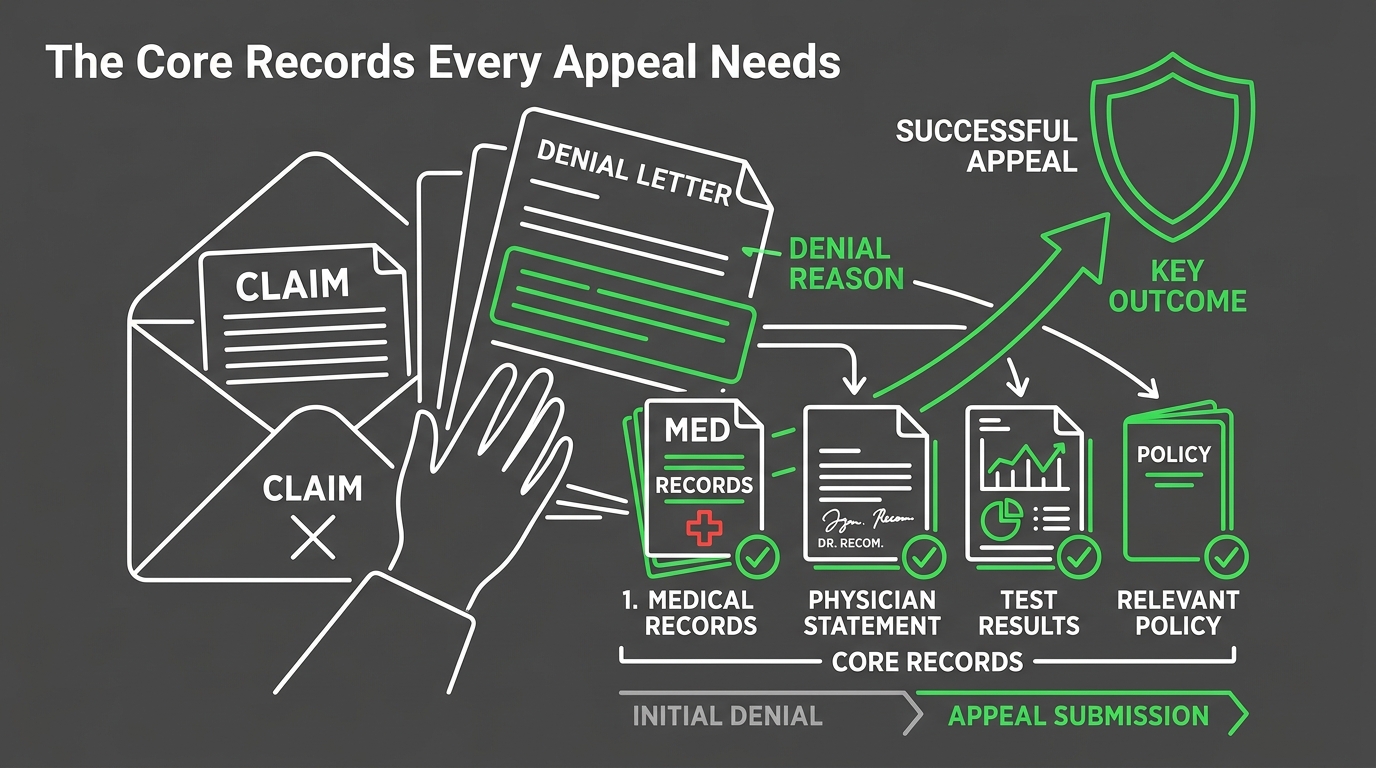
An appeal rests on two things: the supporting records and the letter that presents them.
Gather the Proof Before You Write
The American Medical Association says that to appeal a claim successfully, your practice should gather information that supports your position on the service in question. Step 6 of its appeal steps is to gather supporting documents that back up reversing the health insurer’s decision through the claims appeals process.
An American Medical Association appeals booklet, Appeal That Claim – AMA instructional booklet, says physician practices are entitled to payment for the procedures and services they provide when they have coded and documented the procedure or service appropriately.
What the Appeal Letter Must Say
The American Medical Association says your letter should do three things:
- Clearly state the specific payment adjustment made.
- Say why your practice believes the health plan incorrectly limited or denied the payment.
- Specifically reference and include the supporting documentation.
For the full steps, see Handling Denied Chiropractic Claims and Appeals: A Complete Guide.
What Commercial Payers Want to See in the Chiropractic Record
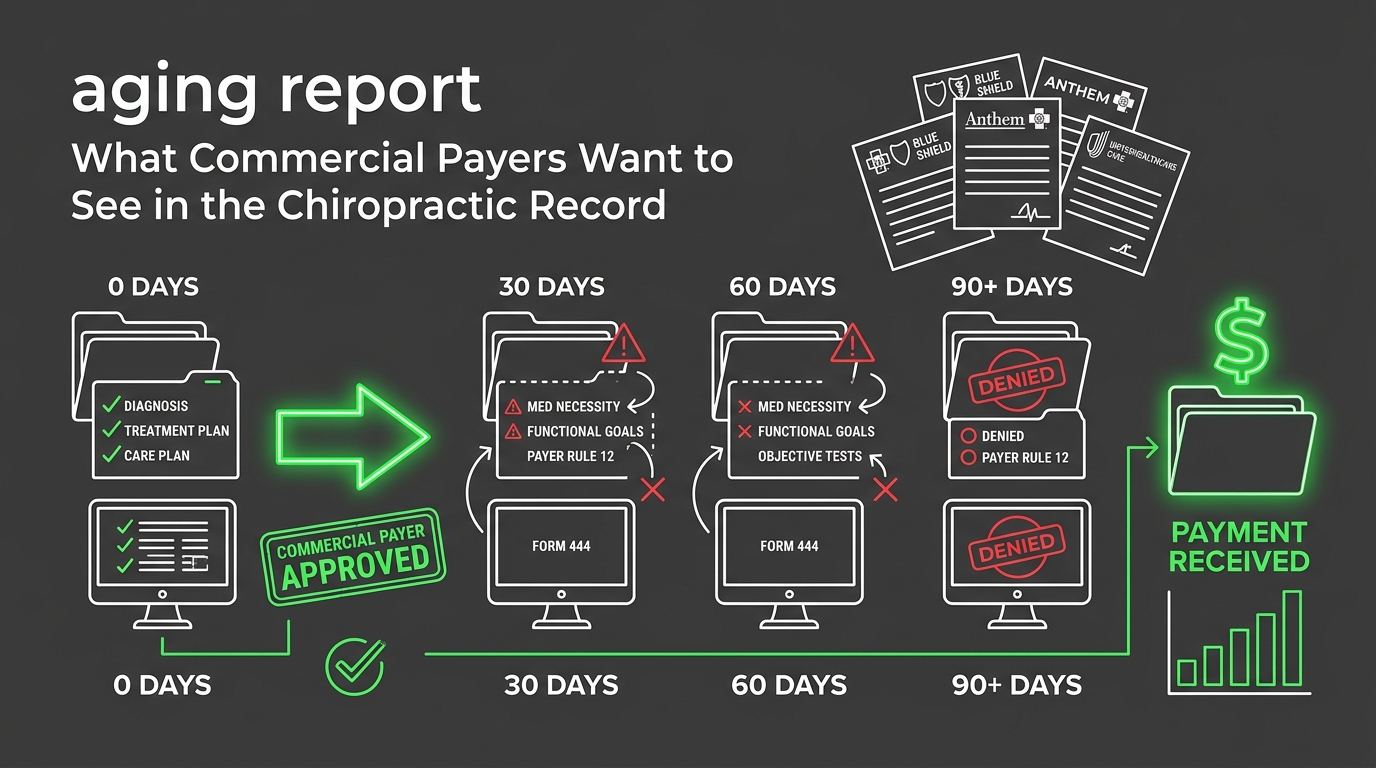
Each payer writes its own rules for a chiropractic record. These are the policies behind this section: Chiropractic Services – Clinical Policy Bulletin 0107 from Aetna, Chiropractic Care Medical Policy 8.03.501 from Premera Blue Cross, Manipulative Therapy (Commercial Medical Policy, eff. 06/01/2026) from UnitedHealthcare, and the Medicare Chiropractic Services Clinical Guideline from Optum.
I keep payer-specific chiropractic record rules with billers who work in chiropractic, not with billers who cover every specialty. I count on a specialist to meet chiropractic’s own demands every time.
The table below shows what Aetna, Premera Blue Cross and Optum each ask the chiropractic record to show. The Optum row comes from its Medicare chiropractic guideline.
| Payer policy | Treatment plan | Showing progress | When care counts as maintenance |
|---|---|---|---|
| Aetna (CPB 0107) | Initial evaluation, assessment, history and physical exam; objective, measurable short- and long-term goals; reasonable estimate of when goals will be achieved | Improvement documented within the initial 2 weeks; if none, more care is not medically necessary unless treatment is modified | Care when the condition is neither regressing nor improving is not medically necessary |
| Premera Blue Cross (policy 8.03.501) | Measurable short- and long-term goals, visit frequency and duration, anticipated date of discharge to self-care | Each follow-up visit documents symptom changes, changes in objective findings, and measured improvement toward care plan goals | After maximum rehabilitation potential is reached, or functional level shows no significant improvement for two weeks |
| Optum (UnitedHealthcare Medicare Advantage guideline) | Recommended level of care with duration and frequency of visits, specific goals, objective measures, date of initial treatment | Need for skilled or medically necessary care shown via measurable outcome tools, pain and/or activities of daily living | Further improvement not reasonably expected; care supportive rather than corrective |
Check the Member’s Own Benefit Plan First
Aetna’s policy notes that some plans have limits or exclusions that apply to chiropractic care. You need to check the benefit plan descriptions for the details.
UnitedHealthcare’s policy puts it this way: whether a health service is covered is decided by the member’s own benefit plan document and by any laws that may require coverage for a certain service.
Aetna covers these chiropractic manipulative treatment (CMT) Current Procedural Terminology (CPT) codes only if the policy’s selection criteria are met:
- 98940: spinal, one to two regions
- 98941: spinal, three to four regions
- 98942: spinal, five regions
- 98943: extraspinal (outside the spine), one or more regions
A Treatment Plan With Measurable Goals and an End Date
Aetna. Your plan of care must include an initial evaluation, an assessment, and a history and physical exam. It needs objective and measurable short-term and long-term goals, plus a reasonable estimate of when you’ll reach them. It must also name the specific chiropractic techniques, treatments or exercises you’ll use, and the spinal or body regions you’ll treat. Then give how often and how long the treatments will be. That has to be reasonable and customary by accepted chiropractic standards.
Premera Blue Cross. Under policy 8.03.501, your plan of treatment includes objectively measurable short-term and long-term goals for specific clinical and/or functional improvements. It also includes how often and how long the visits will be to reach those goals, and the anticipated date of discharge to self-care. The initial treatment plan should not project care beyond a 30 to 45 day interval.
Optum. Its Medicare chiropractic guideline says your treatment plan should include four things:
- The recommended level of care, including how long and how often the visits will be
- Specific treatment goals
- Objective measures to evaluate how well the treatment works
- The date of the initial treatment
Proof of Functional Loss and Measured Improvement
Showing the loss. One of Aetna’s tests for medically necessary chiropractic care is that the care is for a member with a neuromusculoskeletal condition that resulted in functional impairment. Examples are limited range of motion, reduced mobility, or difficulty performing daily activities.
UnitedHealthcare defines musculoskeletal disorders as injuries or conditions that start in the joints, muscles, ligaments, discs or other soft tissues of the spine or limbs. They produce clinically relevant symptoms, such as pain or numbness, and functional limitations, such as in the ability to perform daily activities.
For objective findings, Premera wants your documentation to include three things:
- A physical exam specific to the patient’s reported complaint
- Signs and symptoms of the impairment or injury, including its cause and date of onset
- Signs or symptoms of the patient’s inability to perform activities of daily living (ADLs)
Don’t lean on the word “pain” alone. Premera also says that simply stating or diagnosing “pain,” without documentation of its cause, is not enough to support medical necessity for CMT.
Showing the progress. At each follow-up visit, Premera says your documentation of progress must include three things:
- Changes in the patient’s subjective complaints or symptoms
- Changes in objective physical findings about the patient’s current status
- Measured clinical and/or functional improvement in the patient’s condition and in meeting the care plan goals
To continue chiropractic care, Aetna says your records must include all three of these: clinical improvement in the member’s condition, specific goals to be achieved from ongoing services, and the expected duration and nature of ongoing services.
Aetna also says improvement should be documented within the initial 2 weeks of chiropractic care. If none is documented in those 2 weeks, Aetna considers more chiropractic treatment not medically necessary, unless the treatment is modified.
Optum’s Medicare chiropractic guideline says that a lack of demonstrating the need for skilled or medically necessary care, via measurable outcome tools, pain and/or activities of daily living, may result in inappropriate denial of ongoing care.
Where Coverage Stops: Care That Has Become Maintenance
I won’t give the call between maintenance care and active care to a generalist. I keep that documentation with someone who knows chiropractic. Here is how each payer draws the line.
- Aetna: Under policy 0107, chiropractic care for people whose condition is neither regressing nor improving is considered not medically necessary.
- UnitedHealthcare: Manipulative therapy is unproven and not medically necessary for all other indications, due to insufficient evidence of efficacy. The policy says “including but not limited to” its list, so the list is not complete. The list includes nonmusculoskeletal disorders (such as asthma, otitis media, infantile colic, and internal organ disorders), and prevention, maintenance or custodial care.
- Premera Blue Cross: Coverage will be denied if continuing chiropractic treatment is not expected to improve the patient’s condition. Premera counts therapy as maintenance therapy when it is given after the patient has reached maximum rehabilitation potential, or after the patient’s functional level has shown no significant improvement for two weeks.
- Optum: When further clinical improvement cannot reasonably be expected from continuous ongoing care, and the treatment becomes supportive rather than corrective, the treatment is considered maintenance therapy.
Legible Notes With Initials and a Symbol Key
Your notes also have to be easy to read, per Premera. They must include the initials of the provider of service and of any staff who provide services. They must also include a key explaining any symbols or codes the provider or staff use.
Match the Records to the Denial Reason
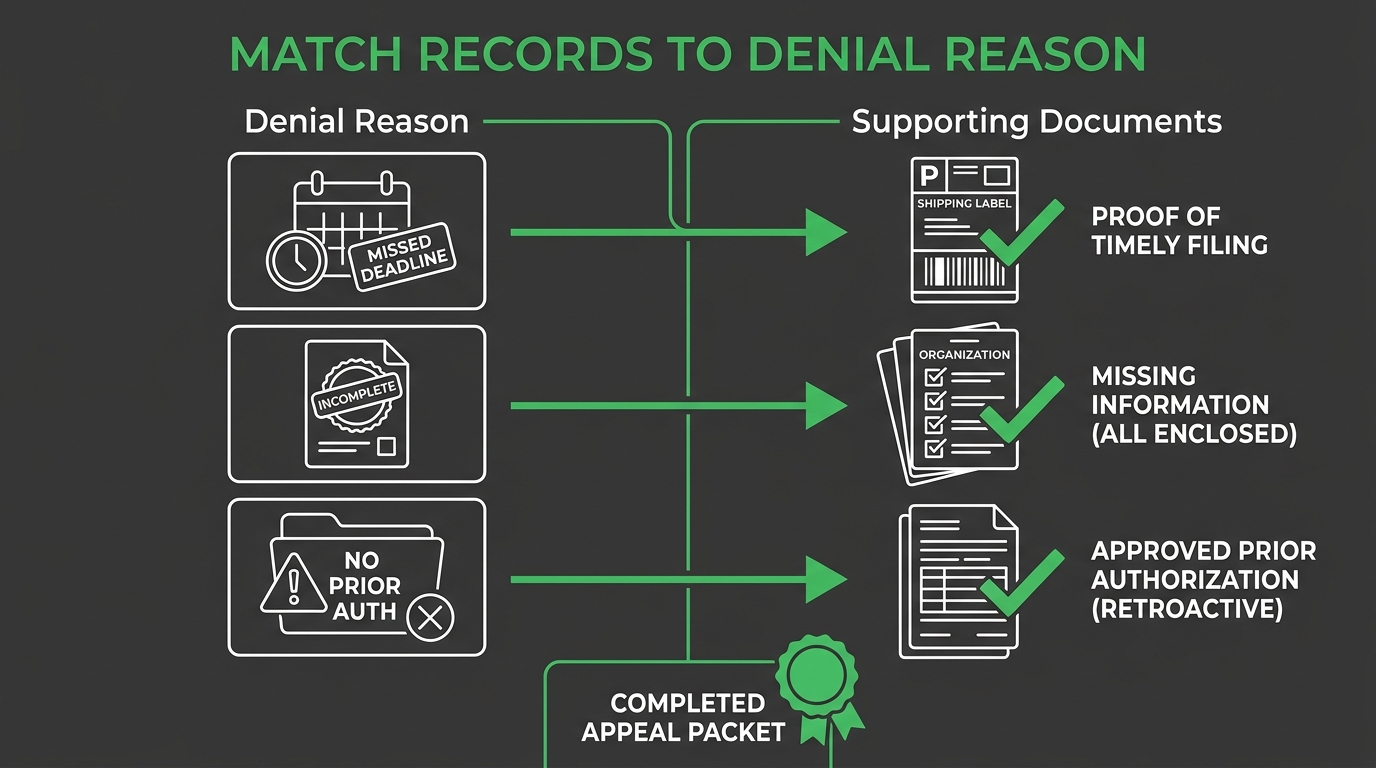
The denial reason tells you which proof to send. The American Medical Association covers these in Identifying and Appealing Health Insurance Claim Payment Issues.
I let automation handle routine claims with no errors. When a denial needs someone to justify why care was medically necessary, or needs an appeal written for that one case, I put a skilled person on it. Technology gets a real job here, but a limited one.
The table below lines up four denial reasons with the records that answer each one.
| Denial reason | Records to submit |
|---|---|
| Untimely filing | Screenshots or transmission information establishing the specific time of claim submission |
| Downcoded to a lower CPT level | Appeals letter with documentation supporting a higher service level, after checking the record meets all components of the coded service |
| Not medically necessary | Appeals letter specifying the justification for the procedure, plus supporting documentation |
| Bundled same-day services (modifier 25 or 59) | Documentation that the same-day services are separate, distinct and each deserving of payment |
Timely Filing: Keep Your Submission Timestamps
For claims denied for failure to timely file, the American Medical Association lists screenshots or transmission information establishing the specific time of claim submission as evidence to support an appeal.
AMBCI says timely filing disputes are won with proof, not memory. Save these:
- Clearinghouse acceptance timestamps
- Rejection timestamps and reasons
- Timestamps for when you sent corrections
- Payer receipt confirmations, when available
Downcoding
The American Medical Association says practices should review their medical record documentation to make sure they have met all components of the coded service based on CPT codes and guidelines. For any improperly reduced claim, it says to send an appeals letter with documentation supporting a higher service level.
Medical Necessity
To challenge a medical necessity denial, you can send the health plan an appeal letter that gives the reason the procedure was needed, along with supporting documents. The American Medical Association lays out this route.
Bundled Same-Day Services
In certain situations, such as when billing modifiers 25 and 59 apply, several services done on the same day are separate and distinct, and each one deserves payment. That comes from the American Medical Association.
It also notes that health plans have set up a wide range of policies and procedures to deal with what they see as misuse of billing modifier 25. These run from claim edits to record requests to reductions in global payment.
How ERISA Plans Treat a Provider’s Appeal
The U.S. Department of Labor explains how its claims rules treat a provider’s request in the Group Health and Disability Plans Benefit Claims Procedure Regulation.
When a Provider’s Request Counts as the Patient’s Claim
The regulation sets requirements only for employee benefit plans covered by ERISA, the Employee Retirement Income Security Act.
It does not apply to requests by health care providers for payments due them, rather than due the claimant, under contracts between the provider and an insurer or managed care organization.
The Department of Labor also says a request counts as a claim for benefits by the patient, whether the patient or the medical provider makes it. One example is when the patient signs their benefits over to you, called an assignment of benefits.
A Plan Cannot Block an Authorized Representative
A reasonable claims procedure may not stop an authorized representative from acting for the patient on a benefit claim. It also may not stop one from acting on an appeal of a denial, which the regulation calls an adverse benefit determination.
One Payer’s Rules: How Optum Reviews Chiropractic Records
The Optum Physical Health Operations Manual shows how one payer handles clinical appeals.
What a Clinical Appeal Request Includes
Optum says your request should include these:
- The reference number from the first decision
- The patient’s name
- A clear statement of the denied services you are appealing
- The basis for your appeal
- Any other information that may affect the decision
You can make a clinical appeal request to Optum by phone or in writing. Written requests are preferred.
What Optum Leaves Out of That Process
Optum says issues that are not clinical, such as reimbursement, coding, or administrative denials, are not handled under its Clinical Appeals Process.
Who Reviews Ongoing Care
Under Optum’s Medicare chiropractic guideline, an Optum clinical specialist provider reviews all ongoing care.
Optum also says that when you send in complete records, its criteria are unlikely to lead to outpatient rehabilitation and chiropractic services being denied when they should not be.
After You Submit: Standard Packets and an Appeals Log
Sending the appeal is not the last step.
Build Standard Packets and Keep Proof
AMBCI says to build a standard set of papers for each type of service, and to keep proof that you sent them in.
Keep a Log of Open Appeals
The American Medical Association says it is best to maintain a log for all outstanding appeals and to keep reviewing outstanding claims, so that payment is correct and prompt. Its page, Tools for proper payment & appeals, has more.
External Review Is Also Available
Section 2719 of the federal health care reform law, the Affordable Care Act, requires health plans to provide external review processes. These must follow the National Association of Insurance Commissioners Uniform External Model Review Act.
Our Medical Billing Services page explains how the work is done.
Frequently Asked Questions
How quickly must an ERISA plan tell you that a claim was filed the wrong way?
As soon as possible, and no later than 24 hours for urgent care claims or 5 days for nonurgent claims. That’s the notice requirement under the U.S. Department of Labor’s regulation.
Can a practice appeal again if Optum upholds its first decision?
There may be more steps. Optum says the next steps may include a second-level appeal request to Optum, and/or a review by an independent review organization if state regulations require it.
What changes when the injury came from work, a car accident or another party’s fault?
Premera notes that spinal and other manipulations given to treat an injury or condition from the workplace, a motor vehicle accident or a third party’s liability may require coordination of benefits. That means sorting out which payer pays.
What does it mean when a payer pends a claim instead of deciding it?
The payer is briefly holding the claim for more review before it makes a final decision. Stedi says this is common for high-dollar or complex claims that need a person to review them or need supporting documents (attachments).
Is manual therapy (CPT 97140) reviewed under UnitedHealthcare’s chiropractic policy?
Not in that policy. For information on billing code 97140, UnitedHealthcare’s policy sends you to a different one, called Habilitation and Rehabilitation Therapy (Occupational, Physical, and Speech).
Match Your Records to the Payer’s Reason
To overturn a commercial denial, you need records that match the payer’s reason and its chiropractic policy. You also need to turn your documentation around quickly.
I treat billing as a partnership, not a handoff you forget about. Bushido Billing needs a minimum level of help from your practice: access to your electronic health records, quick turnaround on your documentation, and providers who are available to answer questions. I count on that cooperation for results, and I can’t promise them to a practice that has checked out.
I don’t count a claim as done when it goes out. The job is done when money lands in your account, and I judge billing by what is collected, not by how many claims went out.
Bushido Billing handles commercial (private) health insurance. We do full-service insurance billing, fix and appeal denied claims, and clean up unpaid insurance claims for chiropractic and allied health practices. Want to talk through your commercial denials with us? Book a Call