

What Are the Retroactive Billing and Effective Date Limits for Chiropractic Payer Contracts?
Chiropractic payer contracts limit retroactive billing and effective dates. See how Medicare, state rules, and delegation agreements set the boundaries.
Retroactive billing and effective date limits determine the earliest date a chiropractic practice may legally bill a payer for services already rendered, and these limits vary by payer type, state law, and contract terms. The effective date is the official start date of in-network status under a payer contract, distinct from the date credentialing paperwork is approved or the date a provider begins seeing patients. Medicare generally sets its own retroactive enrollment rules through federal regulation, while commercial payers set effective dates individually within each contract, and state insurance statutes sometimes impose additional notice or timing requirements on top of those contract terms. When a provider starts treating patients before a payer contract's effective date takes hold, services rendered in that gap are frequently billed at out-of-network rates or denied outright, regardless of when credentialing approval eventually arrives. Some payers permit a retroactive effective date extending back to the application submission date, the credentialing approval date, or another negotiated point, while others enforce a strict effective date with no retroactive allowance at all. Timely filing limits then govern how long a practice has to submit a claim once the effective date is established, and those windows differ by payer and by claim type. Appeals for claims denied due to effective date mismatches or timely filing issues require specific supporting documentation, including proof of the credentialing timeline and the contract's stated terms. Because these variables intersect across federal regulation, state law, and individual contract language, the actual retroactive window for any single chiropractic claim depends on which combination of those three sources governs that particular payer relationship.
What the Effective Date Actually Controls on a Payer Contract

One line in a payer contract decides whether a claim can be paid at all. That line is the effective date, not the signature date and not the approval date.
The effective date is the official start date from which a chiropractor can be reimbursed as an in-network provider for covered services. Everything before that date sits outside the contract's protection, regardless of what else has already happened.
Where the Term Gets Confused
Most practices treat approval, signature, and effective date as one milestone. They are three separate events, and only one of them starts the reimbursement clock.
That confusion is exactly why retroactive billing and effective date limits rank among the most confusing and costly areas in chiropractic payer contracting. A denial rarely comes from bad care or a bad claim. It comes from a date nobody tracked separately. The mechanics behind that credentialing timeline are covered in descriptions of how credentialing and CAQH enrollment shape reimbursement timing.
What the Contract Language Is Actually Deciding
So what is the contract language actually deciding? Not just a start date. A boundary line that splits every claim into paid or denied depending on which side of it the date of service falls.
That boundary does not move on its own. It moves when a practice negotiates it, or when a statute forces a payer's hand before the gap ever opens.
What the Numbers Show Across Payers and Programs
So what do the actual clocks look like once you line them up? Every one runs on its own schedule, and not a single one defers to the others.
| Program or Jurisdiction | Governing Rule | Key Timeframe | What It Controls |
|---|---|---|---|
| Medicare Provider Enrollment | CMS revocation authority | Retroactive revocation effective date | CMS provider enrollment revocations |
| Veterans Affairs Claims (Paper) | Federal statute governing VA claims payment | 45 calendar days | Deadline for VA to pay a clean paper claim |
| Veterans Affairs Claims (Electronic) | Federal statute governing VA claims payment | 30 calendar days | Deadline for VA to pay a clean electronic claim |
| New Jersey Carrier-Provider Agreements | State notice requirement for unilateral contract changes | 90 days advance notice | Window before an adverse billing term change can take effect |
Medicare's Retroactive Rules as a Benchmark
Medicare moved first, and it moved toward stricter enforcement, not looser paperwork. Per CMS, CMS regulations now permit retroactive revocation effective dates to be applied for certain grounds involving provider revocations. That tells you the effective date is an enforcement lever here, not an administrative footnote.
Federal payment timelines already set one benchmark earlier in this article. Now the same instinct toward firm, enforceable deadlines turns up again, just pointed at revocation instead of payment.
Where State and Federal Timelines Diverge
State law can move faster than a payer's own contract language. New Jersey's provider contract regulations require that a New Jersey agreement permitting unilateral changes to provider contracts must provide 90 days advance notice before adverse changes to billing terms can take effect, allowing providers to terminate in advance of the effective date. That window lets a provider terminate before the change ever applies. Multi-location practices feel this divergence hardest, since each site can sit under a different state's notice rules. That structural question is covered in When Does a Multi-Location Chiropractic Practice Require.
How a Compliant Credentialing File Is Built to Support an Earlier Date
A denial costs more than the claim it lands on. It exposes every gap the credentialing file carried into signature.
| Credentialing Path | Who Signs | Effective Date Trigger |
|---|---|---|
| Standard Direct Contracting | The individual provider and the payer | Set by the payer's own internal credentialing review, with the practice unable to move that date once submitted |
| Delegated Credentialing Agreement | The delegate agency and the credentialing body | Set by the date the delegation agreement itself is signed between those two organizations |
| Retroactive Negotiated Terms | The practice and the individual payer, at the contract table | Set by whichever prior milestone the negotiated language names, such as application submission or approval |
| Strict No-Retroactive Contract | The individual provider and the payer | Set only at signature, with every date of service before it falling outside in-network status entirely |
The Delegation Path to an Earlier Effective Date
Look at what a delegation agreement actually does to that timeline. Published government guidance documents that delegated credentialing activities become effective as of the date the delegation agreement is signed by CAMHD and the delegate agency. That means the gateway opens on a signature date between organizations, not whenever a payer's internal queue clears. Multi-state groups structuring that arrangement should see rules governing credentialing delegation across state lines.
Why the Passive Approach to the Credentialing Gap Fails
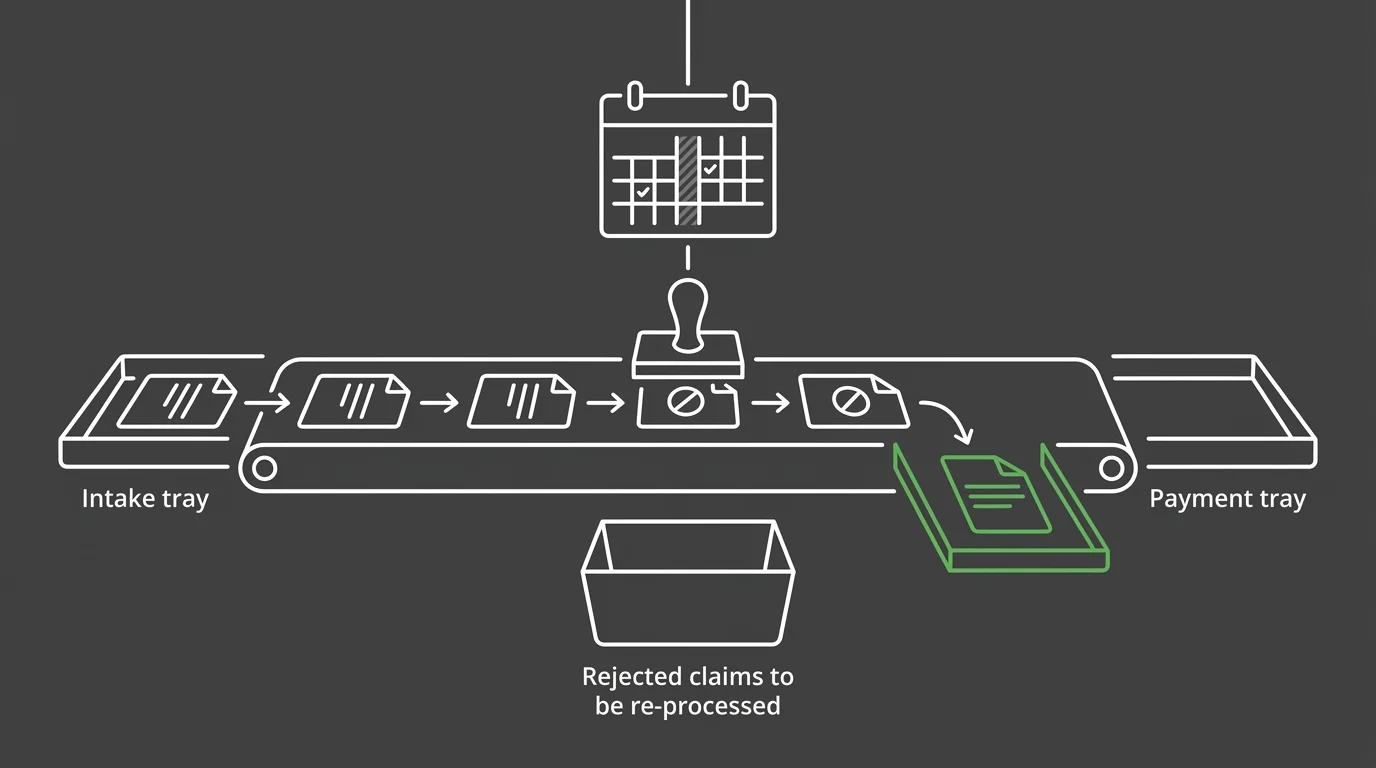
So what happens when a practice stops fighting for the earlier date and just accepts the gap as a cost of doing business? The gateway stays shut for however long the payer's internal queue takes, and every claim filed against a date of service inside that window gets written off before anyone even argues the point.
How the Failure Actually Plays Out in Claims Data
Look at where that passive posture actually shows up. State law, Medicare's own revocation rules, and a commercial payer's contract language never move on the same clock, and treating them as one problem instead of three is what keeps the gap open longer than it has to be. That interplay is exactly why claims tied to services like credentialing and payer enrollment support get caught in effective date disputes that a more contested credentialing file would have avoided.
Building the Appeal When a Claim Is Denied for an Effective Date Mismatch
A denial for an effective date mismatch does not close the case. It opens a specific, document-driven argument.
That argument only works when the appeal identifies which of the three dates the payer actually disputes, then answers that dispute directly instead of resubmitting the same claim unchanged.
| Appeal Step | Documentation Required | Purpose |
|---|---|---|
| Identify the disputed date | Payer denial notice specifying the reason code, plus the contract page stating the effective date | Confirms which of the three dates (credentialing approval, contract signature, or effective date) the payer is actually contesting |
| Assemble the credentialing timeline | Application submission record, approval correspondence, and any delegation agreement signature date | Establishes a documented sequence the payer cannot dispute on timing alone |
| Cite the governing contract or statute language | The specific contract clause or state notice provision that sets the effective date or the notice window | Grounds the appeal in the exact rule the payer is bound by, rather than a general objection |
| Submit a cross-referenced appeal packet | A single ordered file linking the denial reason, the timeline, and the governing clause, not a resubmission of the original claim | Gives the reviewer everything needed to reverse the denial without requesting additional records |
Sequencing the Appeal Once the Denial Reason Is Known
Sequencing matters because payers work against fixed clocks, not open-ended patience. Per the U.S. Code, the Secretary of Veterans Affairs must pay clean claims for hospital care, medical services, or extended care services within 45 calendar days upon receipt of a paper claim or 30 calendar days upon receipt of an electronic claim. That federal posture toward firm payment windows is the same instinct that shows up in commercial contract language. So an appeal that arrives ordered, dated, and cross-referenced closes the gap faster than one that repeats the original claim and hopes the reviewer connects the dots.
Negotiating Contract Language Before the Signature, Not After

So the strongest appeal is the one a practice never has to file. Every dispute covered above traces back to language a contract already contained before signature.
That means the real leverage point sits earlier than the claim, earlier than the denial, earlier than the appeal. It sits in the notice and amendment clauses a practice negotiates before signing anything.
What to Ask For in the Notice and Amendment Clauses
Look for a fixed advance-notice window before any billing term can change. Not a vague nod to "reasonable notice."
Ask for the delegation and credentialing signature dates to control the effective date wherever a delegated arrangement applies, instead of leaving that date to a payer's internal queue.
That one request moves the gateway's opening date into the contract itself, before the gap ever gets a chance to form.
Frequently Asked Questions
A handful of mechanical questions show up in almost every effective date dispute. Here are the direct answers.
What is the difference between a contract's effective date and a credentialing approval date?
Credentialing approval just means a payer reviewed the provider's file and accepted it. The effective date is the separate, later date when in-network reimbursement actually starts.
Can a chiropractic practice bill for services rendered before the contract's official effective date?
Only if the contract or a governing law grants a retroactive effective date reaching back to that service. Without that provision, services before the effective date usually get billed out-of-network or denied outright.
How can a practice negotiate for a retroactive effective date with a new payer?
Raise it before signature, never after. Ask the payer to tie the effective date to the application submission date or the credentialing approval date, then get that term written into the contract itself.
What documentation is needed to appeal a claim denied for timely filing or effective date issues?
You need proof of the credentialing timeline, the contract's stated effective date language, and dated correspondence showing when each milestone hit. The appeal has to name which of the three dates the payer disputes.
Do Medicare and commercial payers use different rules for retroactive billing?
Yes. Medicare runs its own federal enforcement posture, while commercial payers set contract-specific terms that can be more or less generous depending on the language negotiated.
If a payer delays the credentialing process, does that extend the retroactive billing window?
Not automatically. A delayed credentialing process can shrink the usable retroactive window unless the contract or a delegation agreement already pins the effective date to an earlier milestone.
What is the first step when a batch of claims is denied for an effective date mismatch?
Sort the batch by which date each denial actually disputes. That sorting decides whether the fix is a documentation appeal, a contract term, or a delegation agreement issue.
Where This Leaves the Practice
So the gateway image holds. A payer contract's effective date either opens on day one, or it stays shut for as long as a passive posture allows.
An aggressive contracting and credentialing strategy fights for the earliest possible date before signature, closes the retroactive window as a negotiated term rather than an accident, and documents every credentialing milestone so an appeal has something to stand on. A passive posture waits for the payer's queue to decide, then absorbs whatever falls in the gap.
That difference is the whole thesis of this article. Practices ready to push their own contracting and credentialing posture toward the earlier date can schedule a call with Bushido Billing.