

Billing Active Treatment Under Medicare Rules: A Complete Guide
Learn Medicare's AT modifier rules for chiropractic active treatment billing, the documentation standards required, and how maintenance care differs.
Billing active treatment under Medicare rules requires appending the AT modifier to claims for chiropractic manipulative treatment codes, maintaining documentation that proves a reasonable expectation of functional improvement, and distinguishing that care from maintenance therapy, which Medicare does not cover. Medicare defines active treatment as corrective care intended to produce measurable improvement in a patient's condition, not care intended to preserve a static state or prevent symptom progression. This distinction governs every chiropractic claim submitted to Medicare, because the program only reimburses manipulation performed to correct acute or chronic subluxation when that correction is still clinically underway. The AT modifier signals to Medicare that the treatment billed falls on the active side of that line rather than the maintenance side. Supporting documentation must establish the patient's baseline condition, a treatment plan aimed at correction, and objective evidence of progress or a revised plan when progress stalls. Claims lacking this documentation, or claims where the clinical notes describe a stable or chronic condition without ongoing correction, are vulnerable to denial even when the modifier is present. Once a patient's condition stabilizes and further manipulation serves only to maintain function rather than improve it, the claim shifts into maintenance territory and Medicare coverage ends for that service. Correctly billing active treatment therefore depends on accurate modifier use, documentation that matches the clinical reality of the visit, and an ongoing clinical judgment about where a patient's care falls between active correction and maintenance. Each of these elements works together, and a failure in any one of them can result in claim denial regardless of whether the other elements are correctly executed.
Articles in this cluster
- Steps for appealing a denied Medicare claim — How to Appeal a Denied Medicare Claim: The Steps to Take
- Training front-desk staff on active care billing — Training Front-Desk Staff on Medicare Active Care Billing
- Documentation standards for spinal manipulation codes — New Medicare Documentation Standards for Spinal Manipulation Codes
- Documenting active spinal manipulation — How to Document Active Spinal Manipulation Under Medicare Now
- A pre-submission checklist for active care claims — A Pre-Submission Checklist for Federal Active Care Billing Compliance
- Active care versus maintenance billing under Medicare — Active Care vs. Maintenance Billing Under Medicare Rules Today
- Regional variation in Medicare Part B payment updates — How Medicare Part B Payment Updates Vary by Region for Chiropractors
- Comparing regional Medicare fee allowances for chiropractic clinics — Regional Medicare Fee Allowances: A Comparison for Chiropractic Clinics
- Common Medicare billing misconceptions for chiropractors — What Chiropractors Get Wrong About Medicare Billing Rules Today
- The 2026 Medicare fee schedule changes for chiropractic — Do 2026 Medicare Fee Schedule Updates Raise or Cut Chiropractic Pay?
- Weighing the decision to drop Medicare enrollment — Should Your Practice Drop Medicare Enrollment? What to Know
Why Medicare Draws a Hard Line Between Active Treatment and Maintenance Care
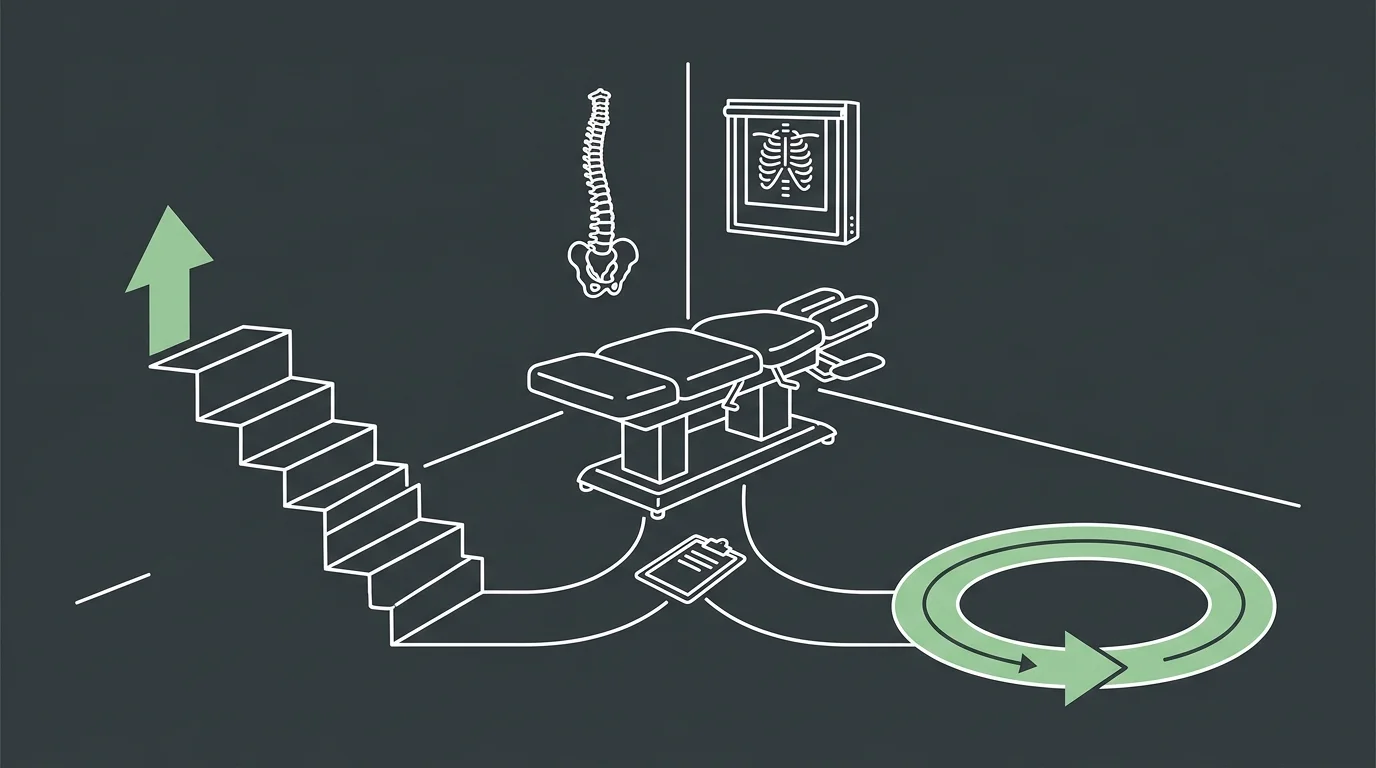
Medicare doesn't treat chiropractic care as one thing. It draws a line, with active treatment on one side and maintenance care on the other.
Every modifier, every clinical note and every denial comes back to one question: which side of that line does this claim sit on? Get the answer wrong, and payment stops.
What Counts as Active Treatment Under Medicare
Active treatment, in Medicare's view, is corrective care that has a reasonable expectation of functional improvement for the patient. It is not care aimed at comfort or stability.
A claim only qualifies when the clinical picture still shows a condition actively being corrected. Once that correction stalls, the claim no longer belongs on the active side of the line.
Why the Distinction Exists in the First Place
The distinction between active treatment and maintenance care is the central compliance challenge for chiropractors billing Medicare. It is not a technicality buried in a manual.
Here's the root of it: Medicare was built to pay for correction, not upkeep. That's exactly where generalist billers stumble, and it's why chiropractic revenue cycle management built around this rule set matters more than general billing skill.
The Assumption That Any Biller Can Handle Chiropractic Claims
So the idea that any billing company can handle chiropractic claims treats drawing that line as clerical busywork. It isn't.
Active treatment billing under Medicare gets close review. But a generalist workflow built for routine evaluation and management codes has no reason to flag the specific conditions that decide whether a chiropractic claim gets paid.
Why Generalist Billing Workflows Miss the AT Modifier's Conditions
According to CMS, Medicare requires the Active Treatment (AT) modifier to pay for CPT codes 98940, 98941 and 98942 when the care is active or corrective treatment of acute or chronic subluxation. A generalist workflow built around standard claim fields has no built-in trigger for that rule. It submits the claim and moves on, but submission isn't billing.
CMS also says the AT modifier must not be used when the visit was maintenance therapy. So a claim can be coded correctly and still land on the wrong side of Medicare's line when the modifier and the visit don't match. That error traces back to a system that was never built to ask where the line sits.
What the AT Modifier Actually Certifies on a Claim
The AT modifier isn't a formality to tack onto a code. It's a statement that this visit meets Medicare's definition of active correction, not comfort care.
| CPT Code | Service Type | AT Modifier Requirement |
|---|---|---|
| 98940 | Chiropractic manipulative treatment, spinal, one to two regions | Required when the visit represents active or corrective treatment of acute or chronic subluxation; absence of the modifier signals maintenance care to Medicare |
| 98941 | Chiropractic manipulative treatment, spinal, three to four regions | Required under the same active-versus-maintenance standard; documentation must support continued correction rather than a stable condition |
| 98942 | Chiropractic manipulative treatment, spinal, five regions | Required whenever the broader scope of manipulation still serves a corrective purpose; the modifier cannot substitute for notes proving functional improvement |
The Codes the Modifier Attaches To
That statement belongs only on the manipulation codes Medicare already ties to the line between active and maintenance care. Put it on any other code, and the claim misrepresents what Medicare is being asked to pay for.
What Submitting the Modifier Is Claiming to Medicare
Submitting a claim with the modifier attached is not the same as getting paid for it. CMS states that the AT modifier doesn't by itself prove a service was reasonable and necessary, and contractors may still deny the claim after medical review. Payment depends on whether the record backs the modifier up.
The Documentation Record Medicare Actually Scrutinizes

Documentation isn't just a clinical record. It's the main evidence that proves a claim belongs on the active side of the line and holds up under audit.
Where Claims for Acute and Chronic Subluxation Go Wrong
Claims for acute and chronic subluxation go wrong when the notes describe a patient holding steady rather than improving. The modifier can be correct and the code can be correct, and the claim still fails once the record shows maintenance, not correction.
Reading the 2024 CERT Findings Without Panic
Reading the 2024 CERT findings without panic starts with what they actually measured: paperwork, not intent. According to CMS, a Comprehensive Error Rate Testing (CERT) Program review in 2024 found errors in 33.6% of chiropractic claims. That rate doesn't say what caused each error, but a mismatch between the modifier and the chart is one gap a careful documentation process can close.
The Point Where Active Treatment Becomes Maintenance Care
The transition from active treatment to maintenance care isn't a date on a calendar. It's a clinical judgment, made visit by visit, about whether correction is still underway.
That judgment is where a chart can stop matching the modifier. Notes that stop describing progress and start describing stability mark the moment the claim crosses the line, whether or not the modifier changes.
Signals That the Transition Has Already Happened
A plateau in objective measures is the clearest signal, because once functional gains stop showing up visit over visit, the care has already shifted toward maintenance no matter which codes get billed. Repetition without a revised plan is the other giveaway, since identical notes across consecutive visits describe upkeep, not correction. Medicare's coverage doesn't follow the bill — it follows evidence of change.
Building a Claim File That Documents Progress, Not Just Visits

A claim file earns payment by showing a line of progress, not a list of appointments. Each visit note has to demonstrate movement toward correction, because a chart that reads the same from visit to visit reads as maintenance no matter what the modifier says.
| Documentation Element | Active Treatment Standard | Common Gap |
|---|---|---|
| Baseline status | Notes a patient's functional limitations at the start of a course of care, stated in measurable terms. | A generic intake note that never restates the patient's starting condition in terms that later visits can compare against. |
| Visit-to-visit comparison | Each note measures current status against the prior visit and states what moved. | Identical or near-identical phrasing across consecutive visits, with no comparison language at all. |
| Treatment plan updates | A plan revised in response to documented progress or a documented plateau. | A plan written once at the start of care and never revisited as the clinical picture changes. |
| Functional improvement evidence | Objective measures tied to the corrective goal, showing movement toward it over time. | Subjective comfort language substituted for functional measures, leaving no evidence of correction. |
| Modifier-to-chart alignment | The AT modifier and the narrative describe the same clinical reality on every claim. | A modifier applied by habit while the chart quietly describes a stable, maintained condition. |
Sequencing the Visit Note So the Modifier and the Chart Agree
The modifier and the chart make the same claim, or the claim fails. An EHR template will populate fields and transmit the form, but it has no judgment about whether this visit's note actually supports an AT modifier or quietly contradicts it. That reconciliation is a human task, not a software default.
What a Defensible Progress Note Includes
A defensible note records the patient's current function, compares it to the last visit, and says what changed. Any plan revision ties back to that comparison. Skip that structure, and the file can't prove which side of Medicare's line the visit sits on.
Frequently Asked Questions
A few questions come up again and again once practices start applying these rules to real patients. Here are the straight answers.
What is the difference between active treatment and maintenance care for Medicare?
Active treatment aims at measurable correction of subluxation, and Medicare expects improvement to keep showing up. Maintenance care just preserves a stable condition. Medicare doesn't cover chiropractic manipulation for that.
What kind of documentation does Medicare require to prove active treatment?
Notes need a documented baseline, a treatment plan aimed at correction, and objective evidence of progress visit over visit. A plan revision tied to stalled progress strengthens the file further.
How do I know when a patient has transitioned from active treatment to maintenance care?
Watch for two signals: objective measures that plateau, or notes that repeat without change. Either one marks the shift to maintenance, no matter what the modifier says.
Can I bill Medicare for an exam or X-ray in addition to the adjustment?
No. The Medicare Benefit Policy Manual says Medicare covers only manual manipulation of the spine to correct a subluxation, and all other services a chiropractor furnishes or orders aren't covered. An X-ray can still be used to document a subluxation, but Medicare won't pay for it.
What are the most common reasons Medicare denies claims for active chiropractic treatment?
A common cause is a mismatch between the modifier and the clinical note. A chart describing stability rather than correction undercuts an AT modifier even when the code itself is correct.
What happens if I forget to add the AT modifier to a claim?
A missing AT modifier on an active treatment claim typically means Medicare won't reimburse it. The code and the documentation can be flawless, and the claim still fails without that modifier attached.
Where This Leaves the Practice Billing Medicare
Medicare's line between active treatment and maintenance care isn't going to move. Every claim either proves it sits on the active side, or it doesn't get paid.
That proof isn't the modifier alone, and it isn't the clinical note alone. It's the two working together, visit after visit, under a documentation process built specifically for this rule set rather than adapted from general billing habits.
So here's what to do: build a practice that can show, on demand, exactly where each patient sits on that line. If a practice's claims can't answer that one by one, the modifier isn't the problem. The system behind it is, and that's worth talking through: book a call with Bushido Billing.