

What Is the Medicare Revalidation Process for Chiropractic Groups Using PECOS?
How Medicare revalidation works for chiropractic groups using PECOS, including deadlines, CMS-855B and CMS-855I forms, and what missed cycles cost.
The Medicare revalidation process for chiropractic groups using PECOS is the periodic requirement to resubmit and recertify enrollment information in order to keep Medicare billing privileges. Providers and suppliers must complete this cycle roughly every five years after their initial enrollment application is submitted and validated. For a chiropractic group, it means two connected but distinct actions inside the Provider Enrollment, Chain and Ownership System, known as PECOS. The group entity, enrolled under a Type 2 NPI, must revalidate its business enrollment information, typically through Form CMS-855B. Each individual chiropractor in that group, enrolled under a Type 1 NPI, must separately revalidate their own enrollment record. Reassignment of benefits to the group may require Form CMS-855R alongside Form CMS-855I when an individual practitioner is not already enrolled in Medicare. Revalidation confirms that practice locations, ownership information, and reassignment relationships stay current and accurate in the federal system of record. Medicare Administrative Contractors send notices ahead of a provider's specific due date, and PECOS also lets providers look up that due date directly. Missing the submission window carries operational consequences beyond a paperwork delay. Failing to submit within the required window can trigger a hold on Medicare payments and, in some cases, full deactivation of billing privileges. Revalidation can also be triggered outside the standard cycle by events such as a change in practice location or ownership. Because a chiropractic group holds both an entity-level enrollment and multiple individual-level enrollments, tracking due dates and required forms across every provider becomes a structural necessity rather than an occasional task.
What Actually Happens During Medicare Revalidation for Chiropractic Groups
Revalidation exists to force accuracy, not to generate busywork. Every provider and supplier apart from DMEPOS suppliers must resubmit and recertify enrollment information on a recurring five-year cycle to keep Medicare billing privileges active. That cycle starts counting the moment a completed enrollment application is submitted and validated.
Treating that cycle as a paperwork refresh misreads what it actually is. It functions as a checkpoint on a chiropractic group's revenue stream, one that either holds under precision or gives way under neglect. Research published through the U.S. Code found must enter a 5-year revalidation cycle once their completed enrollment application is submitted and validated. The same discipline extends backward to how a provider or practitioner entered the system in the first place, a connection covered in what happens before and after a chiropractic provider joins an insurance network.
Why Treating Revalidation as a Paperwork Refresh Fails
Treat a checkpoint like a form to file and it stops doing its job. By the time a notice lands, a practice that waited for it is already behind.
That recurring cycle we walked through isn't a formality. It's the mechanism that keeps a group's revenue moving without a break.
The Problem With Treating Revalidation as a Check-the-Box Task
PECOS is the one portal for every Medicare enrollment and revalidation action. On paper it streamlines the work. In practice it's notorious for precision that forgives nothing.
A single mismatched practice location or an outdated ownership field can stall an entire submission. The system does not distinguish between a careless error and an honest oversight, it just rejects both.
How a Reactive Filing Habit Compounds Across a Multi-Provider Group
A solo practitioner managing one enrollment record faces one deadline and one point of failure. A chiropractic group multiplies that exposure across every Type 1 NPI it carries alongside its Type 2 entity filing.
Reactive filing doesn't scale. What holds when you're watching one due date falls apart the moment a group has several, each on its own clock, each exposed to the same PECOS precision. That rhythm matters just as much on the credentialing side, which is why How Often Do Chiropractors Need to Re-Attest their CAQH ProView profile runs on the same logic of recurring, non-negotiable deadlines.
The Real Cost of a Missed Revalidation Window
A missed revalidation window doesn't announce itself with a warning shot. It shows up as a payment hold, and by then the damage is already in motion.
Medicare providers and suppliers who fail to submit a revalidation application within six months of their due date may face a hold on Medicare payments and possible deactivation of their Medicare billing privileges. For a chiropractic group carrying multiple individual enrollments alongside its group filing, that risk multiplies across every provider on the roster. CMS reports providers who fail to submit a revalidation application within six months of their due date may face a hold on Medicare payments and possible deactivation of their Medicare billing privileges.
The Mechanism Behind a Payment Hold
PECOS won't pause processing while a group scrambles to catch up. Once the six-month window closes, the Medicare Administrative Contractor treats a payment hold as procedure, not a judgment call.
An administrative oversight in the revalidation process can lead to immediate payment holds and deactivation, a disruption many practices underestimate until it hits their receivables. The same fragility shows up when a group's footprint changes, which is why When Does a Multi-Location Chiropractic Practice Require an NPI Type II group enrollment is worth understanding before expansion outruns the paperwork.
How PECOS Structures the Individual and Group Enrollment Layers
PECOS doesn't treat a chiropractic group as one filer. It treats the group entity and every individual provider inside it as separate enrollment records, each carrying its own revalidation clock.
| Form | Filed By | Purpose | Filed Alongside |
|---|---|---|---|
| CMS-855B | The group entity, under its Type 2 NPI | Revalidates the group's business enrollment record, including practice locations and ownership | Filed independently of individual provider forms |
| CMS-855I | Each individual chiropractor, under a Type 1 NPI | Revalidates the provider's own individual Medicare enrollment record | Filed alongside CMS-855R when the provider is not already enrolled in Medicare |
| CMS-855R | The individual chiropractor reassigning benefits | Establishes or confirms reassignment of benefits to the group entity | Filed concurrently with CMS-855I for a provider new to Medicare |
Where CMS-855I, CMS-855B, and CMS-855R Fit Together
The group's Type 2 NPI revalidation rides on Form CMS-855B. Each chiropractor's individual Type 1 NPI record rides on Form CMS-855I, and reassignment runs through Form CMS-855R. Research published through the Medicare Program Integrity Manual found form CMS-855I is required when an individual who is not enrolled in Medicare wants to reassign benefits to an entity, and can be submitted concurrently with form CMS-855R.
When a chiropractor isn't yet enrolled in Medicare but needs to reassign benefits to the group, CMS-855I and CMS-855R can go in together instead of one after the other. That split between individual and group filings, Type 1 against Type 2, is what keeps a multi-provider revalidation from collapsing into one point of failure. Groups that build their Billing Services around that separation catch the mismatches before PECOS does.
What the Revalidation Timeline Looks Like in Practice
Form architecture only matters because a calendar sits behind it. Every enrollment record we just separated carries its own clock, and that clock runs on a fixed rhythm.
| Timeline Marker | What It Means | Action Required |
|---|---|---|
| Every 5 years | The standard revalidation cycle for providers and suppliers other than DMEPOS suppliers, counted from validated enrollment. | Confirm the group's due date in PECOS and prepare Form CMS-855B alongside each provider's Form CMS-855I well before the cycle closes. |
| Due date reached | The point at which a completed enrollment application must be resubmitted and recertified to keep billing privileges active. | Submit the revalidation application to the Medicare Administrative Contractor rather than waiting on a courtesy notice. |
| Within 6 months of due date | The window in which a revalidation application must reach the Medicare Administrative Contractor to avoid payment consequences. | File before this window closes for every individual and group enrollment record tied to the practice. |
| Past the 6-month window | The point at which a provider or supplier may face a hold on Medicare payments and possible deactivation of billing privileges. | Treat a missed window as an active payment hold risk and escalate the outstanding submission immediately. |
Reading the 5-Year Cycle and the Six-Month Warning Window
The five-year cycle we outlined earlier isn't a suggestion. It resets the moment a completed application clears validation, and it runs quietly until the notice arrives. The six-month window after a due date is where the real exposure sits, because that's the line between routine filing and a payment hold.
What Triggers Revalidation Outside the Standard Cycle
The standard cycle isn't the only clock a group has to watch. A change in practice location or ownership can force revalidation outside the normal schedule, on no fixed notice. A group tracking one clock per provider still has to watch for the ones that trigger early.
Building the PECOS Revalidation Packet Step by Step
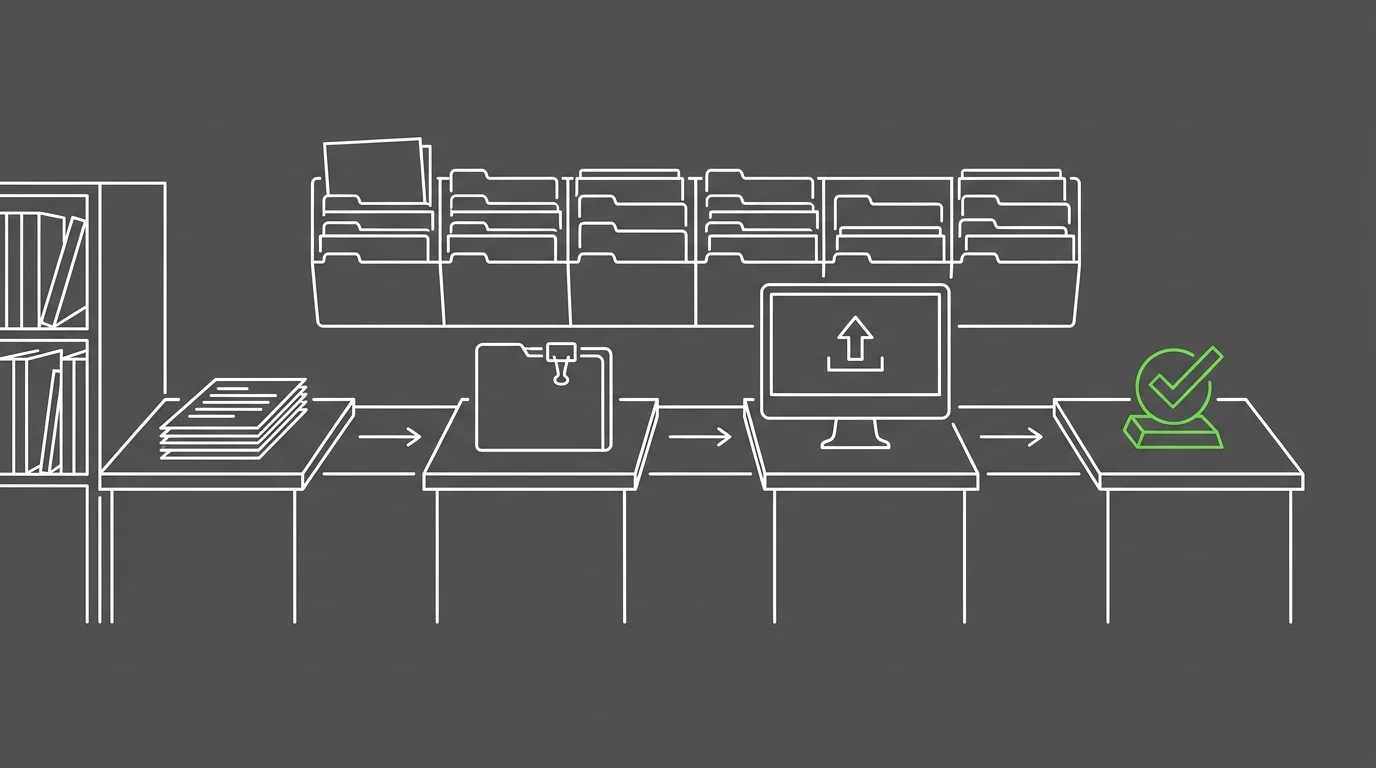
One missed field is all it takes to turn clean architecture into a payment hold. Build the packet right the first time and the clock never becomes a threat.
| Step | Document or Action | Responsible Party |
|---|---|---|
| Gather source documents | Confirm current practice locations, ownership records, and reassignment details for the group and every individual provider | Practice manager or credentialing lead |
| Verify NPI structure | Match each Type 1 individual record against the Type 2 group filing before touching PECOS | Practice manager |
| Prepare Form CMS-855B | Update the group entity's enrollment information for the Type 2 NPI submission | Practice manager or designated administrator |
| Prepare Form CMS-855I per provider | Update each chiropractor's individual enrollment record under their Type 1 NPI | Individual provider with administrative support |
| Attach Form CMS-855R where needed | Include reassignment of benefits for any provider not already enrolled, filed alongside Form CMS-855I | Practice manager |
| Submit through PECOS | File the group and individual records as separate submissions inside the portal | Practice manager or credentialing lead |
| Track confirmation per record | Monitor status for the group filing and every individual filing independently, since PECOS does not group them | Practice manager |
Assembling the Documentation Before the Portal Opens
Gather every practice location, ownership record, and reassignment document before you open a PECOS session, not while you're inside one. Each Type 1 provider record and the Type 2 group filing need current, matching information in every field the system checks. Assemble a packet piecemeal inside PECOS and you invite the exact mismatch it rejects without a word.
Submitting and Tracking the Application Inside PECOS
Submit the group's Form CMS-855B and each provider's Form CMS-855I together, with Form CMS-855R attached wherever reassignment applies. Track confirmation for every individual record separately, since PECOS treats each one as its own filing with its own clock. A practice manager who checks status per provider, not per group, catches a stalled record before it becomes a payment hold.
Frequently Asked Questions
A recurring five-year clock raises specific questions once a group starts tracking more than one provider on it. Here's where the mechanics get concrete.
Do individual chiropractors in a group need to revalidate separately from the group entity?
Yes. Each Type 1 NPI runs its own revalidation clock, apart from the group's Type 2 filing. The group revalidating on schedule doesn't cover a single one of its chiropractors.
What happens if our chiropractic group misses its Medicare revalidation deadline?
Once the six-month window closes, PECOS moves toward a payment hold without waiting for the group to catch up. Let the gap continue and deactivation of billing privileges follows.
Is there an application fee for a chiropractic group to revalidate its Medicare enrollment?
No. Physician and non-physician practitioner organizations are exempt from the revalidation application fee. A chiropractic group's provider filings sit inside that exemption.
How can our group find its specific Medicare revalidation due date?
Medicare Administrative Contractors send notices ahead of a provider's specific due date. PECOS also lets a group look up that date directly rather than waiting on a notice to arrive.
What are the most common mistakes chiropractic groups make during PECOS revalidation?
The recurring failure is reading one provider's revalidation as proof the whole group is current. What actually stalls submissions is mismatched practice location or ownership fields across separate Type 1 and Type 2 filings.
Does changing a practice location or ownership trigger an off-cycle Medicare revalidation?
Yes. A change in practice location or ownership can force revalidation outside the standard five-year cycle, on no fixed notice. A group has to watch for that trigger alongside its scheduled clocks, not in place of them.
What This Means
Revalidation isn't a form. It's the checkpoint that decides whether a chiropractic group's revenue keeps moving or stalls without a word of warning.
A group that tracks its Type 1 and Type 2 clocks with precision never meets that checkpoint as a crisis. A group that waits for the notice meets it as a payment hold.
Discipline is what separates the two outcomes, not luck and not paperwork speed. Bushido Billing built its process around that distinction, treating every revalidation clock as a structural priority rather than an afterthought. If your group wants that same precision applied to its own PECOS calendar, book a call with Bushido Billing.