

What Should I Look for in a PI Lien Billing Specialist in 2026?

A PI lien billing specialist should have a strong working knowledge of lien law, the ability to communicate and negotiate directly with attorneys, experience reviewing clinical documentation for medical necessity, a reliable system for managing Med-Pay alongside third-party liens, and familiarity with the claims evaluation tools that insurance adjusters rely on in 2026.
That's the short version. But there's a lot of context behind each of those traits that's worth understanding before you bring someone onto your team.
If you're a chiropractor building your personal injury caseload, you already know that PI revenue doesn't follow the same rules as standard insurance billing. There's no electronic claim submission. No 30-day turnaround. No predictable reimbursement schedule.
Instead, you're treating on a medical lien — providing care now and waiting for a legal case to resolve before you're paid from the settlement.
That wait can stretch well past a year. And when payment does arrive, attorneys commonly ask providers to reduce their bills as part of the disbursement process.
None of that is unusual. It's how PI works.
But it does mean that the person managing your PI billing needs a very different skill set than the person managing your insurance claims. A PI lien billing specialist functions as a bridge between your clinical documentation and the legal process — making sure your work is accurately represented when it's time to settle.
This article walks through what that role actually looks like in 2026, why it matters more now than it has in previous years, and how to evaluate whether someone has the expertise to handle it well. The goal is to help you understand what identifying revenue leakage looks like in a PI context, and why the level of human intelligence in billing becomes especially important when settlements — not payers — determine what you collect.
Why PI Lien Billing Is a Separate Discipline
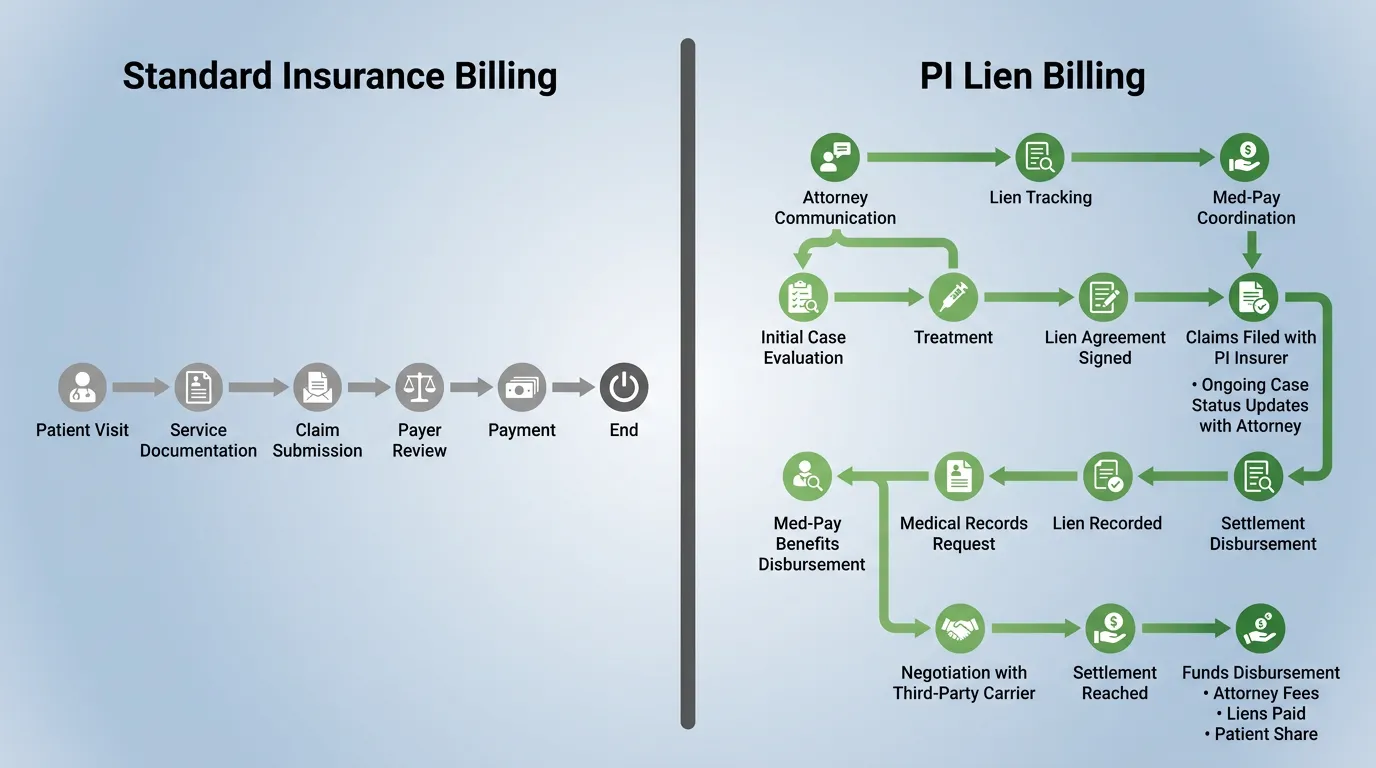
If you've ever tried to manage PI cases the same way you manage insurance billing, you've probably noticed how quickly things get complicated. That's not a reflection of your team's ability — it's a reflection of how different these two systems really are.
Understanding the distinction is the first step in knowing what to look for in a specialist.
The Lien-Based Revenue Model
When you treat a personal injury patient on a medical lien, you're agreeing to defer payment until the patient's legal case resolves. That makes you, in practical terms, a creditor — not a claim submitter.
The average personal injury case takes roughly 11.4 months to resolve, and a meaningful percentage extends past 18 months. During that time, your accounts receivable grows while the revenue stays pending.
Managing that process well involves several moving parts.
- Lien verification and management — A properly executed lien agreement with the patient, acknowledged by the attorney, is the foundation of your legal right to payment from the settlement. Without it, your position is significantly weaker.
- Attorney coordination — The attorney manages the settlement funds. Your billing team needs to stay in communication with the legal team throughout the case — not just when the check is ready.
- Med-Pay coordination — Many patients have Medical Payments coverage on their auto insurance. This benefit can be billed immediately and doesn't require fault to be established. It's one of the most reliable ways to generate cash flow while the lien is still open.
Settlement communication — When the case resolves, attorneys regularly request lien reductions from providers. This is a normal part of the process, but how your team responds — and how well your documentation supports your billing — directly affects what you collect.
Where the Workflow Diverges From Standard Billing
A standard insurance biller works within a defined system — CPT codes, modifiers, clearinghouse submissions, ERA processing, denial follow-ups. The rules are complex, but the structure is consistent.
PI lien billing doesn't operate inside that structure.
There's no electronic claim going to a clearinghouse. There's no negotiated fee schedule. The entity that ultimately pays you is an attorney whose job is to maximize the patient's net recovery — which sometimes means asking providers to accept less.
That's not a flaw in the system. It's just how PI works. And it's why it requires someone who understands the legal side of the billing relationship, not just the clinical side.
| Payment source | Insurance payer | Settlement via attorney |
| Submission method | Electronic (clearinghouse) | Paper lien + direct coordination |
| Payment timeline | 14-45 days | 6-18+ months |
| Primary risk | Coding/documentation denials | Attorney bill reduction at settlement |
| Cash flow pattern | Predictable, recurring | Delayed, lump-sum, negotiated |
The Five Non-Negotiable Traits of a PI Lien Billing Specialist

Not every billing professional who has worked a PI case is prepared to manage one well. Here are the five areas of expertise that matter most — and what each one looks like in practice.
Trait 1: Working Knowledge of Lien Law and Settlement Mechanics
Your PI billing specialist should understand how medical liens function in your state — not just in general terms, but in the specific details that affect whether you get paid.
That includes the requirements for a valid lien agreement, the provider's rights during settlement disbursement, and the legal frameworks that can limit or protect your recovery.
In California, for instance, the Hospital Lien Act caps hospital recovery at 50% of the patient's net settlement. But chiropractors and other private providers operate under different rules, governed by the lien contract itself.
Your specialist should also be familiar with the Ahlborn Formula — especially if you treat patients who have Medi-Cal or Medicaid coverage. The 2006 U.S. Supreme Court decision in Arkansas Department of Health and Human Services v. Ahlborn established that Medicaid's lien recovery is limited to the portion of a settlement that represents past medical expenses — not the full amount.
The formula is: Total Settlement ÷ Total Case Value × Medicaid Lien = Maximum Recovery Amount.
Applying it requires documentation to establish the total value of the case — typically through expert reports, attorney stipulations, or court orders. A billing specialist who understands this process helps ensure that lien reductions are calculated properly, not estimated loosely.
Trait 2: Attorney Communication and Negotiation
When a PI case settles, the attorney distributes the funds. And before your payment is issued, it's common for the attorney to request a reduction on your bill. This is a standard part of the process.
How your team handles that conversation determines what you ultimately collect.
Attorneys typically request 25% to 40% reductions from chiropractic providers. On lower-value settlements — where total liens may exceed the available funds — the requests can be higher.
A good PI billing specialist approaches these conversations with clarity and documentation, not emotion.
- When your lien is a small percentage of the settlement — There's usually room for everyone. A well-documented bill in this range often doesn't need to be reduced at all.
- When the settlement is tight — A reasonable, documented response carries more weight than either refusing outright or accepting whatever's offered. Your clinical records, treatment timeline, and the role your care played in the case outcome all support your position.
- When you have an ongoing relationship with the attorney — The best PI billing specialists understand that these relationships matter. Attorneys remember providers who are reasonable and well-organized. That reputation pays dividends on future cases.
The difference between a 10% reduction and a 40% reduction on a $5,000 lien is $1,500. Across a year of PI cases, that adds up.
Trait 3: Clinical Documentation Review
This is one of the most important — and most overlooked — parts of the role.
Your PI billing specialist should be reviewing your SOAP notes, not just your invoices.
Here's why that matters. Insurance adjusters and claims evaluation software convert your clinical documentation into numerical scores that influence settlement value. Colossus, one of the most widely used systems, applies over 10,720 value drivers and 600+ injury codes to calculate a recommended range. By late 2025, major carriers were routing roughly 80% of initial claims through automated systems.
What your notes say — and how specifically they say it — directly affects what the software calculates.
A PI billing specialist reviews your documentation for several key elements.
- Duties Under Duress — Does the record clearly state that the patient is performing daily activities (working, household tasks, driving) while still experiencing pain? This is a significant factor in claims evaluation software.
- Functional Limitations — Are the specific activities the patient can't perform documented with enough detail? "Patient reports difficulty turning head to check blind spot while driving" is more useful than "limited cervical ROM."
- Treatment Continuity — Unexplained gaps in treatment can signal recovery to an adjuster or software system. If there's a gap, the record should explain why.
- Diagnosis Specificity — The FY 2026 ICD-10 update introduced 487 new codes with expanded specificity requirements. Using an outdated or unspecified code when a more precise option exists weakens your documentation.
None of this changes how you treat your patients. It's about making sure the care you're already providing is reflected accurately in the record.
Trait 4: Med-Pay Coordination and Dual-Stream Management
Med-Pay (Medical Payments coverage) is a no-fault benefit on the patient's own auto insurance. It pays for treatment regardless of who caused the accident, with common limits ranging from $1,000 to $25,000.
A PI billing specialist should always check for Med-Pay coverage and bill it early.
This serves two purposes. First, it brings in revenue while the third-party lien is still pending — converting a portion of your PI income from a 12-month wait to a 30- to 45-day turnaround.
Second, it reduces the size of your remaining lien. A smaller lien is easier to defend at settlement and puts less pressure on the disbursement if the total settlement is modest.
The best PI billing specialists manage both streams at the same time — billing Med-Pay promptly, documenting what's been collected, and adjusting the lien balance accordingly.
| Med-Pay | Direct to patient's auto carrier | 30-45 days | Generates steady cash flow while the case is open |
| Third-party lien | Settlement-based via attorney | 6-18+ months | Larger potential recovery, but requires documentation and negotiation |
| Health insurance (if applicable) | Standard claim submission | 14-45 days | May be available but comes with subrogation considerations |
A specialist who only tracks the lien and doesn't explore Med-Pay is missing an opportunity to improve your cash flow and strengthen your position at settlement.
Trait 5: Familiarity With AI-Led Claims Evaluation
This is the trait that reflects how the PI landscape has changed in recent years.
Insurance companies now rely heavily on software to evaluate bodily injury claims. Colossus, developed by Computer Sciences Corporation, is used in more than half of insurance claims nationwide. Over 300 carriers use it or similar platforms.
The system works by converting medical data into a severity score. Adjusters input diagnosis codes, treatment details, and notes. The software assigns severity points based on its rules and generates a settlement range.
What this means in practice: your clinical documentation is being evaluated by software that has very specific criteria for what increases or decreases the recommended value.
A PI billing specialist who understands how these tools work can review your notes for accuracy and completeness — not to manipulate the outcome, but to make sure your care is represented the way it actually happened.
For example, the software distinguishes between "active" treatment (hands-on adjustments, manual therapy) and "passive" modalities (heat, electrical stimulation). It also applies multipliers for permanent impairment findings. If those elements are present in your care but absent from your documentation, the evaluation won't reflect the full picture.
This is a detail-level skill, and it's increasingly important as more claims are processed through automated channels before a human adjuster reviews them.
The 2026 Legal Landscape and Why It Matters for PI Billing

Several regulatory changes in the past two years have shifted the PI billing landscape in ways that are worth understanding — whether you're managing this process yourself or evaluating someone to manage it for you.
The Protect California Drivers Act and Expanded Coverage Limits
California's Senate Bill 1107, known as the Protect California Drivers Act, took effect on January 1, 2025. It was the first update to the state's minimum auto liability requirements in over 50 years.
The new minimums are $30,000 per person for bodily injury, $60,000 per accident, and $15,000 for property damage. The previous limits were $15,000/$30,000/$5,000.
For PI practices, the practical effect is that there's more coverage available per case. Settlements that previously bumped up against low policy limits now have more room — which means more potential recovery for providers and patients alike.
These limits stay in place until 2035, when they're scheduled to increase again to $50,000/$100,000/$25,000.
A PI billing specialist should be aware of these coverage dynamics and how they affect case strategy.
MICRA Cap Adjustments
California's Assembly Bill 35 modernized the state's Medical Injury Compensation Reform Act (MICRA), introducing annual increases to noneconomic damages caps that had been unchanged since 1975.
For non-death injury cases, the cap rises by $40,000 per year. For wrongful death cases, it increases by $50,000 annually. These increases continue through 2034.
While MICRA applies to medical malpractice specifically, it shapes the broader legal environment in which attorneys evaluate and negotiate cases. Attorneys who handle both PI and malpractice work bring increasingly detailed expectations around documentation quality and case valuation.
That's not a problem — it's just something to be aware of. The more thorough your clinical records, the better your position in any negotiation.
FY 2026 ICD-10 Updates
The FY 2026 ICD-10 update, effective October 1, 2025, added 487 new codes, deleted 28, and revised 38. The total code set now includes over 78,000 individual codes.
For PI billing, the most relevant changes involve expanded specificity requirements for symptom codes and new Social Determinants of Health (SDOH) Z-codes that can add context to a patient's overall health picture.
Using a general or unspecified code when a more precise option exists can weaken your documentation in the eyes of both human reviewers and automated evaluation tools.
A PI billing specialist should stay current on these updates and make sure your coding reflects the level of detail your clinical notes support.
Evaluating Whether In-House PI Billing Is Working
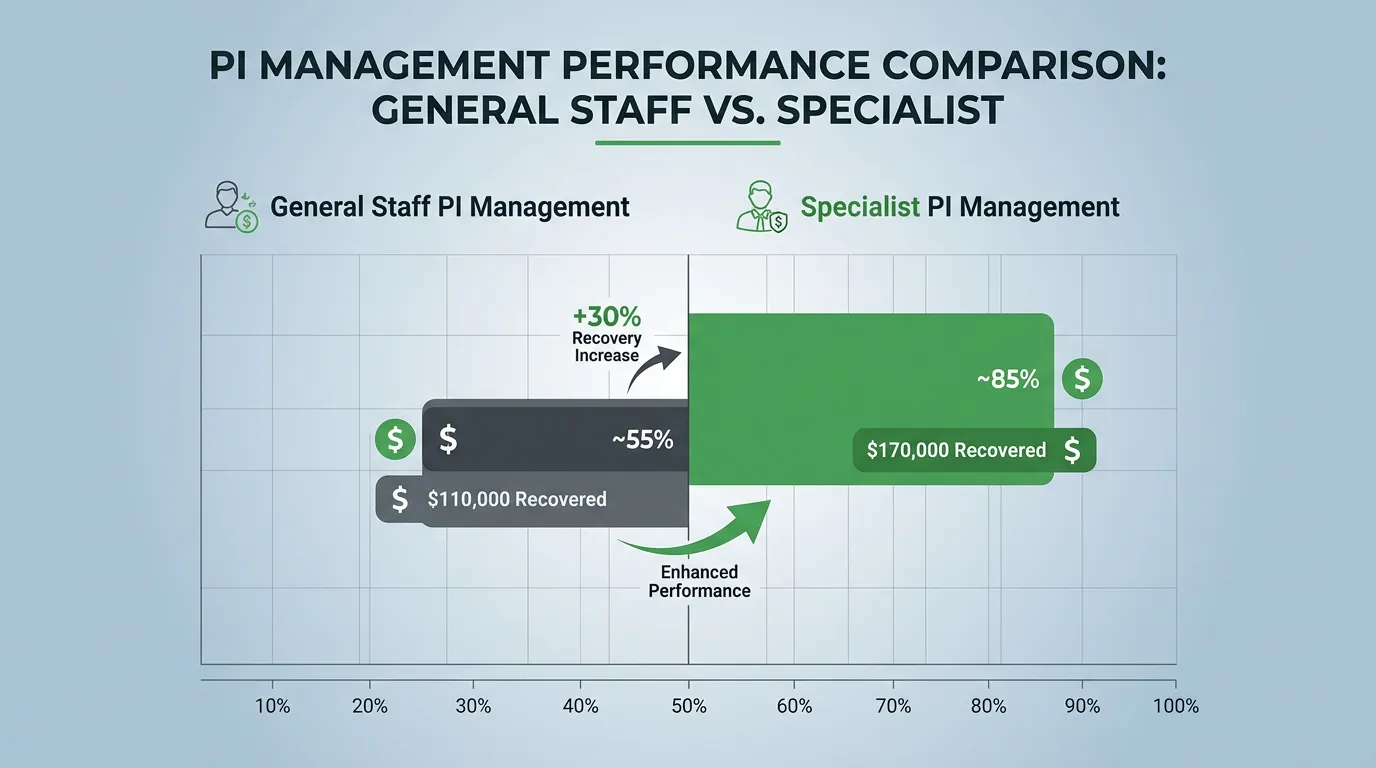
Many practices handle PI billing through their existing team — and in some cases, that works just fine. The question isn't whether in-house billing is inherently wrong. It's whether the people doing it have the tools and training this specific work requires.
Where the Gaps Typically Show Up
PI lien billing requires knowledge of lien law, attorney negotiation, Med-Pay coordination, settlement tracking, and clinical documentation review. That's a different set of skills than what most office staff have been trained for.
When a team without specialized PI experience manages these cases, a few patterns tend to emerge: longer payment timelines, higher reduction rates at settlement, Med-Pay coverage that goes unbilled, and documentation that doesn't fully reflect the care provided. And because PI revenue sits in a different part of your books than standard claims, problems can go unnoticed — especially if your team is already stretched thin just reading an AR aging report for your insurance-based collections.
None of that means the team isn't capable. It means the work requires specialization that most billing training programs don't cover.
Here's a simple way to think about the numbers.
If you treat a PI patient and bill $5,000, and the attorney requests a 40% reduction that gets negotiated to 30%, your recovery is $3,500.
With stronger documentation, consistent attorney communication, and Med-Pay billed in parallel, that same case might see a much smaller reduction — or none at all. Recovery could be $4,250 to $5,000.
That difference, multiplied across your annual PI caseload, adds up meaningfully.
What a Specialist Adds From the Beginning
The most valuable work a PI billing specialist does happens at the start of a case, not at settlement.
From the first visit, a specialist ensures that lien agreements are properly signed, Med-Pay coverage is identified and billed, diagnosis codes are specific and current, SOAP notes are structured to support the clinical narrative, and the attorney of record is documented.
This front-end work means that when the case eventually resolves, the documentation is already in order. There's less to negotiate, less to explain, and a stronger foundation for the full amount of your bill.
That's what active revenue defense looks like in a PI context. It's not about being adversarial. It's about being organized and thorough from the start — the same approach that applies to securing predictable clinic cash flow across every part of your billing.
What a PI Case Audit Can Tell You
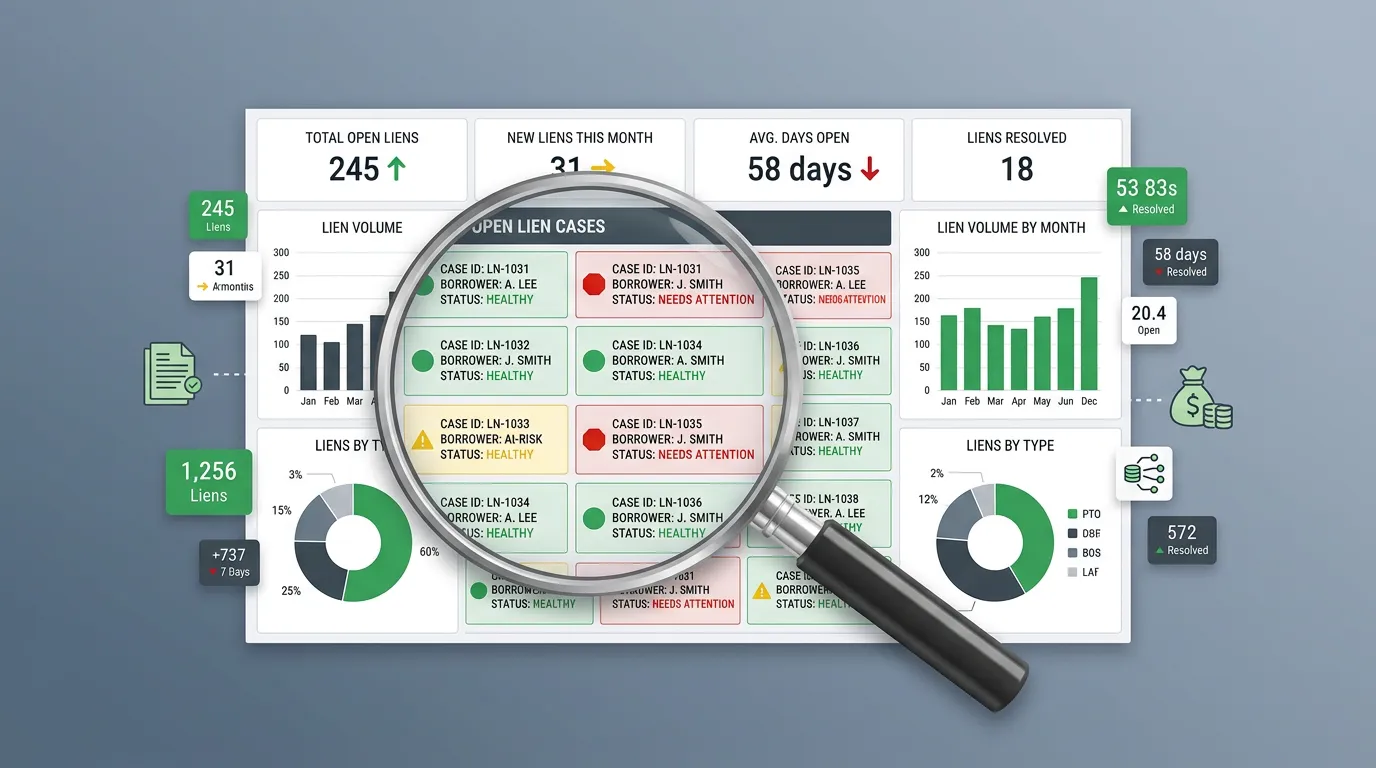
If you're already treating PI patients and want a clearer picture of how your billing is performing, a PI case audit is a practical place to start.
What Gets Reviewed
A thorough audit looks at every open lien in your practice. The specialist examines documentation completeness, coding accuracy, lien execution status, attorney communication history, Med-Pay utilization, and where each case stands in the legal timeline.
They're looking for patterns and opportunities.
- Are lien agreements properly signed and acknowledged by the attorney? A missing signature can create real complications when it's time for disbursement.
- Is Med-Pay being billed where the patient carries coverage? Some practices don't ask about auto insurance details beyond liability, which means available benefits go unused.
- Do SOAP notes support the level of billing? The audit should identify any documentation gaps that could lead to lower valuations in claims review.
Are any cases approaching legal deadlines? If a case has gone quiet with no attorney communication, it's worth checking on the status.
What You Get From the Results
The output is a clear, organized picture of where things stand — and where there's room to improve.
Cases are categorized by status: on track, needs attention, or at risk. The specialist provides a prioritized list of actions — which cases need immediate follow-up, where Med-Pay should be billed, and which documentation needs to be strengthened.
For practices that have been managing PI billing without specialized support, the audit often highlights areas where small adjustments could meaningfully improve recovery at settlement.
| Lien execution | Missing or incomplete agreements | Re-execute or update agreements |
| Med-Pay utilization | Unbilled first-party benefits | Submit claims for available coverage |
| Documentation quality | Notes that could be more specific | Provide feedback for clinical team |
| Attorney communication | Gaps in case status updates | Re-establish contact and confirm timeline |
| Coding accuracy | Outdated or overly general ICD-10 codes | Update to current FY 2026 code set |
Frequently Asked Questions
What is the difference between a standard medical biller and a PI lien specialist?
A standard medical biller submits claims to insurance payers and manages denials. A PI lien billing specialist works within a completely different system — one that involves medical liens, attorney coordination, Med-Pay billing, and settlement disbursement tracking.
They understand lien law, know how to communicate effectively with attorneys during the reduction process, and can navigate the relationship between third-party liability claims, Med-Pay, and health insurance subrogation. It's a different skill set than traditional billing requires.
Should a PI billing specialist handle Med-Pay and third-party liens differently?
Yes. Med-Pay is a no-fault benefit that can be billed directly to the patient's auto carrier, usually within 30 to 45 days. Third-party liens depend on the legal case resolving, which can take 12 to 18 months or longer.
A qualified specialist manages both at the same time — using Med-Pay for near-term cash flow while maintaining and protecting the lien for the larger recovery at settlement.
How do 2026 MICRA cap increases affect chiropractic PI settlements?
California's MICRA cap increases under Assembly Bill 35 raise the noneconomic damages ceiling annually. While MICRA applies to medical malpractice specifically, it influences the broader legal environment in which PI cases are valued. Stronger clinical documentation supports a stronger position in any case where the attorney is evaluating what your care contributed to the patient's outcome.
What is the Ahlborn Formula and why should my PI biller know it?
The Ahlborn Formula comes from a 2006 U.S. Supreme Court decision that limits Medicaid's recovery to the portion of a settlement that represents past medical expenses. The formula divides the settlement amount by the total case value, then multiplies by the Medicaid lien.
A specialist who understands this can help ensure that lien reductions for Medi-Cal or Medicaid patients are calculated accurately — protecting both your revenue and the patient's net recovery.
How do I protect my chiropractic bill from being reduced by an attorney in 2026?
Thorough clinical documentation is your strongest foundation. SOAP notes that clearly establish medical necessity, track functional improvements, and connect each diagnosis to the injury mechanism give your bill the support it needs during settlement discussions.
A PI billing specialist reviews this documentation proactively — before negotiations begin — so that gaps can be addressed while there's still time to strengthen the record.
Does a PI billing specialist need to review my SOAP notes?
Yes. Insurance adjusters and claims software like Colossus translate your documentation into severity scores that influence settlement value. Notes with vague language, missing diagnoses, or unexplained treatment gaps result in lower scores.
A specialist reviews your notes for completeness, coding alignment, and the specific clinical language that ensures your care is accurately reflected in the evaluation process.
Can I handle PI lien billing in-house instead of hiring a specialist?
It depends on whether your team has the training and bandwidth for this specific work. PI billing involves lien law, attorney negotiation, Med-Pay management, settlement tracking, and documentation review — areas that most general billing training doesn't cover.
Some practices handle it well in-house. Others find that the complexity leads to longer timelines and lower recovery rates. An honest assessment of your current results is the best way to decide.
What should I expect during a PI case audit with a billing specialist?
A PI case audit reviews your open liens for documentation quality, coding accuracy, lien execution, attorney communication, and Med-Pay utilization. The specialist identifies where things are on track and where there's room for improvement, then provides a prioritized action plan.
It's a practical way to get a clear picture of your PI revenue health without making any commitments upfront.
Bringing It All Together
PI lien billing in 2026 requires a specific set of skills that sit at the intersection of clinical documentation, legal coordination, and revenue cycle management. It's a different discipline than standard insurance billing — not harder or easier, just different.
The right specialist brings clarity to a process that can feel uncertain, especially when cases stretch over months and the outcome depends on how well your documentation tells the story of the care you provided.
Whether you're growing your PI caseload, evaluating your current billing process, or just trying to understand what good PI billing looks like — the five traits outlined here give you a clear framework for making that assessment.
Choosing the right support for your PI billing doesn't have to be complicated. If you're wondering whether your current process is working as well as it could, a straightforward conversation is a good place to start.
That's why we offer a free discovery call. It's a chance to talk through your billing situation and get clarity on what's working, what could improve, and what your options are.
We'll help you understand:
- Where your claims might be getting stuck
- What's causing denials or delays
- Whether your AR is healthy or needs attention
- How your current process compares to best practices
- What a partnership with Bushido would actually look like
Book a Call — no pressure, no obligation, just a clear conversation about your billing.
SCHEDULE YOUR FREE DISCOVERY SESSION TODAY.


Copyright 2026 | All rights reserved | Web Design by iTech Valet