

Why Staff Billing Training on Jane App or ChiroFusion Shortcuts Will Not Solve Billing Leakage
Why Jane App and ChiroFusion training will not stop chiropractic billing leakage, and where the real revenue drains actually live.
Staff training on Jane App or ChiroFusion shortcuts will not solve billing leakage because the leakage originates in revenue cycle processes that occur after a claim leaves the electronic health record, not within the software's data entry functions. An electronic health record accurately records a transaction at the point of care, but it has no built-in mechanism to manage what happens once a claim enters the payer adjudication system. Billing leakage is driven by unworked denials, payer-specific coding rules that shift without notice, credentialing gaps between a provider and a specific payer, and clearinghouse rejections that require manual reconciliation. None of these failure points sit inside the software interface a staff member is trained to navigate. A provider can master every keyboard shortcut and every scheduling feature an EHR offers and still lose revenue to a denial that is never appealed, a claim that rejects at the clearinghouse level for a reason the front desk cannot see, or a credentialing file that lapses with a specific insurer. These are systemic revenue cycle functions that require dedicated denial management workflows, coding appeal expertise, and ongoing clearinghouse audit practices. Software proficiency training addresses front-end accuracy, meaning correct codes entered and claims submitted cleanly. It does nothing to address back-end recovery, meaning what happens to a claim after submission when a payer denies it, underpays it, or rejects it for administrative reasons. Solving billing leakage requires treating the revenue cycle as a full system spanning credentialing, submission, denial resolution, and reconciliation, rather than treating it as a single software competency that improves with more staff training hours.
Why 'Just Train Them Better on Jane App' Misses the Real Leak

Buried in that question is a quiet assumption: that billing leakage is a skills gap. Buy the powerful software, drill the staff harder on its shortcuts, and the revenue problem sorts itself out. Plenty of chiropractic practices sign up for Jane App or ChiroFusion on exactly that logic, treating the EHR as a silver bullet for billing efficiency.
That premise misreads what leakage actually is. Once the software feels mastered, practice energy shifts toward learning more shortcuts and features, as though billing were only a data entry problem. But an EHR is a cash register. It records the sale accurately at checkout, yet it was never built to chase a supply chain failure happening three states away. why EHR software alone can't manage chiropractic revenue walks through exactly where that design gap shows up.
What Software Training Actually Fixes (And Its Hard Ceiling)
Here's what software training actually fixes: a narrower problem than most practices assume. It teaches a staff member to submit a clean claim. It does not teach them to recover a broken one.
And that distinction is the whole boundary. Once a claim leaves the EHR, training has nothing left to touch.
| Task | Handled Inside the EHR | Handled Outside the EHR |
|---|---|---|
| Code selection at point of care | Correct CPT and diagnosis code choice inside the visit workflow | Whether that code survives a payer's shifting adjudication rules after submission |
| Claim submission accuracy | Clean formatting, complete patient demographics, modifier attachment before the claim leaves the practice | What the clearinghouse does with the claim once it is batched and transmitted |
| Denial response | Flagging that a claim came back unpaid inside the EHR dashboard | Building the appeal, tracking the deadline, and resolving the payer-specific reason behind the denial |
| Credentialing status | Storing a provider's payer enrollment record as a static file | Monitoring that enrollment for lapses and resolving gaps before a claim is ever filed |
| Clearinghouse reconciliation | Recording that a claim was sent | Investigating rejected batches, underpayments, and unresolved discrepancies between what was billed and what was paid |
The Data Entry Layer Software Was Built For
Correct code selection, an accurate modifier, a patient demographic entered without a typo — these are teachable inside the EHR interface, and Jane App or ChiroFusion both teach them well. A staff member who masters that layer produces claims that pass a payer's first-pass edits.
That skill prevents a real loss. A claim rejected for a mistyped policy number never gets adjudicated at all. But passing a first-pass edit says nothing about what a payer's adjudication engine decides three days later, and no shortcut inside the software follows the claim that far.
The Ceiling Every EHR Shares
Every EHR on the market hits the same wall at the same point. It is a system of record, not a system of recovery, and that design choice was made long before any staff member logged in.
So a rejected clearinghouse batch, or a denial coded with no clear reason, falls past the edge of what any interface reports. Reading those failures at scale looks a lot more like an audit than a training refresher, which is the territory How to Audit Clearinghouse Error Logs in Jane App and ChiroFusion covers in full.
Why Best-in-Class EHRs Still Can't See Denial Patterns
A clearinghouse audit catches what already slipped past the software's view. Denial patterns are harder still. A pattern only shows up across dozens of claims, scattered across payers, stretched over months, and no EHR dashboard was ever built to surface that shape.
What CFOs Report About RCM Software Limitations
Ask any CFO weighing revenue cycle management software, and the complaints come back the same, vendor after vendor.
According to published trade reporting, EHR software for revenue cycle management can suffer from overall system limitations including low interoperability, inaccurate data delivery, and incomplete responses that contribute to respondent dissatisfaction. Those are not bugs a software update quietly fixes. They describe what the category itself was built to do, and what it was not. How to Run a Chiropractic EHR Ledger Audit covers where that gap becomes visible on a practice's own ledger.
The Credentialing Layer No Front-Desk Training Touches
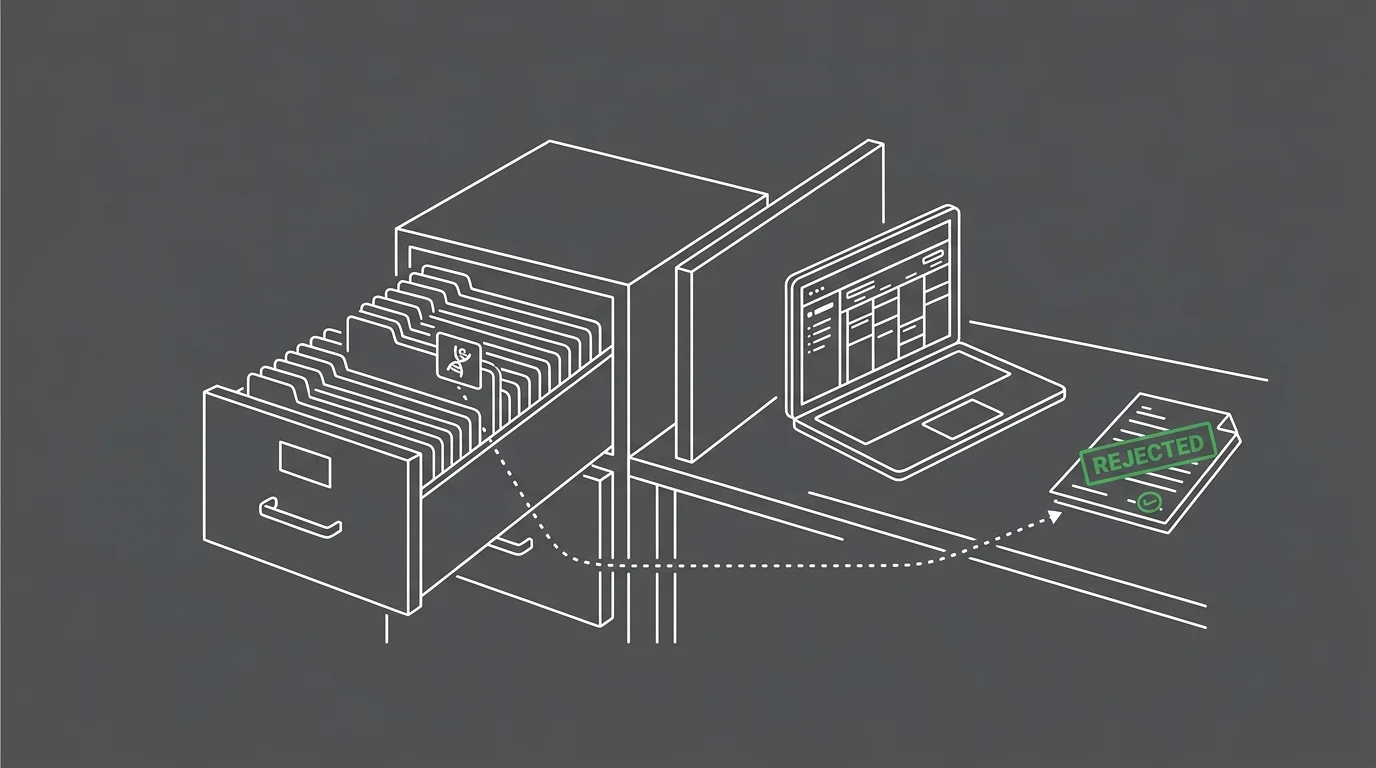
Credentialing never lands on a training checklist. No shortcut inside Jane App or ChiroFusion reaches into a payer's own provider file.
How a Misfiled Specialty Code Denies a Claim Before It's Reviewed
Incorrect practice or billing information in payor databases can trigger claim denials. That includes cases where a provider's specialty is misidentified inside a payer's own adjudication system. Findings published through this published analysis show incorrect practice or billing information in payor databases can trigger claim denials, including when a provider's specialty is incorrectly identified in adjudication systems — one expert assessment rather than a study finding. A denial like that fires automatically, before any human reviewer reads the claim.
Why This Failure Sits Entirely Outside the EHR
The EHR submitted a clean claim. The payer's own records were wrong before submission ever happened. No front-end training touches a payer database the practice never logs into. This is the supply chain failure three states away, and the cash register at checkout was never built to see it. There is more on Billing Services if this is the part that matters to you.
How Denial Patterns Compound When No One Owns the Follow-Up
A denial that sits untouched does not stay still. It compounds, because the payer's clock keeps running while nobody on staff owns the follow-up.
| Service Type | Initial Denial Rate |
|---|---|
| Professional services | Denied on initial submission for reasons tied to payer-specific edits, then left unworked once the front desk assumes the EHR queue is the last checkpoint |
| Inpatient services | Carries the widest exposure of the group, compounding fastest when no one is assigned to track the payer's response window past submission |
| Outpatient services | Denied at a rate close to professional claims, but often missed longer because outpatient volume buries individual denials inside routine batch processing |
The Difference Between Safety-Net and Non-Safety-Net Denial Exposure
Denial exposure isn't spread evenly across practice types. Findings published through PubMed Central show safety-net providers faced initial denial rates of 13.6% for professional services, 18.3% for inpatient services, and 13.3% for outpatient services. That gap describes how payers actually behave toward inpatient services. It's not a training deficiency inside any one practice.
What Happens to a Denial That Sits Untouched
Age a denial past the payer's appeal window and it stops being recoverable revenue. It becomes a permanent write-off. No EHR flags that clock ticking down. The cash register recorded the sale, and nobody was watching the supply chain fail three states away.
Reading a Clearinghouse Rejection Report Like a Systems Audit

A clearinghouse rejection report isn't an error log you clear and forget. Read it right, and it's a systems audit — every point where a claim's data failed to match what a payer expected, laid out in one place.
| Rejection Category | Likely Cause | Where the Fix Lives |
|---|---|---|
| Duplicate Claim Rejection | A claim resubmitted before the payer finished processing the original, or a clearinghouse queue that never confirmed the first submission cleared. | Denial management workflow that tracks submission status before a claim is ever resent. |
| Eligibility Mismatch | A payer record showing coverage lapsed, or a plan detail the practice's file never updated even though the patient's coverage is active. | Front-desk verification paired with a credentialing file that stays current with each payer, not the EHR's eligibility check alone. |
| Provider Specialty Not Recognized | The payer's own adjudication system has the provider's specialty listed incorrectly, so specialty-linked codes deny automatically. | Credentialing data on file with the payer, corrected upstream of any claim touching the clearinghouse. |
| Missing or Invalid Modifier | A code submitted without the modifier a specific payer requires, even though the code itself was chosen correctly. | Payer-specific coding rule tracking, reviewed on a fixed cadence rather than caught once and forgotten. |
| Repeating Rejection Code Across One Payer | The same rejection reason appears on claim after claim tied to a single payer, pointing to a systemic mismatch rather than isolated errors. | Clearinghouse audit reading rejection patterns across weeks or months, not a single claim reviewed in isolation. |
Categorizing Rejections: Front-End Typo or Back-End Systemic Fault
Some rejections are a typo. A transposed digit in a policy number is a front-end fault, and it corrects in seconds. But a rejection code that repeats across dozens of claims tied to one payer is not a typo pattern. It is a systemic fault the software never labeled as one.
Building a Denial Management Cadence That Outlives Any Single Software Update
One audit is a snapshot. The real value comes from reading these reports on a fixed cadence, no matter which EHR version is running underneath. That cadence outlives every software update, because the failure it tracks was never inside the software to begin with.
Frequently Asked Questions
These are the questions that surface once the systemic view lands. Here are the direct answers, no walk-through attached.
Can't my staff just get better at using Jane App or ChiroFusion to stop billing leakage?
Staff can get faster inside Jane App or ChiroFusion, and that speed does help clean claim submission. But it does nothing for denials, credentialing gaps, or clearinghouse rejections that hit after the claim leaves the software.
What are the most common billing errors that EHR software shortcuts don't catch?
Three of them: unworked denials, payer-specific coding rules that shift without notice, and a credentialing lapse with one specific insurer. None of them surface inside an EHR interface a shortcut could reach.
What is the difference between an EHR software problem and a revenue cycle system problem?
An EHR software problem is a claim entered wrong before it ever ships. A revenue cycle system problem is everything that happens to a correctly entered claim once the payer has it.
How does a clearinghouse rejection report reveal what an EHR dashboard doesn't?
A dashboard shows one claim's status at a time. Read a rejection report across dozens of claims tied to a single payer, and a repeating fault code steps forward — one the software never labeled as systemic.
How do credentialing errors trigger claim denials that software can't flag?
A payer's own database can carry wrong practice or billing information, including a misidentified provider specialty. That fires an automatic denial before any human reviewer opens the claim, and no EHR touches a payer's internal records.
What is the difference between a front-end billing error and a back-end billing error?
A front-end error is a wrong code or a mistyped policy number, caught before submission. A back-end error is what a payer does to a clean claim afterward, which no software interface tracks.
Why do denial rates differ between safety-net and non-safety-net providers?
It comes down to payer behavior by practice type and claim setting, not staff training level. Inpatient services especially carry a higher initial denial rate for safety-net providers than for non-safety-net ones.
Where This Leaves Your Revenue Cycle
The cash register was never the problem. It rang up every sale correctly, right up until the failure happened somewhere the register was never built to look.
So the fix has to move upstream of the software entirely. That means owning credentialing files, denial follow-up, and clearinghouse reconciliation as their own disciplines, not as features waiting inside Jane App or ChiroFusion.
That work does not live inside a training manual. It lives in the systems built to track a claim after the EHR stops watching it, and that is the conversation worth having before another denial ages past its appeal window: schedule a revenue cycle review.