

How to Successfully Onboard a New Associate for Insurance Billing in 2026
Bringing a new associate into your practice is one of the most exciting milestones in growing a chiropractic clinic. It means you’re expanding, reaching more patients, and building something sustainable.
It’s also one of the moments when billing workflows need the most attention.
New associates typically arrive with strong clinical skills and genuine enthusiasm for patient care. What they often haven’t had much exposure to is the documentation and coding specificity that insurance billing requires. That’s not a criticism-it’s simply how chiropractic education tends to work. Clinical training takes priority, and billing knowledge develops on the job.
The good news is that a clear, organized onboarding process can bridge that gap. When new associates understand what payers need to see in documentation, they develop strong habits early. When they don’t have that foundation, the learning curve shows up as denied claims and delayed payments.
This guide walks through how to set up your new associate for billing success from day one. We’ll cover credentialing timelines, EHR setup, documentation training, and the monitoring systems that help you identify revenue leakage before it becomes a pattern.
The process takes some planning upfront. The clarity and stability it creates make that investment worthwhile.
Understanding the 2026 Billing Environment

Before diving into the specifics of onboarding, it helps to understand the current billing landscape. This context shapes why certain training elements matter and where to focus your attention.
Documentation Standards Continue to Evolve
Medicare’s improper payment rate for chiropractic services currently sits at 33.6%, with insufficient documentation accounting for 95.5% of those errors, according to CMS compliance data.
That number isn’t about practices doing anything wrong intentionally. It reflects the gap between how providers naturally document and what payers specifically require. Closing that gap is largely a matter of training and awareness.
The PART framework-Pain, Asymmetry, Range of motion, and Tissue tone-remains the foundation for Medicare subluxation documentation. New associates benefit from understanding this framework early, with clear examples of what compliant documentation looks like in practice.
When providers know exactly what needs to appear in their notes, they can build those elements into their workflow naturally. The documentation becomes part of the clinical thought process rather than an afterthought.
Coding Updates to Be Aware Of
The FY 2026 ICD-10-CM updates, effective October 1, 2025, introduced hundreds of code changes-including new codes, deletions, and revisions across multiple chapters. The core chiropractic manipulation codes (98940, 98941, 98942) remain stable, which is helpful.
What has changed is the level of specificity required for supporting diagnosis codes. Abdominal and pelvic pain codes now require greater anatomical precision. Social Determinants of Health (SDOH) codes have expanded, which can support medical decision-making documentation for complex cases.
Your new associate’s EHR profile should be configured with current codes before they begin seeing patients. This is a straightforward setup task, but it’s easy to overlook in the excitement of a new hire starting.
The Reimbursement Landscape
Chiropractic reimbursement continues to face long-term pressure. While recent legislative adjustments have provided some relief from projected cuts, the broader trend of fee schedule constraints remains a challenge for practices nationwide.
Understanding this context helps when discussing compensation structures with new associates and when modeling how their patient mix will affect practice revenue.
The broader point is that every clean claim matters. When documentation supports the services provided, claims process smoothly. When gaps exist, the administrative work of corrections and resubmissions adds up. A systematic onboarding process is really about building the habits that support active revenue defense over the long term.
Preparing Before Your Associate Arrives
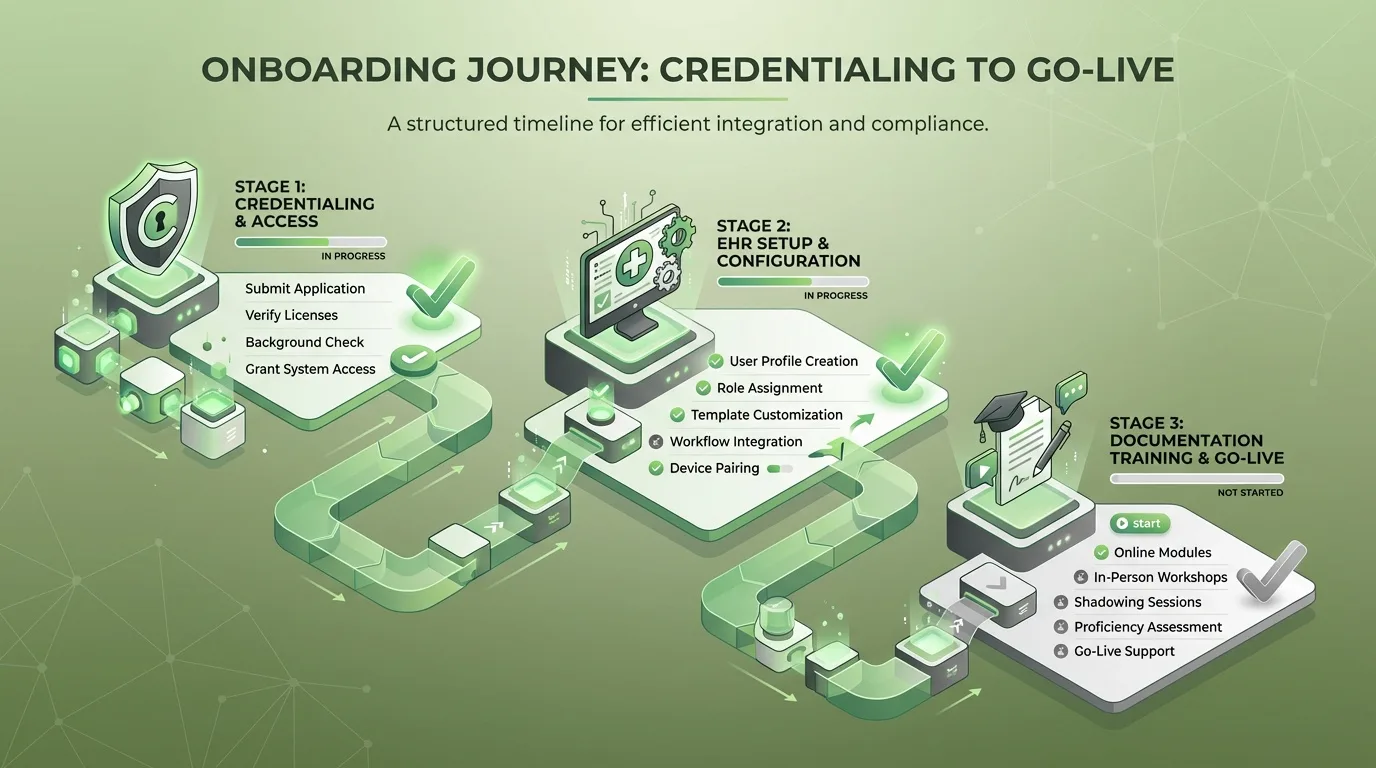
The most effective onboarding starts before your new associate’s first day. Completing these tasks in advance creates a smoother experience for everyone involved.
Starting the Credentialing Process
Credentialing timelines are one of the most commonly underestimated aspects of bringing on a new provider. The process takes longer than most clinic owners expect-typically 60-120 days for commercial payers.
For Medicare, new providers must be enrolled through PECOS before claims can be submitted under their NPI. The 2026 enrollment application fee is $750. Required documentation includes the provider’s NPI number, state license, malpractice insurance documentation, and practice location details.
Starting this process as soon as you’ve signed an associate contract gives you the best chance of having credentials in place when they’re ready to see patients. If there are delays, you’ll have time to address them.
Many practices handle the interim period by having new associates provide services under the supervising provider’s credentials. This approach has limitations and may not be permissible under all payer contracts or state regulations, so it’s worth checking your specific situation.
| CREDENTIALING TASK | TYPICAL TIMELINE | KEY REQUIREMENTS |
|---|---|---|
| NPI Application | Same day to 3 business days | Legal name matching state license and IRS records |
| PECOS Registration | 1-3 days for account setup | NPI, I&A system verification |
| Medicare Enrollment | 30-90 days for processing | $750 application fee, supporting documentation |
| Commercial Payers | 60-120 days average | Varies by payer; often requires CAQH profile |
| State Medicaid | 45-90 days | State-specific requirements |
A simple tracking spreadsheet with submission dates and follow-up reminders helps keep the process moving. Credentialing delays usually come down to communication gaps-a document that wasn’t received, a question that wasn’t answered. Proactive tracking addresses these before they cause problems.
Configuring EHR Access
Your associate’s EHR profile should be set up and tested before their first patient encounter. This includes provider-level settings, documentation templates, code favorites, and billing integration.
Work with your EHR vendor or internal administrator to complete:
- Provider profile setup (NPI, credentials, license numbers, taxonomy codes)
- Code favorites (frequently used CPT and ICD-10 codes for your practice’s typical case mix)
- Documentation templates (SOAP note structures that prompt for required elements)
- User permissions (appropriate access levels for clinical documentation and billing functions)
Most chiropractic EHR platforms-including ChiroTouch, Jane App, and others-offer onboarding support and training resources. Taking advantage of these can save significant time.
Testing the complete workflow before live patients are involved is helpful. Have your associate enter a sample encounter, generate a claim, and walk it through your clearinghouse. Catching configuration issues during testing is much simpler than discovering them after claims have been submitted.
Gathering Reference Materials
Compiling the reference materials your new associate will need creates a resource they can return to throughout their onboarding and beyond.
Your packet might include:
- Your practice’s documentation expectations with examples
- Medicare LCD and NCD requirements for chiropractic services
- Current CMS documentation guidance for chiropractic providers
- AT modifier requirements and when they apply
- Your fee schedule and common CPT/ICD-10 pairings
- Payer-specific notes for your top insurance contracts
- ABN (Advance Beneficiary Notice) procedures for maintenance care situations
A one-page summary of the most critical reminders can be especially useful. Something posted at the workstation tends to be referenced more often than something filed away in a binder.
For a mid-sized chiropractic practice, preventable denials can add up to $35,000 or more annually. A professional audit typically costs a fraction of that while showing you exactly where those issues originate.
The First 30 Days: Building a Strong Foundation

The first month sets the tone for your associate’s documentation habits. Focusing on fundamentals during this period creates a strong base for everything that follows.
Week One: Getting Oriented
The first week works best as an orientation period rather than a push to see patients immediately. This gives your new associate time to understand your systems and processes.
One valuable exercise is having them observe your billing workflow from end to end. They should see how notes move from EHR to claim, how claims transmit to clearinghouses, how EOBs return, and how payments post. Many providers have never witnessed what happens after they finish their documentation.
Understanding the downstream effects of documentation choices changes how providers approach their notes. When someone sees exactly how a vague subluxation description leads to a denial, the importance of specificity becomes clear in a way that lectures alone don’t achieve.
During this week, introduce your associate to team members who handle billing-related functions. If you work with an external billing partner, an introductory call helps establish that relationship. When providers know who reviews their documentation and what those reviewers need, the whole process becomes more collaborative.
Weeks Two and Three: Supervised Documentation
Once patient encounters begin, plan for a period where notes are reviewed before claims are submitted. This allows you to catch documentation patterns early and provide guidance while habits are still forming.
Focus your review on these elements:
- Subluxation documentation – Is the precise level specified? Are at least two of the four PART criteria documented with specific, measurable observations?
- Medical necessity language – Does the note clearly support why this patient needs active treatment?
- Modifier usage – Is the AT modifier applied appropriately? Is Modifier 25 used only when a separately identifiable E/M service was performed?
- Diagnosis specificity – Are ICD-10 codes selected to the highest level of specificity the documentation supports?
- Treatment plan alignment – Does the visit note connect logically to the established treatment plan?
Providing feedback promptly helps your associate connect the guidance to their memory of the patient encounter. This makes the learning more concrete and applicable.
Week Four: Understanding Denial Patterns
Before the month ends, walk your associate through how your practice handles denials. Even if they haven’t generated many denials themselves yet, understanding the process builds awareness.
Show them how to read an EOB, interpret denial codes, and understand what each code indicates. Common scenarios worth reviewing include:
- Missing information denials – Often related to documentation completeness
- Medical necessity denials – Frequently connected to PART documentation or maintenance care distinctions
- Coding errors – Modifier issues, outdated codes, or diagnosis/procedure mismatches
- Eligibility issues – Front desk workflow matters that appear as provider-level denials
The goal during this phase is building familiarity with reducing chiropractic denial rates as a concept, not making your associate an expert overnight. Awareness of what causes denials helps providers avoid those patterns in their own documentation.
Days 31-60: Developing Independence
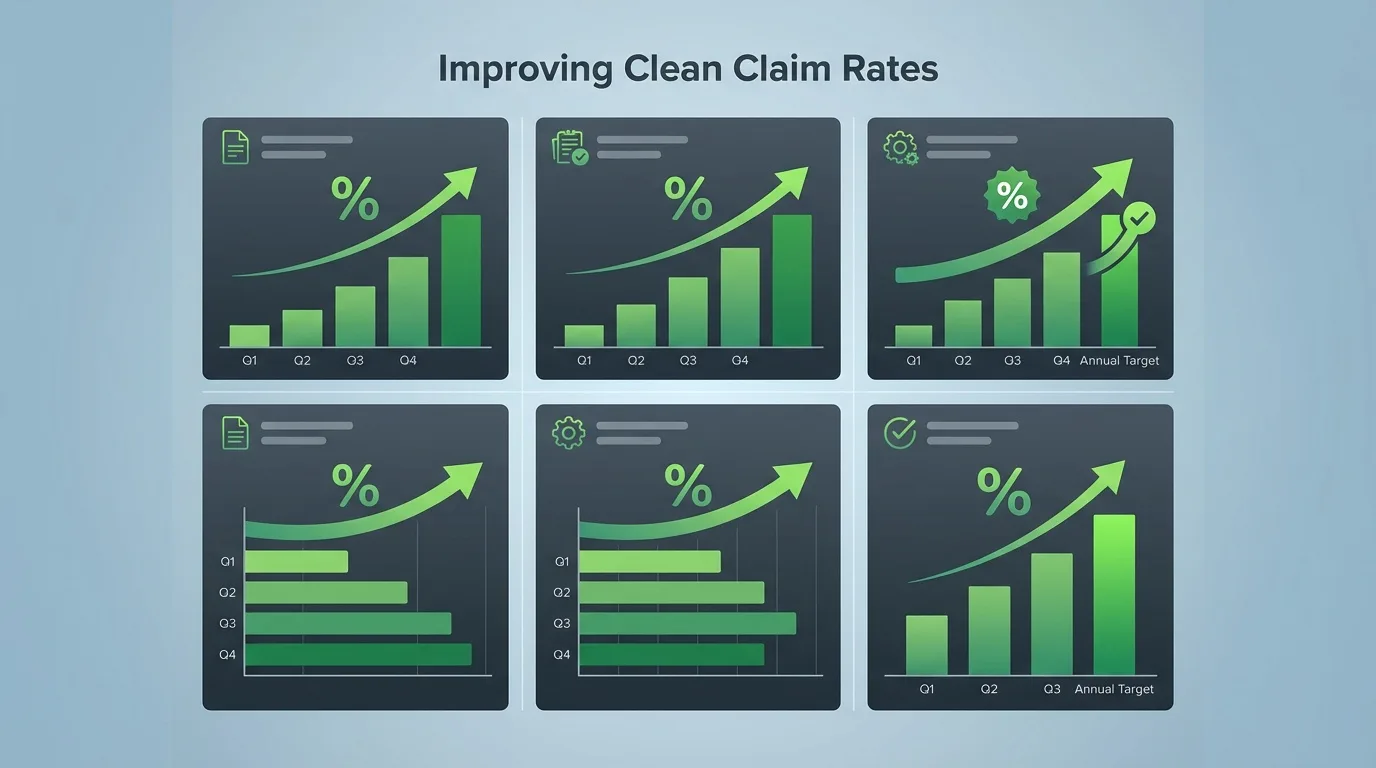
The second month shifts toward more independent work with appropriate monitoring systems in place. Your associate should be submitting claims on their own while you track patterns and provide feedback.
Moving to Sampling-Based Review
Rather than reviewing every note, transition to sampling notes regularly. A reasonable approach might look like:
- Days 31-45 – Review approximately half of notes, randomly selected
- Days 46-60 – Review about a quarter of notes, plus any that generate denials
Use your EHR’s reporting capabilities to track claims by rendering provider. Monitoring first-pass acceptance rates, denial rates by category, and days to payment reveals patterns that individual note reviews might miss.
Industry benchmarks from MGMA suggest aiming for a denial rate under 8% for single-specialty practices and a clean claim rate above 95%. New providers typically start below these benchmarks and improve with consistent feedback.
Addressing Patterns When They Appear
When recurring issues show up in your associate’s documentation, addressing the underlying pattern works better than correcting individual instances.
For example, if several denials relate to incomplete PART documentation, schedule a focused conversation about PART requirements. Walk through examples of compliant versus non-compliant documentation together. Practice documenting sample cases until the approach feels natural.
Sometimes the issue is with your documentation templates rather than provider behavior. If the EHR template doesn’t prompt for all four PART elements, providers naturally follow the path the template creates. Adjusting templates can be more effective than repeated behavioral reminders.
Introducing More Complex Situations
By the second month, your associate is likely ready to handle more complex billing scenarios with appropriate guidance. These might include:
- Medicare patients requiring ABN conversations – Practice the script for explaining maintenance care limitations before the situation comes up
- Personal injury cases – PI billing involves different documentation standards and lien management considerations
- Multi-payer coordination – Patients with Medicare plus commercial secondary coverage have specific billing sequences
- Workers’ compensation cases – State-specific requirements and authorization processes vary
Introducing these one at a time, confirming comfort with each before adding another, prevents overwhelm while steadily building capability.
Days 61-90: Establishing Sustainable Rhythms

The third month focuses on creating systems that work over the long term. Your associate should be functioning independently while staying connected to feedback and support.
Creating Ongoing Review Rhythms
Transition from frequent sampling to periodic audits. A sustainable approach might include:
- Weekly – Brief check-in on any questions or denial patterns
- Monthly – Review of key metrics (clean claim rate, denial rate by category, AR aging for their patients)
- Quarterly – Chart audit of 10-15 randomly selected encounters
Documenting these review findings creates a record that supports continued development conversations and helps identify when additional training might be helpful.
Connect your associate to external education resources for ongoing learning. Organizations like the American Chiropractic Association, AAPC, and specialty consultants offer coding and compliance education that complements in-house training.
Building in Accountability
Making billing performance visible helps providers stay engaged with their documentation quality.
Consider implementing:
- Personal performance dashboards – Clean claim rate, denial rate, and AR aging specific to each provider
- Comparison to practice benchmarks – Shows where individual performance sits relative to practice goals
- Periodic metric reviews – Regular conversations about what the numbers show and what adjustments might help
Some practices connect billing metrics to compensation structures. This approach creates strong incentives, though it’s worth considering how the pressure might affect documentation habits. If you pursue performance-based compensation, focusing on sustainable metrics like clean claim rate tends to work better than pure volume measures.
Planning for Continued Development
Your onboarding process shouldn’t end abruptly at day 90. Building in systems for continued growth helps maintain the foundation you’ve established.
Schedule a comprehensive conversation at the 90-day mark. Discuss what’s working well, what’s still challenging, and what additional support would be helpful. Use this to identify any training gaps that weren’t apparent during initial onboarding.
Plan for annual compliance refreshers. Coding updates happen every October (ICD-10) and January (CPT). Medicare requirements evolve. Payer contracts change. Ongoing education helps maintain the compliance awareness your associate has developed.
Common Patterns to Watch For
Understanding common onboarding challenges helps you recognize them early and address them proactively.
Clinical Skill and Billing Knowledge Develop Separately
Your new associate may be an excellent clinician with strong diagnostic skills and genuine patient rapport. That clinical competence doesn’t automatically translate to billing proficiency.
Chiropractic education focuses primarily on clinical practice. Billing knowledge typically develops through work experience, and new graduates often have limited exposure to real-world insurance scenarios. Treating billing training as its own skill set-separate from clinical competence-helps ensure it gets the attention it needs.
Active Learning Works Better Than Observation
Watching an experienced provider document provides exposure to good habits, but it doesn’t transfer skill as effectively as active practice with feedback.
When observation is part of your onboarding, supplement it with active learning components. Have your new associate document the same encounter they observed, then compare their note to the experienced provider’s note. Discussing the differences transforms passive observation into practical learning.
Timely Feedback Shapes Habits
Providing feedback while documentation patterns are still forming is more effective than waiting until problems have accumulated. Early correction prevents habits from becoming entrenched.
Frequent, prompt feedback during the first 60 days requires time investment, but it typically saves considerable correction effort later. When providers understand the “why” behind documentation requirements early, they integrate those requirements into their natural workflow.
Documented Processes Create Consistency
If your onboarding exists only as informal knowledge passed from person to person, it tends to vary based on who’s available to train and what they remember to cover.
Documenting your onboarding checklist, training materials, and performance expectations creates a resource that works consistently regardless of who handles the training. This documentation also demonstrates that appropriate training was provided if questions arise later.
Creating a Systematic Approach

Converting your onboarding approach into a repeatable system ensures each new associate receives the same foundation.
Developing Standardized Materials
Written resources that can be used consistently reduce variation in training quality. Your library might include:
- Onboarding checklist with timelines – Tasks covering credentialing, EHR setup, training modules, and review milestones
- Documentation standards guide – Your practice’s specific expectations with compliant examples
- Payer reference sheets – Key requirements for your top payers, including any quirks specific to your specialty
- Common denial scenarios – Examples your practice encounters with prevention guidance
- Metric definitions and targets – What you measure, how you measure it, and what benchmarks you aim for
These materials guide the training process and provide ongoing reference for associates after formal training ends. They also document your compliance training program.
Assigning Clear Responsibility
Someone in your practice should own the onboarding process. This might be you, a senior associate, an office manager with billing expertise, or an external billing partner.
Whoever owns the process should have authority to hold new associates accountable, time dedicated to training activities, knowledge of current billing requirements, and ability to access reports and identify concerns early.
When responsibility is unclear, consistency tends to suffer. Clear ownership creates clear accountability.
Connecting to Your Broader Systems
Your new associate’s billing performance connects to your practice’s overall financial health. Their documentation quality affects AR aging. Their coding accuracy affects clean claim rates. Their compliance awareness affects audit exposure.
Ensure your onboarding process connects to these broader systems. If you work with an external billing partner, involving them in onboarding can be valuable. They see patterns across practices and can identify training needs early.
Reading an AR aging report shouldn’t be a mystery to your new associate. Understanding how documentation choices appear downstream and what happens when claims age creates a sense of connection between clinical work and practice health.
Measuring How It’s Working
Clear metrics help you understand whether your onboarding process is achieving its goals and where adjustments might help.
Key Metrics to Track
Track these indicators for each new associate during their first 90 days and ongoing:
| METRIC | TARGET | MEASUREMENT FREQUENCY |
|---|---|---|
| Clean Claim Rate | >95% | Weekly during onboarding, monthly thereafter |
| Denial Rate | <8% | Weekly during onboarding, monthly thereafter |
| First-Pass Resolution Rate | >90% | Monthly |
| Documentation Compliance Score | >90% on audit | Monthly chart audit |
| Days to Claim Submission | <3 days from DOS | Weekly |
| Patient AR Aging (>90 days) | <12% | Monthly |
Compare new associate metrics to your practice benchmarks and to MGMA industry standards. Significant variance indicates areas where additional support might help.
Understanding What the Numbers Show
Metrics tell stories when you know how to interpret them.
A high denial rate combined with good documentation compliance scores suggests the issue is coding selection rather than note quality. A low clean claim rate with accurate coding suggests demographic or eligibility verification processes need attention. Compliance scores that vary widely between audit samples suggest inconsistent application of training.
Looking at trends over time provides important context. Improving metrics indicate the onboarding is working well. Metrics that plateau before reaching targets suggest a need to identify what’s creating the ceiling.
Refining Based on What You Learn
Use the data to improve your onboarding process over time. If each new associate encounters the same challenges, your training materials may need revision. If clean claim rates consistently plateau at a certain level, additional training or template modifications might help.
Building feedback loops between measurement and training creates a system that improves with each new hire rather than staying static.
Frequently Asked Questions
How long should it take to train a new chiropractic associate on billing?
Most new associates need 30-90 days to become proficient with documentation and billing workflows. The first 30 days typically focus on EHR system training and basic documentation requirements. Days 31-60 involve supervised claim submission with regular note reviews. Days 61-90 transition to independent billing with periodic quality checks.
Full proficiency with Medicare-specific requirements typically takes 4-6 months of consistent practice and feedback. Complex case types like personal injury or workers’ compensation may require additional specialized training.
The timeline varies based on prior experience, learning style, and your practice’s case mix. Providers with previous billing exposure adapt faster than new graduates encountering insurance billing for the first time.
What are the most common billing mistakes new chiropractic associates make?
The most frequent errors cluster around documentation and modifier usage.
Documentation issues include incomplete PART criteria for subluxation, vague medical necessity language that doesn’t clearly differentiate active care from maintenance, and treatment plans that aren’t updated when patient status changes.
Modifier challenges include missing AT modifiers on Medicare CMT codes, inappropriate use of Modifier 25 for same-day E/M services that weren’t separately identifiable, and confusion about when Modifier 59 applies.
Coding selection errors-using outdated ICD-10 codes, selecting diagnosis codes that don’t support the procedure, or choosing the wrong CMT code for the regions treated-are also common early in the learning curve.
Do I need to credential a new associate before they start billing insurance?
Yes, with some nuances worth understanding.
For Medicare, new providers must be enrolled through PECOS before claims can be submitted under their NPI. This enrollment typically takes 30-90 days, and the 2026 application fee is $750.
Commercial payers also require credentialing, with typical timelines of 60-120 days. Many payers use CAQH profiles, which can streamline multi-payer credentialing.
During the interim period, many practices have new associates provide services under the supervising provider’s credentials. This approach has limitations and may not be permissible under all payer contracts or state regulations. Checking your specific situation before assuming this workaround applies is important.
What is the PART framework for chiropractic documentation training?
PART stands for Pain, Asymmetry, Range of motion, and Tissue tone changes. Medicare requires documentation of at least two of these four criteria to support subluxation diagnosis, with at least one being either asymmetry/misalignment or range of motion abnormality.
Training should emphasize specific, measurable observations for each element:
- Pain – Location, quality, intensity, aggravating and relieving factors
- Asymmetry – Specific vertebral levels with direction of misalignment
- Range of motion – Measured values with comparison to normal ranges
- Tissue tone – Palpatory findings including location and quality of changes
General statements like “patient reports pain” or “decreased ROM noted” don’t meet the documentation standard. Notes should include enough detail that someone unfamiliar with the patient could understand the clinical picture from the documentation alone.
How do I monitor the clean claim rate of a new billing employee?
Most EHR and practice management systems can generate reports filtering claims by rendering provider or submitting user. Work with your software to create a report that tracks total claims submitted, claims accepted on first submission, claims requiring correction, and denial reason codes.
Calculate clean claim rate as: (Claims Paid Without Rework ÷ Total Claims Submitted) × 100
Review these metrics weekly during the first 90 days, then monthly thereafter. Compare individual performance to practice benchmarks and industry standards. MGMA suggests a clean claim rate above 95% as a target, though new employees typically start lower and improve with feedback.
Steady improvement over the first 90 days is a positive sign. Metrics that stay flat suggest additional training or process changes might help.
Should my new associate handle their own insurance follow-ups?
This depends on your practice structure and how you want to balance clinical time with administrative involvement.
Having new associates review their own denials accelerates learning. When a provider sees their documentation returned with a denial, they understand the connection between their notes and payment in a practical way.
However, dedicating clinical staff to administrative follow-up reduces patient care time. In higher-volume practices, specialized billing staff may be more efficient.
Many practices use a hybrid approach: the associate reviews denial reasons and makes documentation corrections, while billing staff handles payer communication and claim resubmission. This captures the learning benefit while preserving clinical time.
How does the 2026 Medicare fee schedule affect associate pay structures?
Chiropractic reimbursement continues to face long-term pressure from Medicare fee schedule constraints, though recent legislative adjustments have provided some relief from projected cuts. Practices using percentage-based compensation should model how current rates and any future changes flow through to associate pay.
Consider building quarterly or annual rate reviews into associate agreements to adjust for fee schedule changes, payer mix shifts, or other factors affecting net collections.
Securing predictable clinic cash flow works better when you plan for regulatory and reimbursement changes rather than reacting to them after they affect revenue.
Bringing It Together
Onboarding a new associate for insurance billing in 2026 is really about establishing clear systems and supportive training that help providers develop strong documentation habits from the start.
The practices that do this well tend to treat onboarding as an investment in their practice’s stability. They document their processes, track their results, and refine their approach based on what they learn. They recognize that the time spent training upfront creates lasting value.
The process doesn’t have to be complicated. Clear expectations, organized materials, consistent feedback, and reliable monitoring systems cover most of what new associates need. The fundamentals matter more than elaborate training programs.
Your new associate wants to succeed. They want their claims to process smoothly and their patients to receive appropriate care without billing complications. A supportive onboarding process helps them achieve those goals while protecting your practice’s financial health.
That’s a foundation worth building.
If you’re thinking about how to strengthen your onboarding process but aren’t sure where to start, we’re happy to talk through it.
That’s why we offer a free discovery call. It’s a chance to discuss your current situation and get clarity on what’s working, where there might be gaps, and what options could help.
We’ll help you understand:
- Where documentation patterns typically create challenges for new associates
- What compliance elements tend to need the most attention
- How your current approach compares to what we see working well in other practices
- What a partnership with Bushido would actually look like
Book a Call – no pressure, no obligation, just a straightforward conversation about supporting your practice’s growth.
We’re here to help whenever you’re ready.

© . All Rights Reserved | Web Design by iTech Valet