

How to Scale Your Chiropractic Practice Without Adding Staff in 2026

You can scale your chiropractic practice without adding staff by moving administrative work from people to systems. That means automating repetitive tasks like documentation and intake, bringing in specialized support for billing and denial management, and reorganizing your existing team's day so they're focused on patients and growth instead of chasing claims.
Most practice owners we talk to aren't short on patient demand. They're short on administrative capacity.
The office manager is doing the work of three people. Claims follow-up keeps getting pushed to next week. AR reports are growing. And every time you think about hiring someone new, the cost of salary, benefits, training, and the time it takes to manage another person makes the whole idea feel like it would eat the margin on those new patients.
There's a more sustainable way forward. And it starts with understanding which tasks on your team's plate actually need a person sitting in your office, and which ones would be better handled by human intelligence in billing, automation, or a combination of both.
The U.S. medical billing outsourcing market is projected to grow at a 12% compound annual growth rate through 2030, according to Grand View Research. That kind of growth reflects a clear trend: practices are figuring out that the path to seeing more patients runs through smarter systems, not bigger payrolls.
What follows is a clear, step-by-step look at how to identify revenue leakage in your current workflow, close those gaps, and create the space for your practice to grow without stretching your team past the breaking point.
Why Most Practices Stall Between 80 and 100 Visits Per Week
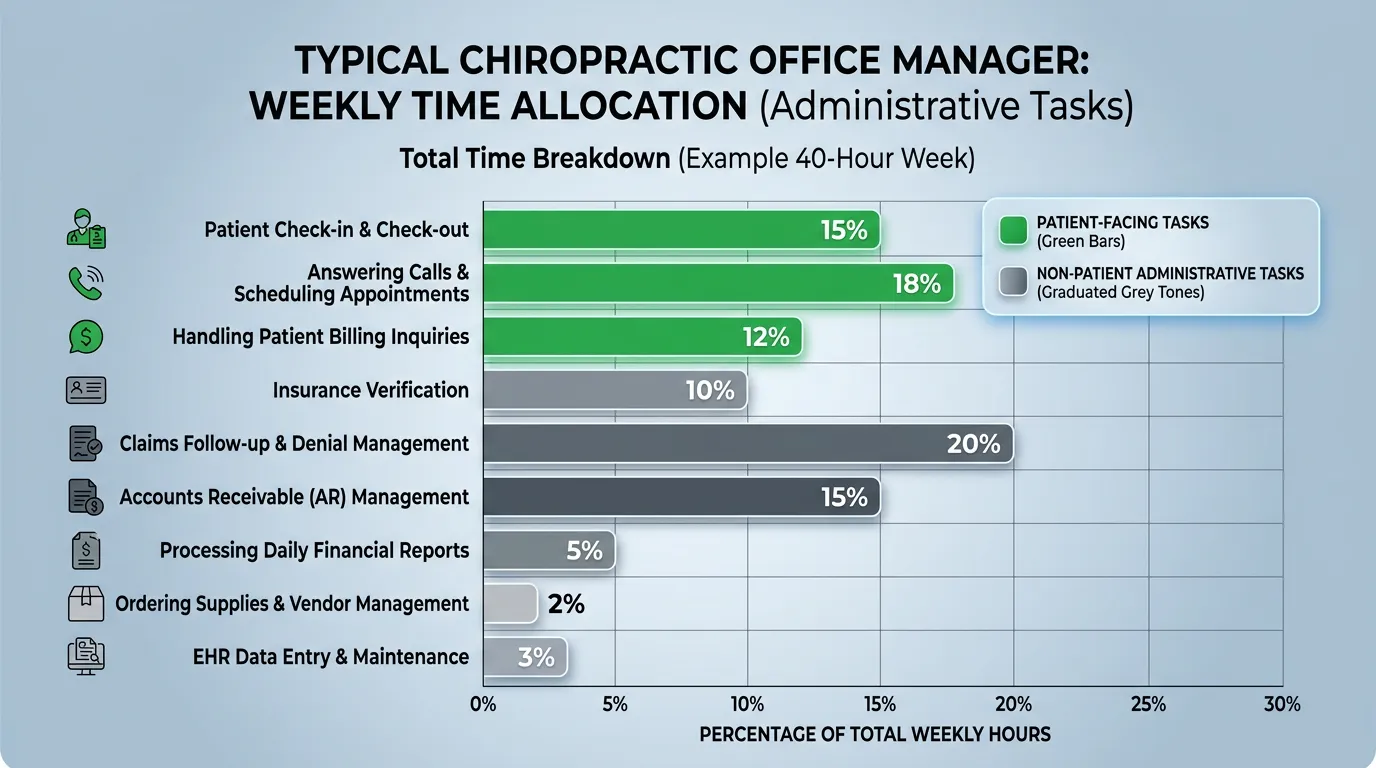
If this sounds familiar, you're not alone. Your patient volume is up. Revenue is climbing. And then things level off — not because patients stop coming, but because the back office can't keep pace.
It usually happens somewhere around 80 to 100 visits per week, especially for practices with one administrative person handling scheduling, billing, and verification.
Where Your Team's Time Actually Goes
A single patient visit creates a long chain of administrative tasks behind the scenes. Insurance verification. Documentation review. Claims submission. Payment posting. Denial follow-up. Patient communication about balances.
When one person is responsible for all of that plus answering phones, scheduling, and greeting patients, something always gives.
Usually it's the work that matters most for cash flow. AR follow-up gets pushed. Denied claims sit in a queue. Verification happens after the visit instead of before.
This isn't a staffing failure. It's a capacity issue.
MGMA's 2025 data reflects how widespread this is. Ninety percent of medical groups reported higher operating costs than the year before, with labor remaining a top concern heading into 2026.
The natural response is to hire. But it helps to look at the full picture first.
What a New Hire Actually Costs
When you post a job listing for a billing specialist or admin at $22 per hour, the number feels manageable. The total cost of that employee, though, tells a different story.
| Base salary ($22/hr, full-time) | $45,760 |
| Employer payroll taxes (FICA, FUTA, SUTA) | $3,900 – $4,600 |
| Health insurance (employer share) | $6,000 – $17,000 |
| Paid time off, sick leave, holidays | $2,200 – $3,500 |
| Training, onboarding, software access | $1,500 – $3,000 |
| Total estimated cost | $59,360 – $73,860 |
According to Homebase's 2026 hiring cost analysis, total employee costs typically run 1.25 to 1.4 times the base salary once you factor in taxes, benefits, and overhead.
And that assumes the hire works out.
Staff turnover in medical practices is still a real challenge. When a biller or admin leaves, cash flow slows for four to six weeks while you recruit, hire, and retrain a replacement.
Thinking About Systems Instead of Headcount
There's another way to approach this.
Instead of adding a person every time your volume grows, you can increase your practice's administrative capacity by combining automation for repetitive tasks, specialized support for technical tasks like billing, and a clearer structure for your existing team's day.
We see this approach consistently help practices handle 20 to 30 percent more volume without adding a W-2 employee.
It doesn't require a complete overhaul. It starts with understanding where your current team's time is going and making a few deliberate shifts.
Three Areas That Create the Most Room to Grow
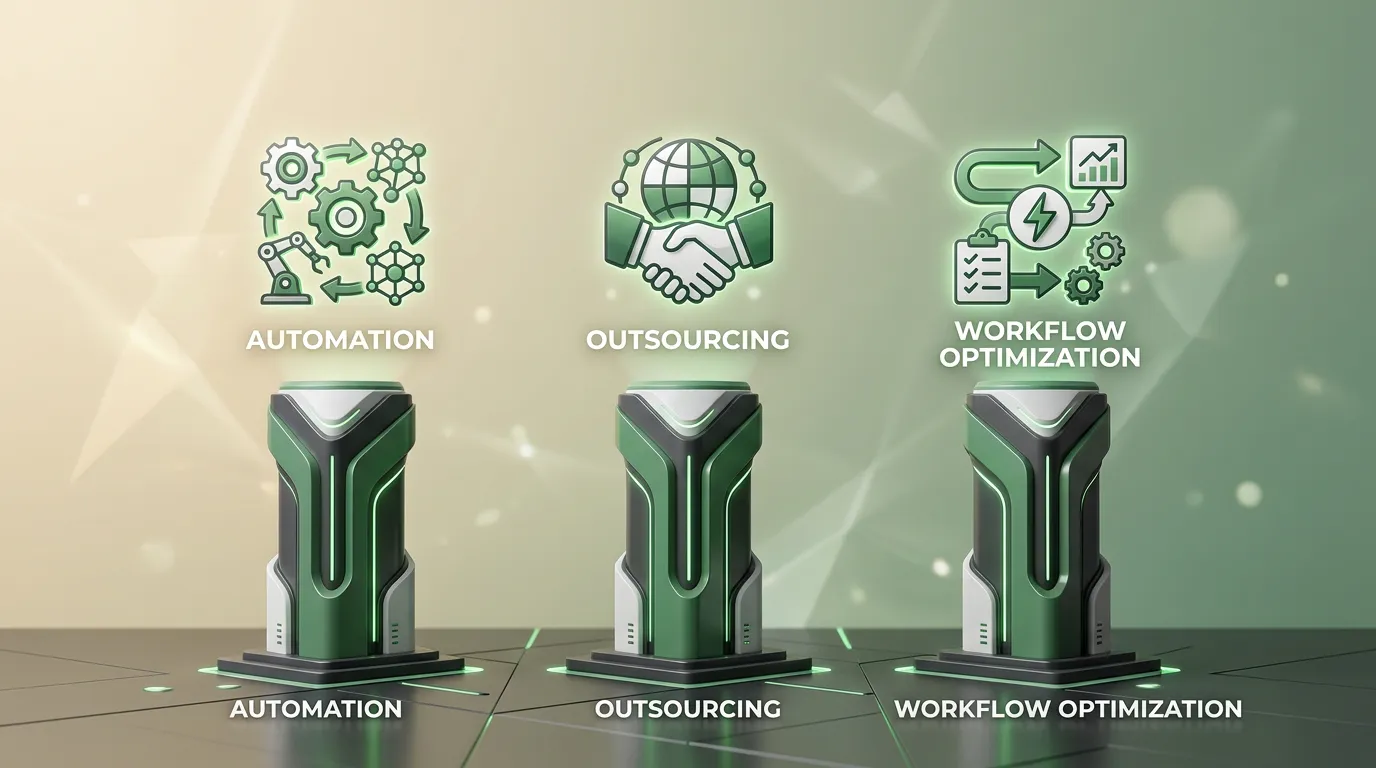
Growing without hiring comes down to three things: automating the repetitive, bringing in specialists for the technical, and giving your current team a more focused role.
Each one addresses a different type of administrative work. Together, they create real breathing room.
Automate the Repetitive Work
Some of the tasks your team handles every day don't need a person's judgment. Documentation, patient intake forms, appointment reminders, and basic eligibility checks are all areas where the right tools can do the job faster and more consistently.
The biggest win for most chiropractic practices right now is clinical documentation.
AI ambient scribes have matured a lot over the past year. Platforms like Lindy AI, Freed, and DeepScribe now generate SOAP notes from natural patient conversations. Most deliver over 90% accuracy and allow custom templates built around chiropractic documentation needs.
Clinicians using these tools are reclaiming one to two hours per day. That's two to four additional patient encounters without extending your hours.
Other areas where automation makes a clear difference:
- Online scheduling and intake — Patients fill out paperwork before they arrive, which shortens check-in and frees your front desk from data entry
- Automated insurance verification — Pre-visit eligibility checks run in the background, so coverage issues surface before the patient is in the chair
- Appointment reminders and recall — Reduces no-shows and keeps your schedule full without manual phone calls
- Automated payment posting — Matches ERA/EOB data to claims and posts payments without someone entering them line by line
The goal isn't to replace your team. It's to take the most time-consuming, repetitive tasks off their plate so they can focus on the work that actually needs their attention.
Bring in Specialists for the Technical Work
Some tasks are too complex for a tool to handle but too specialized for someone who also answers phones and manages the schedule.
Billing is the clearest example.
Chiropractic billing isn't the same as general medical billing. The AT modifier for Medicare, medical necessity documentation for maintenance versus active care, personal injury lien management, and payer-specific quirks all require focused, vertical expertise.
When that work falls to an office manager who's already wearing five hats, things slip. And those slips add up.
Initial claim denial rates reached 11.8% on average in 2024, up from about 10.2% a few years earlier. For practices handling billing in-house with stretched staff, the number is often higher.
Working with a billing partner who specializes in chiropractic means:
- Claims go out within 24 to 48 hours of service — Not whenever the office manager can get to them
- Denials are caught early and appealed systematically — Instead of being discovered weeks later when you're reading an AR aging report and wondering what happened
- Your revenue cycle doesn't pause when someone's out sick or on vacation — Built-in redundancy means claims keep moving
- Your EHR is used the way it's supposed to be — A billing partner who knows JaneApp, ChiroTouch, or Genesis can work within your existing system without requiring a platform switch
Many practice owners worry that outsourcing billing costs more than keeping it in-house. We'll look at those numbers in detail further down. In most cases, the full comparison is encouraging.
Give Your Existing Team a More Focused Role
When automation handles the repetitive tasks and a specialist handles billing, something important happens. Your office manager gets their day back.
Not in a vague way. In a practical, observable way.
They're no longer spending hours on claims follow-up, denial research, or payment posting. Which means they can focus on the things that directly grow your practice:
- Patient communication and retention — Following up with patients who haven't rebooked, managing reviews, building referral relationships
- Schedule optimization — Keeping the provider's calendar full, reducing gaps, managing waitlists to maximize throughput
- Front-desk experience — Being present, attentive, and available for the patients who are standing right in front of them
This isn't about giving your team less to do. It's about giving them the right things to do.
The tasks that make patients stay, rebook, and refer others? Those are the ones that grow a practice. And they're the ones that get squeezed out first when administrative work takes over the day.
Understanding What Your Admin Work Actually Costs Per Visit
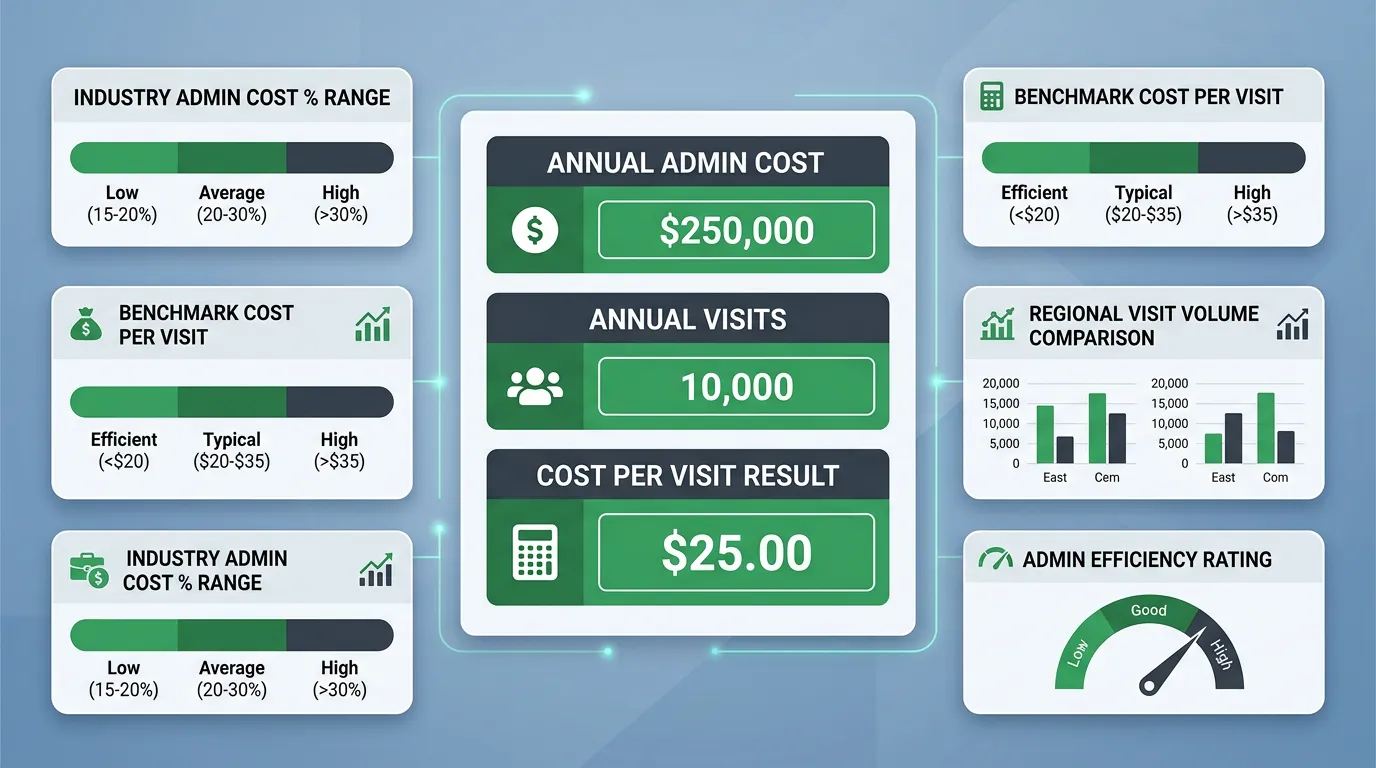
Before making any changes, it helps to know what your current setup costs on a per-visit basis. This is one of the clearest ways to see whether your practice can handle more volume with its current model, or whether something needs to shift.
A Simple Way to Calculate It
Take your total annual administrative cost — salary, benefits, taxes, software, office supplies, and any other overhead tied to admin functions — and divide it by the total number of patient visits your practice handles per year.
That gives you your administrative cost per visit.
If your office manager costs $62,000 annually (fully loaded) and your practice sees 4,500 visits per year, you're at roughly $13.78 per visit for administrative support.
How That Number Compares
Every practice needs someone designated as the compliance contact. In a solo or small practice, that's usually the owner. In a larger clinic, it might be an office manager or billing lead.
The updated GCPG emphasizes that this person should have the authority to investigate concerns and make changes. They shouldn't report to the legal or financial side of the practice—the idea is that they can flag issues independently.
For most chiropractic offices, this is straightforward. The person overseeing billing is often the natural fit.
| 60 – 80 visits | $14 – $18 | $9 – $12 |
| 80 – 120 visits | $11 – $15 | $7 – $10 |
| 120 – 160 visits | $9 – $13 | $5 – $8 |
The second column reflects practices that use a combination of automation and outsourced billing. The gap between the two columns is worth paying attention to, especially if you're approaching the 80 to 100 visit range with a single admin.
Where the Difference Comes From
The cost improvement shows up in a few specific places:
- Fewer claim denials — Specialized billing support typically improves first-pass claim rates, which means less rework and faster payment
- Recovered AR — A billing partner actively works aging claims that an in-house team doesn't have time to get to, and that work often shows noticeable results in the first 90 days
- Lower overhead per visit — No additional benefits, payroll taxes, or training costs, and no productivity dip when someone's out
When you compare a percentage-based billing fee against the fully loaded cost of an employee who handles billing among several other responsibilities, the comparison often favors the active revenue defense model.
What Actually Works for Chiropractic Automation in 2026

There's a lot of noise in the automation space right now. Seventy-one percent of medical practices report using some form of AI in patient visits, but not everything being marketed to chiropractic clinics delivers practical value.
Here's what's actually making a difference.
AI Scribes: The Clearest Time-Saver for Providers
If you're still typing SOAP notes at the end of the day, this is probably the single change that gives you the most time back.
AI ambient scribes listen to your patient conversations through a phone or desktop app and generate structured clinical notes from what was said. The technology has improved significantly. Custom templates for chiropractic-specific documentation are now standard, and most platforms integrate directly with popular EHR systems.
The practical result: 60 to 90 minutes of documentation time reclaimed daily.
That's time you can put back into patient care. Or simply stop working an extra hour at the end of the day.
| Ambient listening | No voice commands or interruptions during adjustments |
| Custom templates | SOAP notes match your preferred format and documentation style |
| EHR integration | Notes go directly into JaneApp, ChiroTouch, or your system |
| Coding suggestions | CPT and ICD-10 code recommendations based on what was documented |
| HIPAA compliance | Encrypted, audit-ready records with secure data handling |
Most AI scribes cost $100 to $400 per provider per month. Compare that to the cost of a documentation-focused hire, and the math is clear.
Scheduling, Intake, and Verification
Front-desk bottlenecks during peak hours limit how many patients your practice can move through in a day. When your receptionist is on the phone verifying insurance while three patients wait to check in, everything slows down.
Digital scheduling and intake tools let patients complete paperwork before they arrive, book their own appointments through a portal, and receive automated reminders.
This doesn't replace your front-desk person. It gives them room to be fully present for patients instead of buried in data entry.
Many EHR platforms already include these features. JaneApp and ChiroTouch both offer online booking, patient portals, and automated reminders. If your practice hasn't activated these built-in tools, that's capacity sitting unused.
Where Automation Reaches Its Limit
It's worth being honest about what these tools can and can't do.
An AI scribe can write a note. It can't argue a complex denial with a payer's peer reviewer.
An automated verification system can check eligibility. It can't explain to a patient why their benefits changed mid-treatment.
A scheduling tool can fill your calendar. It can't decide which patients need priority rescheduling after a last-minute cancellation.
The tasks that require experience, clinical context, and advocacy don't automate well. And they shouldn't. Those are the tasks where human expertise — whether from your internal team or a specialized partner — makes all the difference.
The Outsourcing Question: What the Numbers Actually Show

A lot of practice owners assume outsourcing billing is more expensive than handling it in-house. That's a reasonable concern. But when you compare the full picture — not just the fee, but the total cost of each approach — the numbers usually tell a different story.
Comparing the Real Costs
A percentage-based billing service typically charges 5% to 10% of net collections. For a practice collecting $40,000 per month, that works out to $2,000 to $4,000 monthly for a complete billing function: claims submission, denial management, AR follow-up, and reporting.
Here's how that compares to keeping billing in-house:
| Base compensation | $45,000 – $55,000 | Included in % fee |
| Benefits and taxes | $11,000 – $22,000 | N/A |
| Software and clearinghouse fees | $2,400 – $4,800 | Included |
| Training and continuing education | $1,000 – $2,500 | Included |
| Coverage during PTO/sick leave | Unpredictable | Built-in redundancy |
| Total | $59,400 – $84,300 | $24,000 – $48,000 |
There's also a cost that doesn't show up in a table: the time you personally spend managing, training, and troubleshooting when billing is handled internally. That's time that could go toward patients or practice development.
What Makes a Billing Partner Worth It
Not every billing company works the same way, and the differences matter. For a growing chiropractic practice, here's what to look for:
- Chiropractic-specific knowledge — They understand the AT modifier, medical necessity rules for maintenance versus active care, PI lien management, and the documentation standards that prevent denials before they happen
- Experience with your EHR — They work comfortably in JaneApp, ChiroTouch, Genesis, or whichever system your clinic runs, without asking you to switch
- Clear, consistent communication — Weekly updates, transparent reporting, and direct access to the person working your account
- Systematic denial management — They don't just submit and wait. They monitor for issues, identify patterns, and handle appeals methodically
- Room to grow with you — As your volume increases, your billing support scales without requiring you to renegotiate or start over with onboarding
The right billing partner works like an extension of your team. Not a vendor you check in with once a month.
What Changes When Billing Comes Off the Office Manager's Plate
This is the part that tends to surprise practice owners the most.
When billing moves to a specialist, your office manager doesn't just have fewer tasks. They have a fundamentally different role. One that's focused on the activities that help your practice grow.
Patient retention. Schedule optimization. Referral development. Front-desk experience.
These are the things that turn 80 visits per week into 120. And they're the first things to get deprioritized when administrative tasks dominate the day.
Working with a billing partner who understands your vertical and handles claims systematically is what makes securing predictable clinic cash flow realistic, not aspirational.
A Practical Roadmap for Getting Started

Knowing what to change and knowing where to start are different things. Here's a straightforward sequence that delivers results quickly without disrupting your clinic's daily operations.
Step One: Track Where the Time Goes
Spend one week documenting how your administrative staff spends their hours. Break it into categories: scheduling, verification, claims submission, denial follow-up, payment posting, patient communication, and everything else.
You don't need special software for this. A simple spreadsheet works fine.
What usually surfaces: 30 to 40 percent of an office manager's week is consumed by billing-related work that doesn't require someone physically in the office. That's the clearest starting point.
Step Two: Start with Documentation
If you're still charting manually at the end of the day, this is the first move. An AI scribe typically pays for itself within the first week by giving you back clinical time that translates directly into additional patient encounters.
Most platforms offer free trials. Test one against your actual workflow for two weeks before committing.
Step Three: Transition Billing to a Specialist
Once documentation is handled, billing is the next area with the biggest return.
The transition to a billing partner is smoother than most practice owners expect, especially when the partner already has experience with your EHR platform. A typical transition looks like this:
- AR review — Understanding your current claims status and identifying where revenue can be recovered quickly
- Parallel period — The billing partner begins managing new claims while working through your existing AR
- Communication setup — Establishing a weekly reporting rhythm and direct contact channels
- Full handoff — Your office manager is fully relieved of billing responsibilities, usually within 30 to 60 days
Step Four: Refocus Your Team
With billing and documentation handled, redesign your office manager's role around patient experience and practice growth.
This isn't a demotion. It's an elevation. They move from administrative work that keeps the lights on to patient-facing work that drives real growth.
| Time tracking | Week 1 | Clear picture of how admin time is spent |
| AI scribe setup | Weeks 2 – 3 | 1 – 2 hours of documentation time reclaimed daily |
| Billing partner transition | Weeks 3 – 8 | Billing lifted from your internal team's workload |
| Role redesign | Weeks 6 – 10 | Office manager focused on patients and growth |
| Increased capacity | Months 3 – 6 | 20 – 30% more patient volume with the same team |
Frequently Asked Questions
How many patients can one chiropractic office manager realistically handle?
Most experienced office managers can effectively manage billing, scheduling, verification, and patient communication for about 80 to 100 visits per week.
Beyond that, tasks start falling through the cracks. AR follow-up, denial management, and pre-visit verification are usually the first things to slip.
If you're approaching 100 visits weekly with a single admin person, it's worth evaluating where systems or specialized support could create more capacity — rather than jumping straight to a new hire.
What is the ROI of an AI scribe versus hiring a medical assistant?
AI scribes cost between $100 and $400 per provider per month and typically save one to two hours of documentation time daily.
A full-time medical assistant runs $45,000 to $55,000 annually before benefits, taxes, and overhead — which usually add 25 to 40 percent on top of base salary.
For documentation-specific needs, the AI scribe delivers a faster return. But a medical assistant handles clinical tasks that an AI tool can't. The better question is: where's your actual bottleneck?
How does specialized billing help scale a chiropractic practice?
A billing partner with chiropractic expertise understands the specific codes, modifiers, and payer rules that general billers often miss. The AT modifier for Medicare. Medical necessity documentation for maintenance versus active care. PI lien billing.
That knowledge translates to higher first-pass claim acceptance, fewer denials, faster payment, and recovered revenue from aging AR.
When billing comes off your office manager's plate entirely, they have the bandwidth to support a larger patient volume. That's how specialized billing becomes a scaling tool.
What are the best chiropractic automation tools for 2026?
The tools making the clearest difference fall into four categories:
- AI ambient scribes for clinical documentation (Lindy AI, Freed, DeepScribe)
- Automated insurance verification that runs before the patient arrives
- Online patient scheduling and intake through a portal or EHR integration
- Automated appointment reminders that reduce no-shows without staff involvement
Before buying anything new, check what your current EHR already offers. JaneApp and ChiroTouch both have built-in features that many practices haven't fully activated.
Can I outsource my chiropractic billing without losing control of my AR?
Yes. And a good billing partner actually gives you more visibility into your AR, not less.
Look for weekly status updates, shared dashboards or reporting, and clear documentation of every action taken on your claims. You should always retain full access to your EHR and clearinghouse.
The providers who feel they've "lost control" of billing usually worked with a company that didn't communicate consistently. Transparent reporting is the non-negotiable.
How do I calculate the "cost per visit" for my administrative staff?
Add up the total annual cost of your administrative employee — salary, benefits, taxes, training, software, and equipment.
Divide that by the total number of patient visits your practice handles per year.
For example: $62,000 in total admin cost ÷ 4,500 visits per year = roughly $13.78 per visit.
This number is useful for comparing against the per-visit cost of outsourced billing or automation tools. It takes the decision out of the abstract and into dollars and cents.
What is the difference between outsourcing billing and hiring a remote biller?
A remote biller is your employee. You manage their schedule, training, performance, and coverage when they're out.
An outsourced billing partner takes responsibility for the entire billing function — claims submission, denial management, AR follow-up, and reporting — with built-in redundancy. If someone on their team is out, your billing doesn't stop.
The biggest practical difference: outsourcing takes the management burden off your plate completely. You get reports and results without supervising the day-to-day process.
Getting From Where You Are to Where You Want to Be
The chiropractic care market is growing steadily, valued at approximately $19.6 billion globally and expanding each year. Patient demand is there.
The question isn't whether your practice can grow. It's whether your current setup can support that growth without everyone on your team running on fumes.
The practices that scale well in 2026 aren't necessarily the ones spending the most money. They're the ones who've made deliberate choices about what to automate, what to hand to a specialist, and what their internal team should actually be focused on.
Those choices aren't complicated. They just need to be made intentionally.
If you've been thinking about how to see more patients without the overhead of a new hire, that's exactly where most of the practice owners we work with start the conversation.
If you're thinking "this all makes sense, but I don't have time to figure it out," you're not alone. Most clinic owners we work with felt the same way before they realized how much revenue was slipping through the cracks.
That's why we offer a free discovery call. It's a chance to talk through your current billing situation and get clarity on what's working, what's not, and what your options are.
We'll help you understand:
- Where your claims might be getting stuck
- What's causing denials or delays
- Whether your AR is healthy or needs attention
- How your current process compares to best practices
- What a partnership with Bushido would actually look like
Book a Call — no pressure, no obligation, just a straightforward conversation about your billing.
Because every practice deserves a billing process that's as reliable and organized as the care you provide to your patients.
SCHEDULE YOUR FREE DISCOVERY SESSION TODAY.


Copyright 2026 | All rights reserved | Web Design by iTech Valet