

How Do I Manage Secondary Insurance Claims in Chiropractic? (2026 Guide)

You manage secondary insurance claims by building a consistent coordination of benefits (COB) workflow. That workflow captures secondary payer information at intake, posts primary ERA data accurately, and either relies on automatic crossover programs or submits manual secondary claims with attached EOB documentation.
That's the straightforward version.
In practice, secondary claims tend to be one of those areas that quietly drifts to the bottom of the priority list. The individual payments are modest—often $15 to $30 per visit—so they don't feel urgent on any given day.
Over the course of a year, though, they add up.
If your clinic sees 30 patients per week who carry secondary coverage and the average secondary payment is $20, that represents roughly $31,200 in annual collections. Most clinics would notice if that amount went missing from a primary payer. With secondary claims, the loss tends to happen gradually enough that it doesn't register until someone looks at the AR aging report.
The billing landscape in 2026 adds a few new wrinkles. Updated CAQH CORE Code Combinations for ERA transactions, the February 16, 2026 compliance deadline for 42 CFR Part 2 alignment, and clearinghouse security updates have all added steps to the process.
The encouraging part is that secondary claim issues almost always follow patterns. Once those patterns are identified, they're very fixable.
That's where identifying revenue leakage through a structured review makes a real difference. It gives you a clear picture of where secondary claims are getting stuck—and what to do about it.
Pairing that kind of visibility with human intelligence in billing—people who can spot COB errors and clearinghouse misconfigurations before they become write-offs—is what turns a frustrating process into a reliable one.
This guide walks through how to set up that workflow from end to end: verification, submission, crossover management, troubleshooting, and the 2026 regulatory updates worth knowing about.
Understanding Coordination of Benefits in Chiropractic

Coordination of benefits is the process that determines which payer is responsible for paying first (primary) and which pays second (secondary). When a patient carries two insurance policies, this payer order is governed by federal regulation and individual payer contracts.
For chiropractic clinics, dual coverage comes up regularly—especially with Medicare patients who also carry Medigap or Medicaid, and with patients whose spouses carry separate employer plans.
A clear understanding of how payer order works helps prevent the most common secondary claim issues before they start.
How COB Rules Determine Payer Order
The CMS Medicare Secondary Payer provisions lay out the hierarchy when Medicare is involved. The short version: Medicare is primary when the patient is retired and has no active employer-based group health plan. Medicare is secondary when the patient is still working and covered by an employer group plan with 20 or more employees.
For non-Medicare patients, the "birthday rule" applies to dependents covered by two parents' plans. The plan of the parent whose birthday falls earlier in the calendar year pays primary.
Here's how the most common scenarios break down:
- Working Aged Rule — A Medicare patient who's still employed and covered by a group health plan through an employer with 20+ employees has the employer plan as primary and Medicare as secondary. This is a common scenario in chiropractic clinics, and getting it right at intake saves a lot of rework later.
- Birthday Rule — For dependent children covered under both parents' plans, the parent with the earlier birthday in the calendar year has the primary plan. This is based on month and day only, not the parent's age.
- Divorce and Custody Rules — Court orders may designate which parent's plan is primary for a minor child. It's helpful to have a copy of that documentation on file.
The Revenue Impact of Secondary Claims
The Medical Group Management Association (MGMA) recommends keeping days in accounts receivable below 30 to 35 days for healthy practice performance. Secondary claims that aren't tracked systematically tend to push that number higher—sometimes 20 to 30 percent above the primary-only baseline.
That shift in AR days represents real cash flow that's delayed rather than collected.
Here's how managed versus unmanaged secondary billing typically compares:
| Average Days in AR | 28–35 days | 32–42 days (secondary adds some time) |
| Revenue Captured | 85–90% of allowed amounts | 95–100% of allowed amounts |
| Staff Time per Claim | One submission cycle | Two cycles (second is often automated) |
| Annual Revenue Impact | Baseline | Additional 10–15% recovery |
| Write-Off Risk | Lower (single payer) | Higher if secondary claims aren't tracked |
For clinics working toward securing predictable clinic cash flow, building a secondary billing workflow into the standard process is one of the more straightforward ways to close that gap.
When secondary claims are part of the routine—not an afterthought—the revenue shows up consistently, and the AR report stays cleaner.
The Secondary Claim Workflow: Step by Step
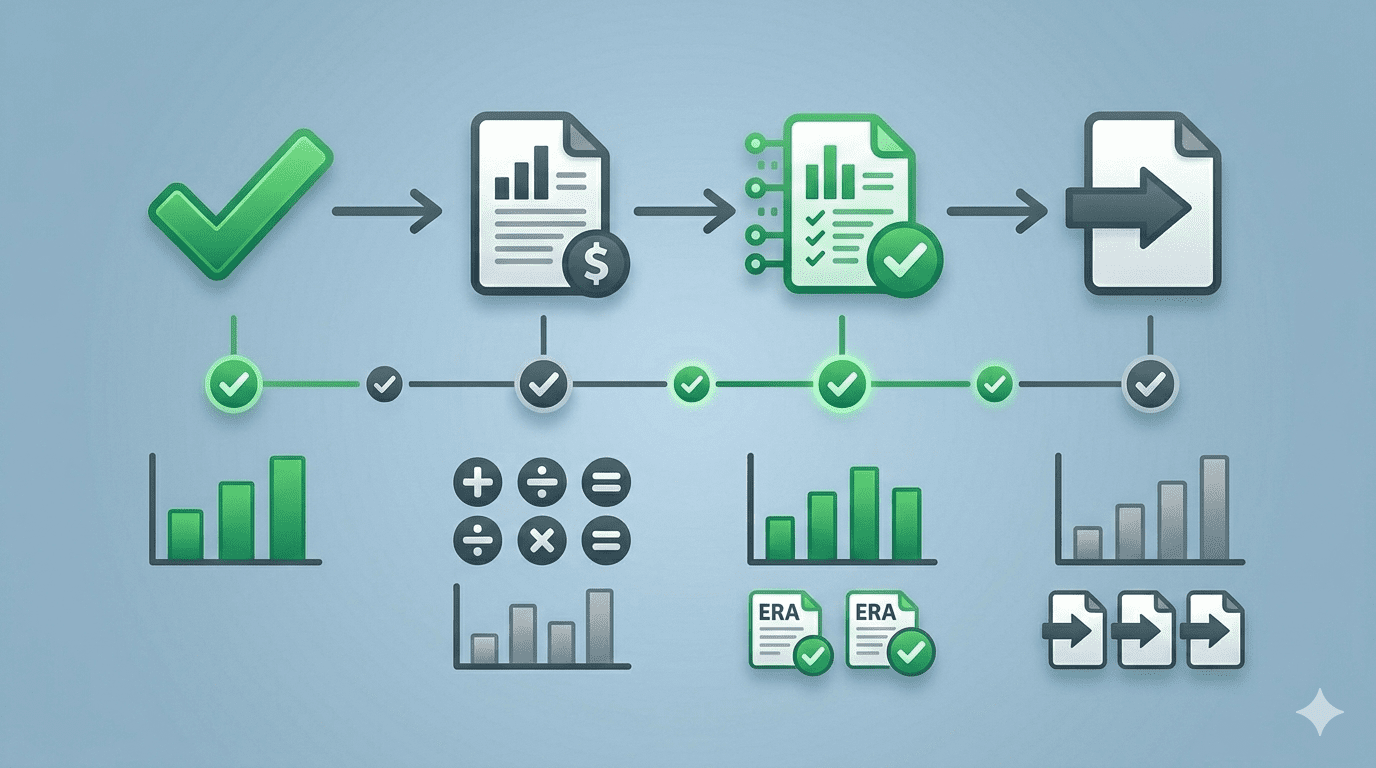
Secondary billing follows a clear sequence. Each step depends on the one before it, so building a reliable process means making sure none of the handoffs get dropped.
Here's how each stage works, and where the common sticking points tend to show up.
Step 1: Capture Secondary Insurance at Intake
Most secondary billing issues trace back to this step.
Your front desk team needs to confirm whether each patient carries more than one insurance plan—and not just at the initial visit. Coverage changes throughout the year: new jobs, new plans through a spouse, Medicare enrollment at 65, Medicaid qualification.
A consistent verification process at every visit catches these changes early.
- Verify both policies electronically — Run eligibility checks on primary and secondary before the appointment. Most EHR platforms, including Jane App and ChiroTouch, support multi-payer eligibility verification.
- Confirm payer order — Don't rely on last month's information. Job changes, divorce, and turning 65 all shift payer order.
- Document the secondary payer ID, group number, and subscriber information — Incomplete secondary data is a leading reason claims don't cross over automatically.
- Keep a copy of the secondary insurance card on file — Digital or physical. You'll need it if a manual claim becomes necessary.
Step 2: Bill the Primary Payer First
The primary claim needs to be submitted and adjudicated before secondary billing can begin.
A clean primary claim includes:
- Correct CPT codes with appropriate modifiers (including the AT modifier for Medicare chiropractic claims indicating active treatment)
- Accurate ICD-10 diagnosis codes with the specificity that payers now expect
- Proper NPI, taxonomy, and place of service codes
- Documentation supporting medical necessity
If the primary claim is denied, the secondary claim can't move forward. The secondary payer needs a completed primary adjudication to reference—even if the primary's decision was a denial.
Step 3: Receive and Post the Primary ERA
Once the primary payer processes the claim, they issue an Electronic Remittance Advice (ERA). This is the electronic version of the Explanation of Benefits (EOB).
This is where the secondary claim process either flows smoothly or stalls.
The primary ERA contains everything the secondary payer needs: what was billed, what was allowed, what the primary paid, what the patient owes, and any adjustments. If that data isn't posted accurately in your practice management system, the secondary claim can't be generated correctly.
ERA reassociation also plays a role here. The CAQH CORE Payment & Remittance Reassociation Rule requires that electronic fund transfers and ERA files match up properly. If your clearinghouse had a recent security update or configuration change, those ERAs may not be posting automatically. When that happens, secondary claims don't trigger.
Catching ERA posting errors, identifying mismatched payment data, and flagging claims that should have crossed over but didn't—that's the kind of detail-level review that keeps the workflow running smoothly.
Step 4: Submit the Secondary Claim
This step takes one of two paths, depending on whether the secondary payer participates in an automatic crossover program.
Path A: Automatic Crossover (COBA)
If the patient's secondary payer participates in the Coordination of Benefits Agreement (COBA) program, the claim should cross over automatically after the primary payer adjudicates it. No separate submission is needed from your team.
You can confirm the crossover by checking your Medicare Remittance Advice for remark codes MA18 or N89, which indicate the claim was forwarded to the secondary payer.
Path B: Manual Submission
If the crossover doesn't happen—or the secondary payer isn't in the COBA network—the claim goes out manually through your clearinghouse. The submission should include the primary payer's EOB data:
- Primary payer's allowed amount
- Amount the primary paid
- Patient responsibility (deductible, coinsurance, copay)
- Adjustment reason codes from the primary ERA
| Automatic Crossover (COBA) | Medicare is primary; secondary payer participates in COBA | No manual work; reduces errors | Not all payers participate; crossover can fail silently |
| Manual via Clearinghouse | Secondary payer not in COBA; crossover failed | Full control over submission | Requires staff time; timely filing deadlines apply |
| Manual Paper (CMS-1500) | Payer requires paper; small volume | Simple process | Slow; no electronic tracking; higher error rate |
Common Reasons Secondary Claims Stall—and What to Do About Each One
Even with a solid workflow, secondary claims occasionally get stuck. The key is recognizing the pattern quickly so the issue can be resolved before it becomes a write-off.
Here are the scenarios we see most often, along with what to do about each one.
Demographic Mismatches
This is the most common—and most preventable—reason crossovers fail.
The patient's name, date of birth, gender, and address need to match exactly between Medicare's records and the secondary payer's eligibility file. Even small differences—a middle initial in one system but not the other, a hyphenated last name entered differently—can block the transfer.
What to do: Verify demographics against both payer systems at each visit. When discrepancies exist, correct them at the source before the claim is submitted. A few extra minutes at the front desk saves significantly more time on the back end.
Secondary Coverage Not on File with Medicare
If Medicare doesn't have the patient's secondary coverage information, it can't forward the claim. This happens when patients change secondary plans mid-year, when Medigap enrollment isn't reported to the Benefits Coordination & Recovery Center (BCRC), or when employer-sponsored retiree plans don't participate in the COBA network.
What to do: If your ERA doesn't show remark codes MA18 or N89, the claim didn't cross over. Submit the secondary claim manually with the Medicare EOB attached. Going forward, confirm COBA participation as part of your secondary eligibility verification.
Clearinghouse Configuration Errors
Recent clearinghouse security updates have interrupted ERA delivery for a number of practices. If your clearinghouse connection was disrupted—even briefly—you may have a backlog of unposted remittances. That means secondary claims that should have been generated automatically are sitting in a queue.
What to do: Contact your clearinghouse to confirm that ERA delivery is active and current. Review any unposted remittances and reprocess claims that were missed during the disruption. This is a good area for active revenue defense—a proactive check rather than waiting for the problem to show up on an aging report.
Timely Filing Deadlines
Each payer has its own timely filing window for secondary claims. Medicare allows one year from the date of the primary ERA. Medicaid varies by state, but many allow 90 days from the Medicare remittance date. Commercial payers often give 90 to 180 days.
Once a filing deadline passes, the claim generally can't be recovered through an appeal. That makes regular follow-up on secondary AR especially important.
What to do: Build secondary claim follow-up into your weekly AR review. Flagging secondary claims at the 45-day mark gives your team enough time to investigate and resolve any issues well before the deadline.
| Demographic Mismatch | Crossover fails silently; no MA18/N89 on ERA | Correct demographics in both systems; resubmit | Verify demographics at every visit |
| Secondary Not on File | No crossover remark codes on Medicare RA | Submit manually with EOB attached | Confirm COBA participation during eligibility check |
| Clearinghouse ERA Gap | ERAs not posting; secondary claims not triggering | Contact clearinghouse; reprocess missing ERAs | Monitor ERA receipt daily |
| Timely Filing Deadline | Claim denied with filing limit reason code | Limited options; prevention is more reliable | Weekly secondary AR aging review |
| Primary Denied | No valid primary adjudication for secondary to reference | Appeal or correct primary claim first | Clean primary claims with thorough documentation |
2026 Regulatory Updates That Affect Secondary Billing
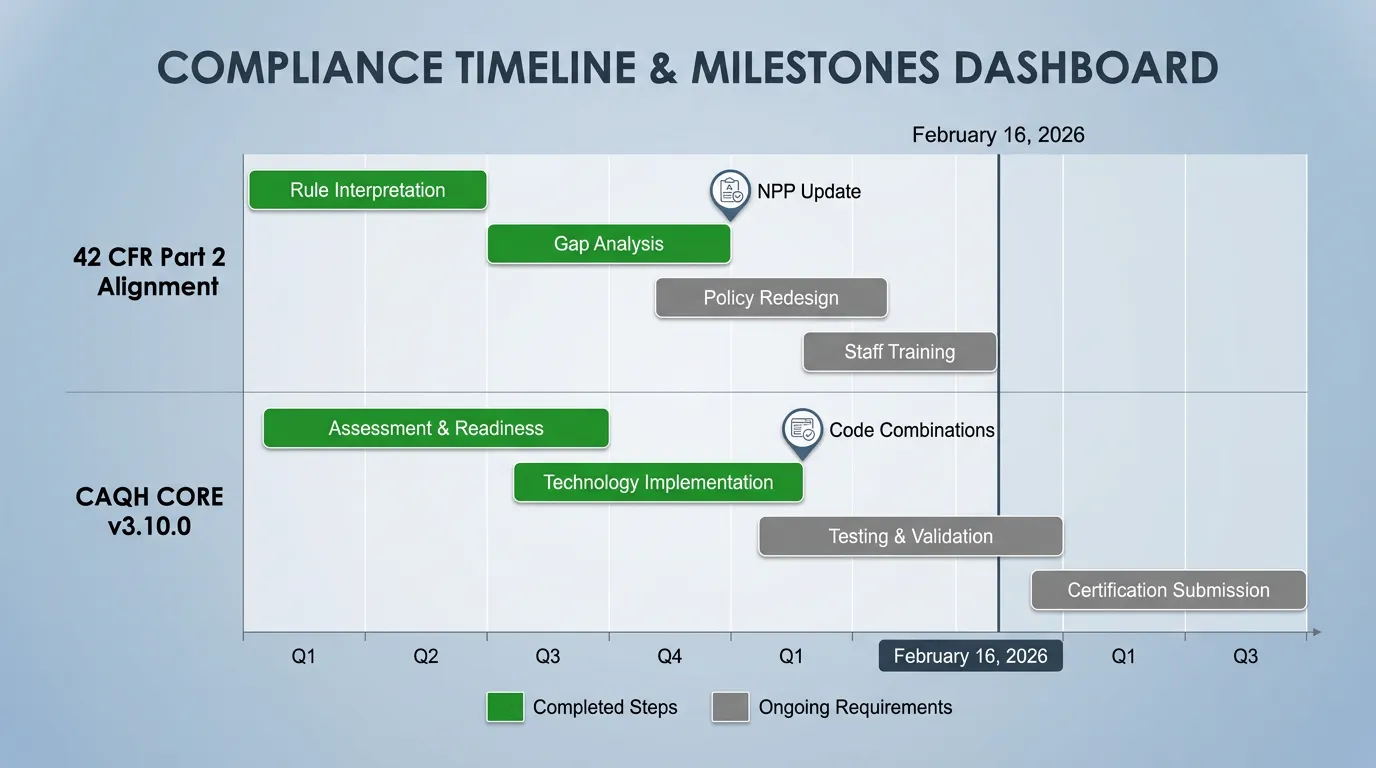
A couple of regulatory changes in 2026 touch the secondary billing process directly. Here's what's relevant and what it means for your workflow.
The 42 CFR Part 2 Alignment Deadline
The 42 CFR Part 2 Final Rule compliance deadline was February 16, 2026. This rule aligns substance use disorder (SUD) record confidentiality with HIPAA, and the HHS Office for Civil Rights has confirmed that enforcement is now active.
If your chiropractic clinic receives, maintains, or transmits SUD records—even incidentally as part of patient intake or care coordination—the rule applies. It changes how patient consent works for sharing records across payers, which can affect secondary claim processing when SUD-related diagnoses appear in the billing record.
Here's what the update involves:
- Updated Notice of Privacy Practices — Your NPP should now include specific language about SUD record protections and how they differ from standard HIPAA protections.
- Single Consent for TPO — Patients can provide one consent for all future uses and disclosures of SUD records for treatment, payment, and healthcare operations. This simplifies secondary billing workflows for affected records.
- Breach Notification — SUD records are now subject to the same breach notification requirements as other HIPAA-protected health information.
For most chiropractic clinics, the practical impact is modest. But it's worth confirming that your privacy practices and consent forms reflect the updated requirements.
CAQH CORE Code Combinations Update
The CAQH CORE Code Combinations v3.10.0, effective February 2026, updates the Claim Adjustment Reason Codes (CARCs) and Remittance Advice Remark Codes (RARCs) used in ERA transactions. These codes are what your billing system reads to determine how a primary payer adjudicated a claim—which directly feeds into secondary claim generation.
If your practice management system or clearinghouse hasn't updated to reflect the new code combinations, secondary claims may be generated with incorrect adjustment data. That can lead to denials on the secondary side.
It's worth checking with your clearinghouse and EHR vendor to confirm they've implemented the v3.10.0 updates. A quick verification now can prevent a pattern of secondary denials later.
Automating Secondary Claims in Your EHR
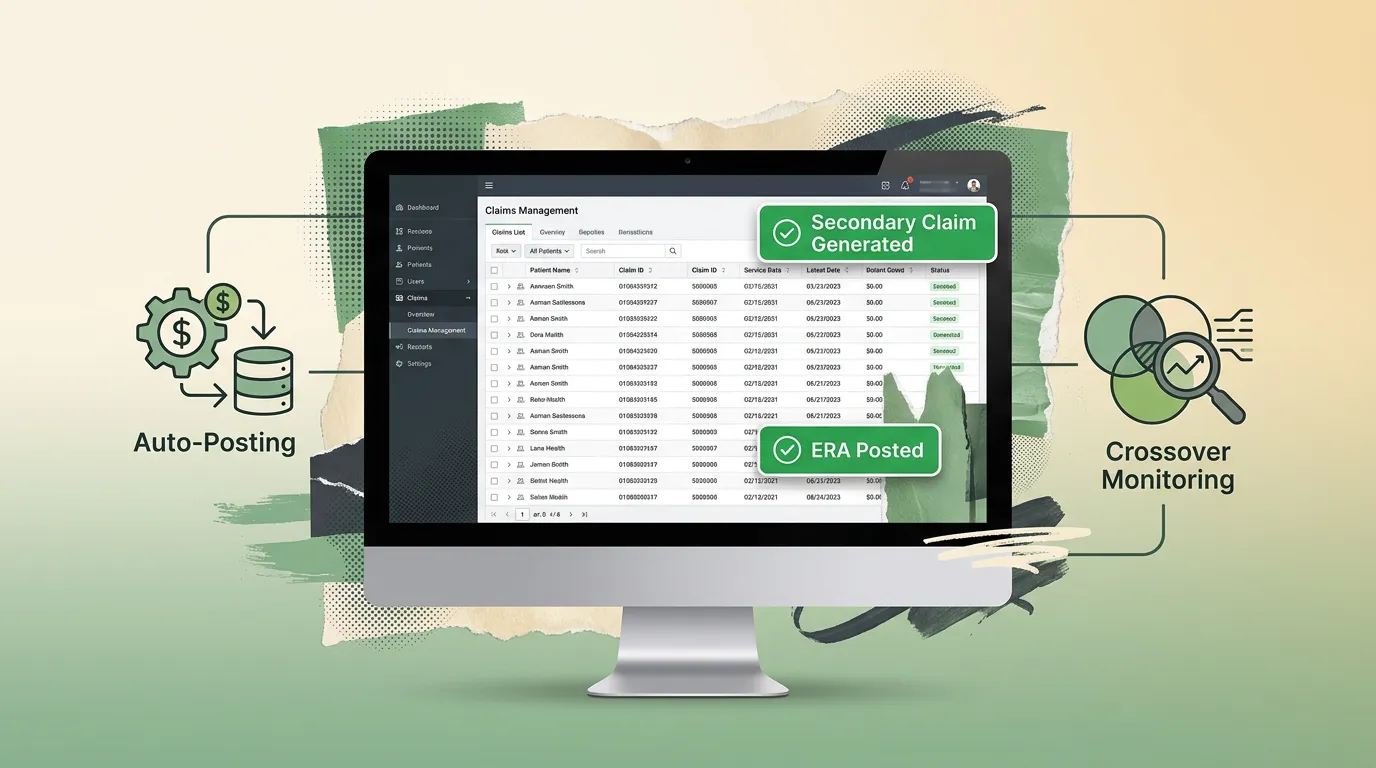
One of the most effective ways to keep secondary claims on track is automating the parts of the workflow that don't require human judgment.
Most chiropractic EHR platforms support some level of secondary claim automation, but the default settings usually need configuration to work well.
What Automation Handles Well
- ERA Auto-Posting — When your clearinghouse delivers a primary ERA and your EHR posts the payment data automatically, it removes the manual step that delays secondary claim generation. Without auto-posting, someone on your team has to enter every primary payment before the secondary claim can go out.
- Secondary Claim Auto-Generation — Some EHR platforms can create a secondary claim automatically once the primary ERA posts. The system pulls the primary payer's adjudication data and populates the secondary claim form. Your team reviews and releases it rather than building it from scratch.
- Crossover Monitoring — Automated alerts when expected crossover claims don't appear within a set timeframe (typically 14 to 21 business days) give your team a chance to follow up before aging becomes a concern.
What Still Needs a Person
Automation handles data transfer well. Judgment calls are a different story.
When a primary claim is partially denied and the EOB shows an unusual adjustment, someone needs to review whether the secondary claim should be submitted as-is or whether the primary needs to be corrected first.
When COB information changes mid-treatment—a patient switches jobs, turns 65, or adds a spouse's plan—the system may not catch the payer order change automatically. That's a front-desk and billing team responsibility.
Practices that build this kind of review into their active revenue defense process—training staff to understand the "why" behind the workflow, not just the steps—tend to catch the issues that automation misses.
| Eligibility Verification (Multi-Payer) | Confirms both primary and secondary coverage before visit | Enable secondary payer fields; connect to clearinghouse |
| ERA Auto-Posting | Triggers secondary claim generation without manual entry | Verify clearinghouse ERA delivery; map payment codes |
| Secondary Claim Auto-Generation | Creates secondary claim with primary adjudication data | Enable feature; configure payer-specific rules |
| Crossover Alert | Flags missing crossover claims for follow-up | Set alert timeline (14–21 days); assign staff responsibility |
| AR Aging by Payer Type | Separates primary and secondary AR for targeted follow-up | Create custom AR report filtered by secondary payers |
Frequently Asked Questions
What is an insurance crossover claim, and how does it work for chiropractors?
A crossover claim is a claim that Medicare or another primary payer automatically forwards to a patient's secondary insurer after processing its portion. For chiropractors, this most commonly applies to Medicare patients who also carry Medigap or Medicaid coverage.
The COBA program administered through the Benefits Coordination & Recovery Center facilitates these transfers. When everything is configured correctly, the secondary payer receives the claim without your team submitting anything additional. Remark codes MA18 and N89 on your Medicare Remittance Advice confirm the crossover went through.
Not all secondary payers participate in COBA. Employer-sponsored retiree plans and some commercial carriers typically require manual secondary submission.
Do I need to attach a primary EOB to every secondary chiropractic claim?
Only when the secondary claim doesn't cross over automatically.
If the crossover processes correctly through COBA, the secondary payer receives the primary adjudication data electronically. No attachment is needed on your end.
When a crossover doesn't go through—or the secondary payer isn't part of the crossover program—you submit the claim manually and include the primary EOB. That gives the secondary payer the documentation they need to process their portion. Without it, most secondary payers will return the claim.
Why are my Medicare secondary claims not crossing over in 2026?
A few things commonly prevent Medicare claims from crossing over. Demographic mismatches between Medicare's records and the secondary payer's eligibility file are the most frequent cause—even small differences in patient name, date of birth, or address can block the transfer.
Other reasons include the secondary payer not participating in COBA, mid-year coverage changes that haven't been updated in Medicare's system, and clearinghouse configuration issues following recent security updates.
Check your Medicare Remittance Advice for remark codes MA18 or N89. If those codes aren't present, the claim didn't cross over, and a manual submission is the next step.
How do I bill a secondary insurance company if I don't have an ERA?
If the primary payer doesn't send an ERA—or if your clearinghouse isn't delivering it—manual billing is still an option.
Download or request the primary payer's paper EOB from their provider portal. Use that data to create a secondary claim in your practice management system, including the primary's allowed amount, payment, and patient responsibility. Submit through your clearinghouse or directly to the secondary payer with the EOB attached.
It's also worth working with your clearinghouse to resolve the underlying ERA delivery issue. Manual billing works in the short term, but it's not a sustainable long-term approach for most practices.
What is the 2026 deadline for COB compliance?
The most relevant deadline for COB workflows in 2026 was February 16, when the 42 CFR Part 2 alignment rule became enforceable. This rule changes how substance use disorder records can be shared between payers for treatment, payment, and healthcare operations.
The CAQH CORE Code Combinations v3.10.0 also took effect in February 2026, updating the claim adjustment reason codes and remittance advice remark codes used in ERA transactions. Your clearinghouse and EHR need to support these updated codes for secondary claims to process correctly.
How can I automate secondary claim submission in ChiroTouch or Jane?
Both platforms support secondary claim workflows, but the setup requires some configuration beyond the defaults.
In Jane App, secondary claims are generated after the primary ERA posts. The system lets you create a secondary claim with the primary's payment data attached, then submit through your clearinghouse. In ChiroTouch, the billing module supports secondary claim generation once primary ERA data is posted.
The key prerequisite for both is that your clearinghouse needs to be configured to deliver primary ERAs electronically, and your system needs to be set to auto-post those ERAs. Without that foundation, the secondary claim workflow can't run automatically.
What percentage of clinic revenue comes from secondary insurance payments?
Secondary payments typically represent 10 to 15 percent of a chiropractic clinic's total annual collections. Individual payments often range from $15 to $30 per visit, which can make them easy to deprioritize.
Across a full patient panel, though, they add up meaningfully. A clinic seeing 120 to 150 patients per week—even with a modest percentage carrying secondary coverage—may be looking at $25,000 to $40,000 or more in annual collections that are available but go uncollected without a systematic approach.
Conclusion
Secondary insurance claims are a manageable part of the billing process when there's a consistent workflow in place.
The steps are straightforward: verify both payers at intake, submit clean primary claims, post ERAs accurately, and either confirm the crossover or submit manually with the EOB attached. The 2026 regulatory updates add a few compliance steps, but they don't change the underlying process.
The difference between clinics that collect this revenue consistently and those that don't usually comes down to whether secondary billing is part of the weekly routine or something that gets addressed when someone has time. Building it into the standard process is the most reliable way to close that gap.
If your secondary AR has been growing quietly in the background—or your team has been meaning to get a better handle on crossover claims but hasn't had the bandwidth—you're not alone. Most clinic owners we work with felt the same way before they realized how much revenue was sitting in those aging buckets.
That's why we offer a free discovery call. It's a chance to talk through your current billing situation and get clarity on what's working, what's not, and what your options are.
We'll help you understand:
- Where your claims might be getting stuck
- What's causing denials or delays
- Whether your AR is healthy or needs attention
- How your current process compares to best practices
- What a partnership with Bushido would actually look like
Book a Call — no pressure, no obligation, just a straightforward conversation about your billing.
Because every week your team spends chasing secondary claims manually is a week that a clear, organized process could have handled for you.
SCHEDULE YOUR FREE DISCOVERY SESSION TODAY.


Copyright 2026 | All rights reserved | Web Design by iTech Valet