

How to Prepare Your Chiropractic Practice for an OIG Audit in 2026

You prepare for an OIG audit by building a compliance program around the seven elements in the OIG's General Compliance Program Guidance, keeping thorough PART documentation for every subluxation claim, checking the OIG exclusion list monthly, and running internal chart reviews that mirror what a federal reviewer looks for.
That's the framework. Let's walk through how to actually put it in place.
The Office of Inspector General has been increasing its focus on chiropractic billing patterns, and 2026 brings two significant regulatory updates that affect how practices should think about compliance. But the good news is that most of this comes down to consistent documentation and clear internal processes—things a well-organized practice can absolutely handle.
According to CMS's 2024 Medicare Fee-for-Service Supplemental Improper Payment Data, the improper payment rate for chiropractic services is 33.6%, with a projected improper payment amount of $178.3 million.
Here's the part that matters most: insufficient documentation accounts for 95.5% of those errors.
That's not a coding problem. It's not a fraud problem. It's a documentation problem. And documentation problems are fixable.
The practices that handle audits smoothly aren't doing anything extraordinary. They're identifying revenue leakage through consistent processes, documenting with intention, and treating compliance as a daily habit rather than an annual project.
This guide walks through every step—from understanding what's changed in the 2026 regulatory landscape to building the kind of documentation workflow that protects your revenue and gives you confidence if an audit letter ever shows up.
What the OIG Is and Why Chiropractic Is on Its Radar

The OIG is the oversight arm of the U.S. Department of Health and Human Services. Its role is to identify and address fraud, waste, and abuse in federal healthcare programs, with Medicare and Medicaid being the primary focus areas.
Chiropractic has been on the OIG's radar for a while now, and it's worth understanding why. That 33.6% improper payment rate makes the specialty one of the most reviewed categories in Medicare Part B. When a third of claims in any specialty come back with issues, federal reviewers naturally spend more time there.
But here's what's important to keep in perspective. The vast majority of those errors come from documentation gaps, not intentional mistakes. That's a meaningful distinction, and it's one the OIG recognizes.
How Practices Come to the OIG's Attention
The OIG doesn't select practices randomly. The HHS-OIG Work Plan outlines the agency's priorities each year, and those priorities are data-driven.
In 2026, a few things are shaping where the OIG focuses:
- Data analytics and pattern matching — The OIG reviews billing data to identify practices whose patterns look significantly different from their regional peers. A high ratio of 98942 (five-region manipulation) claims compared to 98940 or 98941, for example, may prompt a closer look.
- Medicare Advantage oversight — Over half of Medicare beneficiaries are now in MA plans. The OIG released its Medicare Advantage Industry Compliance Program Guidance (ICPG) on February 3, 2026—the first update in more than 26 years. That guidance extends compliance expectations to providers treating MA patients.
- CERT audit findings — The Comprehensive Error Rate Testing program continues to identify chiropractic as a high-error category. Those findings inform the OIG's ongoing priorities.
What Federal Reviewers Actually Look For
When an audit does happen, reviewers are looking at specific documentation and billing elements. Understanding what they're checking makes it much easier to prepare:
- Maintenance care billed as active treatment — A 2024 OIG audit found that 64% of overpayments to chiropractors involved maintenance care billed with the AT modifier as though it were active, corrective treatment.
- Incomplete PART documentation — Claims missing documented Pain, Asymmetry, Range of motion, and Tissue/tone findings for each subluxation level billed.
- Unsupported five-region claims — 98942 claims need subluxation documentation for each region, with individual primary and secondary diagnosis codes. This is the most closely reviewed CPT code in chiropractic billing.
- Extended treatment without updated re-examinations — Long courses of care without documented progress or refreshed treatment plans.
The important takeaway here is that reviewers aren't questioning whether you provided quality care. They're looking at whether your documentation supports the claims you submitted. That's where human intelligence in billing—experienced eyes reviewing charts for completeness—makes a real difference.
What's Changed in the 2026 Compliance Landscape

Two major OIG publications have reshaped the compliance environment for healthcare providers, and both are worth understanding if your practice bills Medicare in any form.
For billing, Rheo helps in two important ways.
The General Compliance Program Guidance (GCPG)
Released on November 6, 2023, the GCPG was the OIG's first comprehensive compliance update in 15 years. It applies to every healthcare entity, including solo chiropractic practices.
The GCPG reaffirmed and refreshed the seven elements of an effective compliance program. These elements are the framework the OIG uses when evaluating whether a practice is making a reasonable effort to stay compliant.
Here's what the updated list looks like:
| Written policies and procedures | A documented code of conduct and billing compliance manual |
| Compliance leadership and oversight | A designated compliance contact (the owner works fine in small practices) |
| Training and education | Annual compliance training for all staff, tailored to their roles |
| Effective communication lines | A clear process for staff to report billing concerns confidentially |
| Enforcing standards | Documented expectations for compliance participation |
| Risk assessment, auditing, and monitoring | Regular internal chart reviews and billing pattern analysis |
| Responding to detected offenses | A process for corrective action and voluntary repayment of identified overpayments |
The GCPG specifically acknowledges that small practices have different resources. You don't need a compliance department. You need a documented process, even if it's a scaled-down version.
The Medicare Advantage ICPG (February 2026)
This is the bigger update. The Medicare Advantage ICPG extends compliance expectations to any entity or individual participating in or engaging with the Medicare Advantage program—a group the OIG calls "MA Parties."
For chiropractic practices, here's what that means:
- If you treat Medicare Advantage patients, you're part of the compliance picture. The ICPG makes clear that compliance expectations extend to downstream providers, not just the plan itself.
- MA organizations may review their contracted providers more closely. Even if the OIG doesn't audit you directly, the MA plan you work with may conduct its own compliance review based on the ICPG's recommendations.
- Encounter data accuracy is a priority. The OIG has highlighted concerns about the accuracy of data submitted by MA plans and their contracted providers.
This creates a two-layer reality. Your practice benefits from meeting both traditional Medicare Fee-for-Service documentation standards and the emerging MA compliance expectations.
The Medicare Fee Schedule Context
The 2025 Medicare Physician Fee Schedule introduced a 2.8% cut to conversion factors, which reduced reimbursement for core chiropractic manipulation codes (98940, 98941, 98942).
When reimbursement tightens, every properly documented and cleanly submitted claim matters more. The practices protecting their revenue best right now are the ones documenting thoroughly and submitting claims that don't need rework.
Building Your 7-Element Compliance Program

The seven elements are the foundation. They're what the OIG looks at when evaluating whether a practice has made a good-faith effort to prevent compliance issues.
Having a strong compliance program won't make you audit-proof. But it does two things well: it reduces the likelihood of problems in the first place, and it gives you a solid defense if questions come up.
Here's how to put each element in place without overcomplicating it.
Element 1: Written Policies and Procedures
Start with a written compliance manual. It doesn't need to be 200 pages. It needs to clearly cover:
- How your practice bills Medicare and private insurance
- Your policy on the distinction between active treatment and maintenance care
- Your documentation requirements for subluxation, including PART criteria
- How you handle overpayments and refunds
- Your HIPAA security and privacy protocols
Write these down. Review them once a year. Have every team member sign an acknowledgment that they've read them.
That's it. The OIG isn't looking for a law firm's compliance binder. They're looking for evidence that you've thought about this and put it in writing.
Element 2: Compliance Leadership
Every practice needs someone designated as the compliance contact. In a solo or small practice, that's usually the owner. In a larger clinic, it might be an office manager or billing lead.
The updated GCPG emphasizes that this person should have the authority to investigate concerns and make changes. They shouldn't report to the legal or financial side of the practice—the idea is that they can flag issues independently.
For most chiropractic offices, this is straightforward. The person overseeing billing is often the natural fit.
Element 3: Training and Education
Annual compliance training is the baseline. The GCPG recommends making it role-specific, which makes sense—your front desk team has different compliance touchpoints than your billing staff.
At a minimum, everyone who handles a Medicare claim should understand:
- The AT modifier and when it's appropriate to use
- The difference between active care and maintenance care in documentation
- How to identify and report a potential compliance concern
- The basics of the Anti-Kickback Statute and False Claims Act
This doesn't need to be a day-long seminar. A focused one-hour session, documented with sign-in sheets, goes a long way.
Element 4: Communication and Reporting
Staff need a way to raise compliance concerns without worrying about pushback. The OIG specifically cautions against requiring employees to bring concerns to their supervisor first, since that can discourage reporting.
For a small practice, this can be as simple as a direct line to the compliance contact or a dedicated email address. The key is that it exists, it's documented, and everyone knows how to use it.
Elements 5-7: Enforcement, Auditing, and Response
These three work together as a system.
Enforcement means having clear, documented expectations for compliance participation—and following through consistently.
Auditing means conducting regular internal reviews. Pull a random sample of Medicare claims each quarter and review the documentation against the PART criteria. Track your denial patterns. Look at your billing data for anything unusual. We'll cover the specifics of internal auditing in more detail later in this article.
Response means having a plan for when you find a problem. The OIG looks much more favorably at practices that identify issues on their own, correct them, and repay overpayments voluntarily. Self-correction is one of the strongest signals of a healthy compliance program.
Getting PART Documentation Right
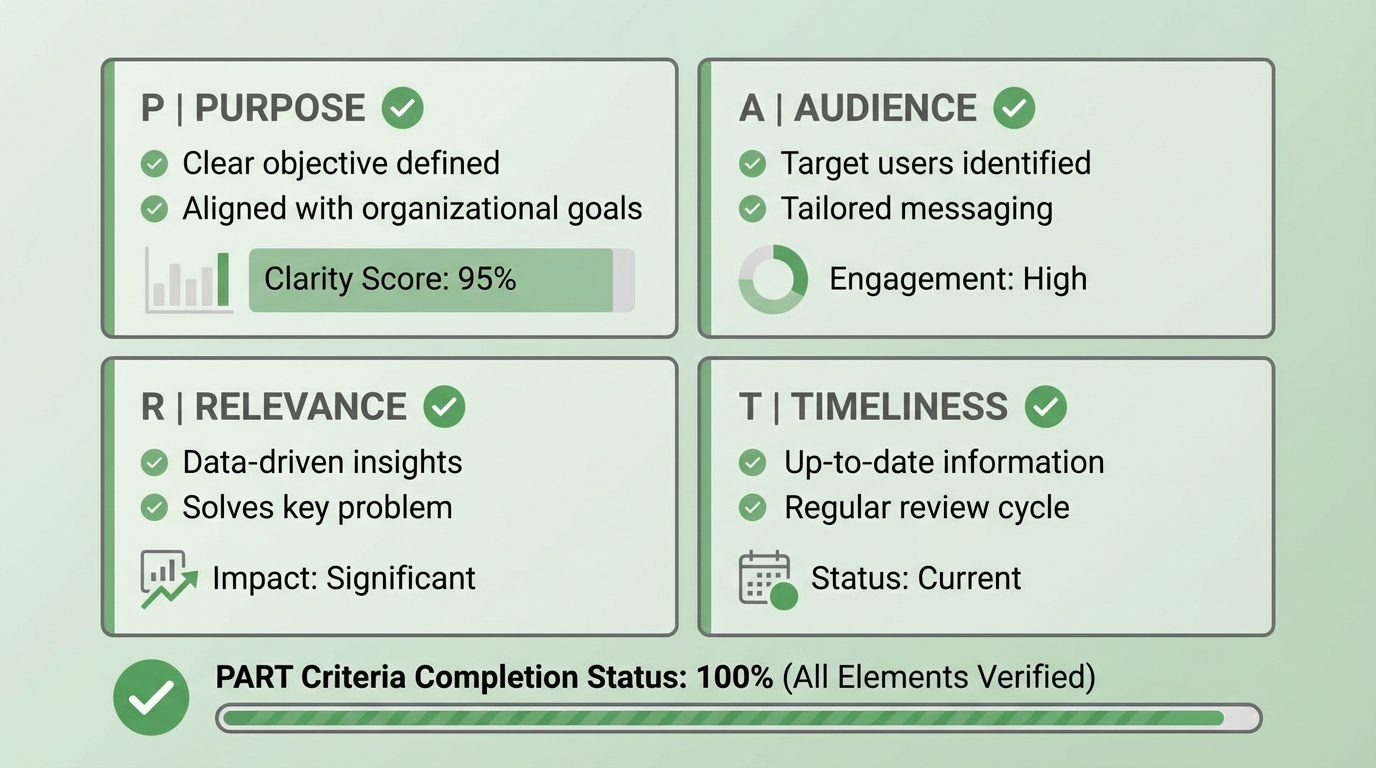
documentation. This is where most compliance issues show up, and it's also where a consistent workflow makes the biggest difference.
PART stands for Pain, Asymmetry, Range of motion, and Tissue/tone changes. These are the four criteria used to demonstrate subluxation on physical examination.
To document a subluxation, you need at least two of the four PART criteria, and one must be either asymmetry/misalignment or range of motion abnormality. That's the standard from the CMS Medicare Benefit Policy Manual, Chapter 15, Section 240.1.
What Each PART Element Needs
Here's a clear picture of what belongs in the chart for each element:
| Pain | Location, onset, duration, intensity, frequency, radiation. Must relate directly to the subluxation level. | Notes that say "patient reports pain" without specifics |
| Asymmetry / Misalignment | Specific findings of postural or structural deviation at the subluxation level | Writing "subluxation present" without describing the misalignment |
| Range of Motion | Measurable restriction or abnormality at the affected spinal level | Subjective notes like "decreased ROM" without actual measurements |
| Tissue / Tone | Changes in contiguous soft tissue including skin, fascia, or muscle | Documenting only bony findings and skipping tissue assessment |
Every claim needs these findings documented for each subluxation level billed. When you're billing 98942 for five regions, that means PART documentation for all five.
It's more work upfront. But it's the kind of work that protects predictable clinic cash flow over time because clean documentation means fewer denials, fewer rework cycles, and a much stronger position if questions ever come up.
The AT Modifier: Getting the Timing Right
The AT modifier tells Medicare that the manipulation you performed was active, corrective treatment—not maintenance care. It's required on every claim for CPT codes 98940, 98941, and 98942.
Here's where the nuance matters.
Appending AT doesn't prove medical necessity on its own. It certifies that you believe the treatment qualifies as active care. Medicare can—and does—review the underlying documentation to verify that.
If your chart shows a patient who has reached maximum therapeutic benefit and isn't demonstrating functional improvement, the AT modifier shouldn't be used. That's not a gray area. Maintenance care documented as active treatment is the single most common reason for overpayment findings in chiropractic audits.
The way to stay clear on this is to document measurable functional improvement at every visit. Not "patient feels better." Objective measurements. Quantifiable findings. Comparison to baseline.
When the documentation supports it, the AT modifier is exactly the right tool. When it doesn't, switching to maintenance care with a signed ABN protects both the patient and the practice.
A Documentation Workflow That Holds Up
The practices that handle compliance reviews well aren't necessarily writing longer notes. They're writing structured notes with a consistent format:
- Chief complaint tied to subluxation level — Every visit note starts with the specific reason the patient came in, connected to the spinal level being treated.
- PART findings for each level billed — Documented at every visit, not just at intake.
- Treatment plan with measurable goals — "Patient will achieve 15% improvement in cervical ROM within 4 weeks" holds up. "Continue adjustments as needed" doesn't.
- Re-examination at least every 30 days — Updated objective findings, comparison to baseline, and a clear assessment of whether the patient is still in an active treatment phase.
- Discharge criteria documented from the beginning — Define what "better" looks like for this patient on day one. Measure against it consistently. Document the transition to maintenance when it happens.
This kind of structure doesn't slow you down once it becomes routine. It actually makes charting faster because you're not deciding what to write each time—you're filling in a framework you already know.
The OIG Exclusion List: A Step Most Practices Skip

The List of Excluded Individuals and Entities (LEIE) is one of the most commonly missed compliance steps in chiropractic. If your practice participates in any federal healthcare program—Medicare, Medicaid, TRICARE, VA—you're not permitted to employ anyone who appears on this list.
It's one of those requirements that's easy to overlook because it doesn't come up in daily operations. But it's also one of the simplest compliance steps to implement once you set up the process.
How Often to Screen
The LEIE is updated monthly. The OIG recommends monthly screening of all employees, contractors, and vendors. While there's no statute mandating that specific frequency, the OIG has stated that providers who screen monthly are in a much stronger position if an excluded person is found on staff.
Many state Medicaid contracts explicitly require monthly checks. Some states consider providers to have knowledge of exclusion status regardless of whether they actually checked—which makes a documented monthly process especially valuable.
What to Screen and How
Your monthly process should cover:
- All current employees (clinical and administrative)
- Independent contractors
- Vendors who provide billing, consulting, or clinical services
- Any new hires, before their first day
The OIG provides a free online searchable database for individual name searches. For larger teams, the downloadable database allows bulk screening. Third-party services can automate the process if you'd rather not manage it internally.
The most important part: document every screening. Date, names checked, results. This creates the audit trail that demonstrates you're staying on top of it.
Internal Auditing: Catching Issues Early
One of the most effective ways to protect your practice is to review your own claims the same way a federal reviewer would—before anyone else does.
This is a core part of active revenue defense. The OIG looks favorably at practices that self-identify issues, fix them, and voluntarily repay any overpayments. It demonstrates exactly the kind of good-faith compliance effort that works in your favor.
What to Review and When
A quarterly internal audit is a practical starting point for most practices. Here's what to include:
- Random claim sample — Pull 10-15 Medicare claims per quarter. Check each one against the full documentation list: PART criteria, AT modifier appropriateness, treatment plan, re-examination notes, and diagnosis code accuracy.
- Billing pattern review — Compare your CPT code distribution against regional averages. If your 98942 usage is significantly higher than peers, make sure you can explain why with clinical documentation.
- Denial tracking — Track every denial by reason code. Patterns in denials point to specific documentation or billing habits that need attention.
AR aging check — Claims sitting beyond 90 days often point to underlying process issues worth reading your AR aging report to identify.
Documenting Your Audit Process
Every internal audit should produce a brief written summary:
- Date of the audit
- Claims reviewed (by date of service and CPT code)
- Findings (compliant, needs improvement, or needs correction)
- Actions taken to address any issues
- Any staff training conducted as a result
This serves two purposes. It helps you improve your processes in real time. And it creates a record of your compliance efforts that speaks well for your practice if questions arise later.
When Outside Help Makes Sense
Internal audits are valuable, but they have a natural limitation. It's hard to objectively review your own documentation when you're the one creating it.
An external billing audit—sometimes called a forensic audit—provides a third-party perspective on your claims, documentation, and billing patterns. This kind of review often uncovers revenue leakage that internal eyes tend to miss, along with compliance gaps that are easier to see from the outside.
The cost of an outside review frequently pays for itself in recovered revenue and corrected processes. And having a third-party audit on record is a clear signal that your practice takes compliance seriously.
Common Patterns That Prompt Closer Review
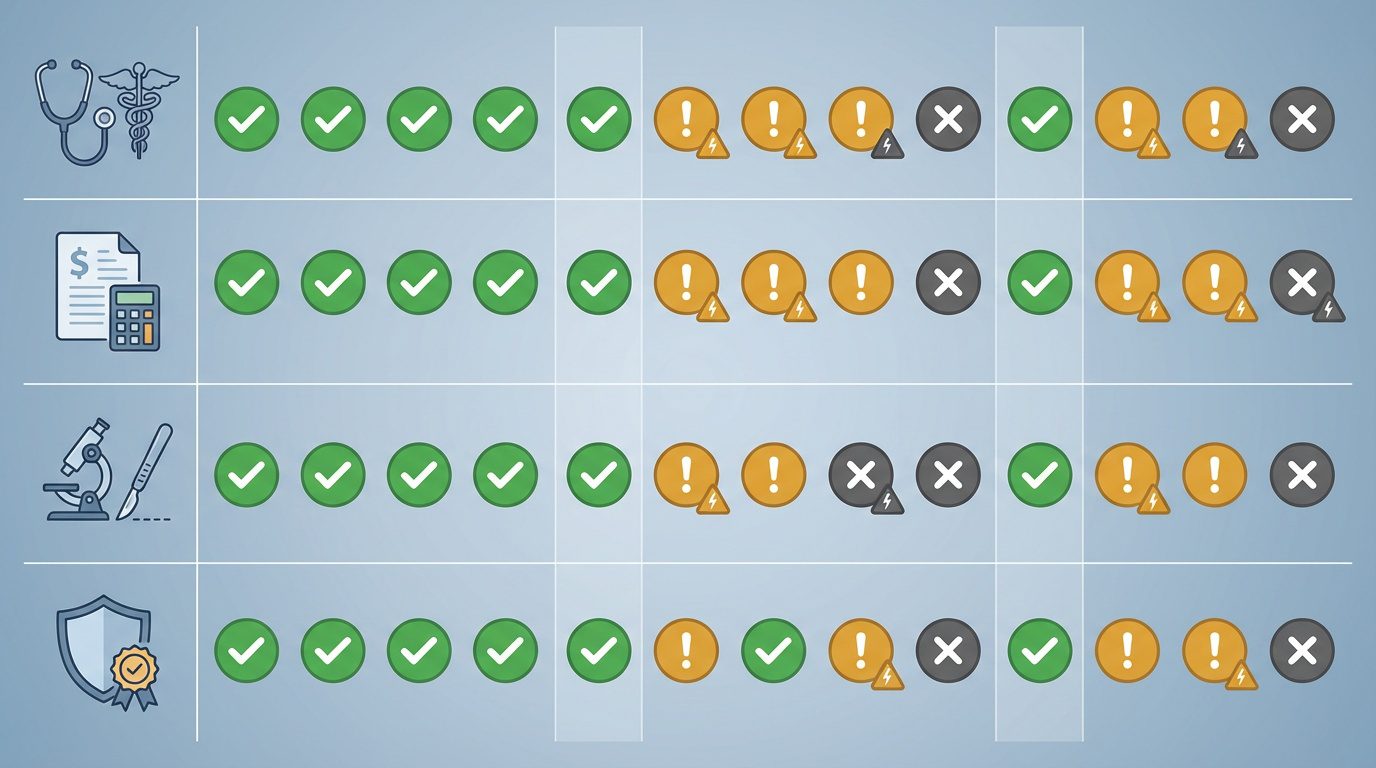
Understanding what the OIG's data analytics look for can help you evaluate your own billing patterns. None of these patterns mean something is wrong—but they do mean it's worth taking a closer look at your documentation to make sure everything is supported.
Billing Pattern Indicators
| High ratio of 98942 to 98940/98941 | May indicate upcoding or pattern billing | Verify that each region billed has independent subluxation documentation |
| Same diagnosis codes on every visit for months | May suggest maintenance care documented as active | Update diagnosis codes based on re-examination findings |
| Every patient receiving identical treatment frequency | May suggest protocol-driven rather than patient-driven care | Individualize treatment plans based on each patient's response |
| No discharge or transition to maintenance | May indicate indefinite active care without clinical basis | Document discharge criteria and transition plans from the start |
| AT modifier on maintenance-level care | Results in overpayment findings if documentation doesn't support active care | Apply AT only when documentation clearly supports the active treatment phase |
Documentation Patterns Worth Reviewing
- Identical or heavily templated notes across patients — Reviewers look for notes that appear copied rather than specific to the actual encounter. Every visit note should reflect what happened with that patient on that day.
- No baseline measurements — Without an objective starting point, there's no way to demonstrate improvement. Functional outcome assessments at the initial visit and at regular intervals give you that baseline.
- Vague treatment goals — "Continue treatment until improvement" isn't a treatment plan. Specific, measurable goals with defined timelines are the standard.
- Missing re-examination notes — CMS expects periodic re-evaluation to determine whether the patient is still improving. Gaps in re-exams over long treatment courses are something reviewers notice.
- Mismatch between billing and chart notes — If the superbill indicates 98942 (five regions) but the chart only documents findings for three regions, that discrepancy needs to be resolved.
Your 2026 Compliance Readiness Checklist

Here's a practical checklist you can work through over the next few weeks to strengthen your compliance posture. None of this requires a consultant. It requires attention, consistency, and a willingness to look at your own processes with fresh eyes.
Compliance Program Foundation
- Written compliance policies reviewed and updated within the past 12 months
- Designated compliance contact documented and communicated to all staff
- Annual compliance training completed by everyone who touches Medicare claims
- Confidential reporting process in place and communicated to staff
- Documented expectations for compliance participation
Documentation Standards
- PART criteria documented for every subluxation at every visit
- Chief complaint linked to specific subluxation level for each visit
- Measurable treatment goals in every treatment plan
- Re-examinations conducted at minimum every 30 days
- AT modifier applied only when documentation supports active treatment
- Discharge criteria established at the first visit
- Functional outcome assessments at baseline and at regular intervals
Billing Integrity
- Quarterly internal chart audit conducted (10-15 claims minimum)
- Denial tracking by reason code with corrective actions documented
- CPT code distribution reviewed against regional peer data
- Any overpayments identified through audit self-reported and repaid
- Billing patterns reviewed for statistical outliers
Exclusion List Compliance
- Monthly LEIE screening completed for all employees, contractors, and vendors
- Pre-hire LEIE screening documented for all new team members
- Screening results documented with dates and names checked
- State exclusion databases also checked where applicable
Security and BAA Compliance
- Business Associate Agreements current with all vendors handling PHI
- HIPAA security risk assessment completed within the past 12 months
- Staff trained on HIPAA privacy and security protocols
- Remote access and electronic data handling policies documented
Frequently Asked Questions
What are the 7 elements of a 2026 OIG chiropractic compliance program?
The seven elements, as updated in the November 2023 GCPG, are: written policies and procedures, compliance leadership and oversight, training and education, effective communication lines with a disclosure program, enforcing standards through consequences and incentives, risk assessment with auditing and monitoring, and responding to detected offenses with corrective action.
For a chiropractic practice, the most relevant applications are documenting your billing policies (especially around the active care vs. maintenance distinction), conducting internal chart reviews, and having a process for self-reporting identified overpayments.
The OIG acknowledges that small entities can scale these elements to match their resources—designating a compliance contact rather than hiring a full compliance officer, for example.
What triggers a 2026 OIG audit for a chiropractic practice?
The most common triggers are data patterns. The OIG's analytics identify practices whose billing looks significantly different from their regional peers.
Specific patterns that may prompt a closer look include a high volume of 98942 claims, extended treatment courses without documented improvement, maintenance care billed with the AT modifier, repeated identical diagnosis codes over long periods, and employing individuals on the OIG exclusion list.
The 33.6% improper payment rate for chiropractic services means the specialty already receives more review than most. Any additional billing patterns outside the norm increase the likelihood of further attention.
Does the OIG audit Medicare Advantage chiropractic claims differently than Fee-for-Service?
Yes, and the distinction became more defined in February 2026.
Traditional Fee-for-Service claims are reviewed through Medicare Administrative Contractors (MACs) and the CERT program. Medicare Advantage claims now carry additional oversight through the newly released ICPG, which extends compliance expectations to all "MA Parties"—including providers like chiropractors who treat MA patients.
In practice, this means chiropractic clinics with MA patients may see compliance reviews from both the OIG and the MA organization they're contracted with. The ICPG specifically highlights encounter data accuracy and third-party oversight as priority areas.
How often should I check my employees against the OIG Exclusion List in 2026?
Monthly. The LEIE is updated monthly, and the OIG has specifically recommended monthly screening as a best practice.
While no statute mandates that exact frequency, the OIG's guidance is clear that monthly checks put providers in a stronger position. Many state Medicaid contracts require monthly screening as a condition of participation.
Screen everyone—not just clinical staff. Administrative team members, billing vendors, and contractors can all create compliance issues if they appear on the exclusion list.
What is the penalty for insufficient documentation in a 2026 OIG audit?
It depends on the scope and pattern of the issue.
The most common outcome is recoupment—the government takes back payments for claims it determines were insufficiently supported. Beyond that, the False Claims Act allows penalties of up to $50,000 or more per false claim, plus triple damages in more serious situations.
In cases involving clear patterns of problematic billing, providers can face exclusion from federal healthcare programs. With 95.5% of chiropractic improper payments attributed to documentation issues, the most practical step any practice can take is to tighten up its charting processes.
How do I use the PART criteria to defend a 98942 claim in 2026?
For a 98942 claim (five regions of spinal manipulation), each region needs its own documentation of at least two of the four PART criteria, with one being either asymmetry/misalignment or range of motion abnormality.
In practical terms, your chart note for each visit should include: the specific chief complaint linked to each subluxation level, physical examination findings demonstrating at least two PART criteria per region, a treatment plan addressing each area, and progress notes showing measurable functional improvement.
The Medicare Documentation Checklist for Chiropractic Doctors from CMS provides the complete requirements. If you're billing five regions, five regions need to be individually justified in the notes.
What is the difference between the OIG's GCPG and the new 2026 ICPG?
The GCPG is the universal compliance framework for all healthcare entities. It covers the seven elements of a compliance program and applies whether you see Fee-for-Service patients, Medicaid patients, or both. Released in November 2023, it was the first update in 15 years.
The ICPG, released February 3, 2026, is industry-specific. This first ICPG targets the Medicare Advantage sector and addresses risk areas unique to MA—including risk adjustment, encounter data accuracy, marketing practices, and third-party oversight.
For chiropractors, the ICPG matters because it extends compliance expectations to downstream providers. If you treat MA patients, you're part of the ecosystem the OIG is focused on.
Can a small chiropractic practice realistically build an OIG compliance program?
Absolutely. The GCPG explicitly addresses small entities and recommends scaled approaches.
You don't need a compliance department. You need documented policies, regular training, internal chart reviews, and a consistent documentation workflow.
A solo practitioner can serve as their own compliance contact, conduct quarterly chart reviews, train staff annually, and check the LEIE monthly—all without hiring additional team members. The key is consistency and documentation of effort.
A billing partner who understands compliance can also serve as a practical extension of your program, providing the oversight and pattern analysis that's difficult to manage on your own.
Putting It All Together
Compliance doesn't need to be complicated. It needs to be consistent.
Every thorough chart note supports a clean claim. Every quarterly review strengthens your process. Every monthly LEIE check is one more piece of documented diligence. The practices that handle compliance well aren't doing anything flashy—they're doing the fundamentals reliably and documenting as they go.
The 2026 regulatory updates—the refreshed GCPG, the new Medicare Advantage ICPG, and the ongoing focus on chiropractic documentation rates—make this a good time to review your current processes and close any gaps.
Start with one section of the checklist this week. Build from there. Compliance is an ongoing system, not a one-time project. And a well-maintained system is the most reliable protection your practice can have.
If you've read through all of this and you're thinking "I know what needs to happen, but I don't have the bandwidth to sort through it alone," you're in good company. Most clinic owners we work with felt the same way before they saw how much smoother things can run with the right support.
That's why we offer a free discovery call. It's a chance to talk through your current billing situation and get clarity on what's working, what's not, and what your options are.
We'll help you understand:
- Where your claims might be getting stuck
- What's causing denials or delays
- Whether your AR is healthy or needs attention
- How your current process compares to best practices
- What a partnership with Bushido would actually look like
Book a Call — no pressure, no obligation, just a straightforward conversation about your billing.
Every claim that goes out with solid documentation behind it is a claim you won't have to worry about later. That kind of confidence is worth building toward.
SCHEDULE YOUR FREE DISCOVERY SESSION TODAY.


Copyright 2026 | All rights reserved | Web Design by iTech Valet