

Handling Denied Chiropractic Claims and Appeals: A Complete Guide
Learn why Medicare denies chiropractic claims, what records to gather, who can appeal, and what to do if a denial is upheld. Steps from Bushido Billing.
A denied claim is one that the health insurance plan has received and processed and then made a negative decision on, according to hfma.org. After Medicare makes its first decision on a claim, any party to that decision, such as patients, providers, and suppliers, or the people they appoint to act for them, has the right to appeal the Medicare coverage and payment decision, according to CMS.gov.
Common Reasons Medicare Denies Chiropractic Claims
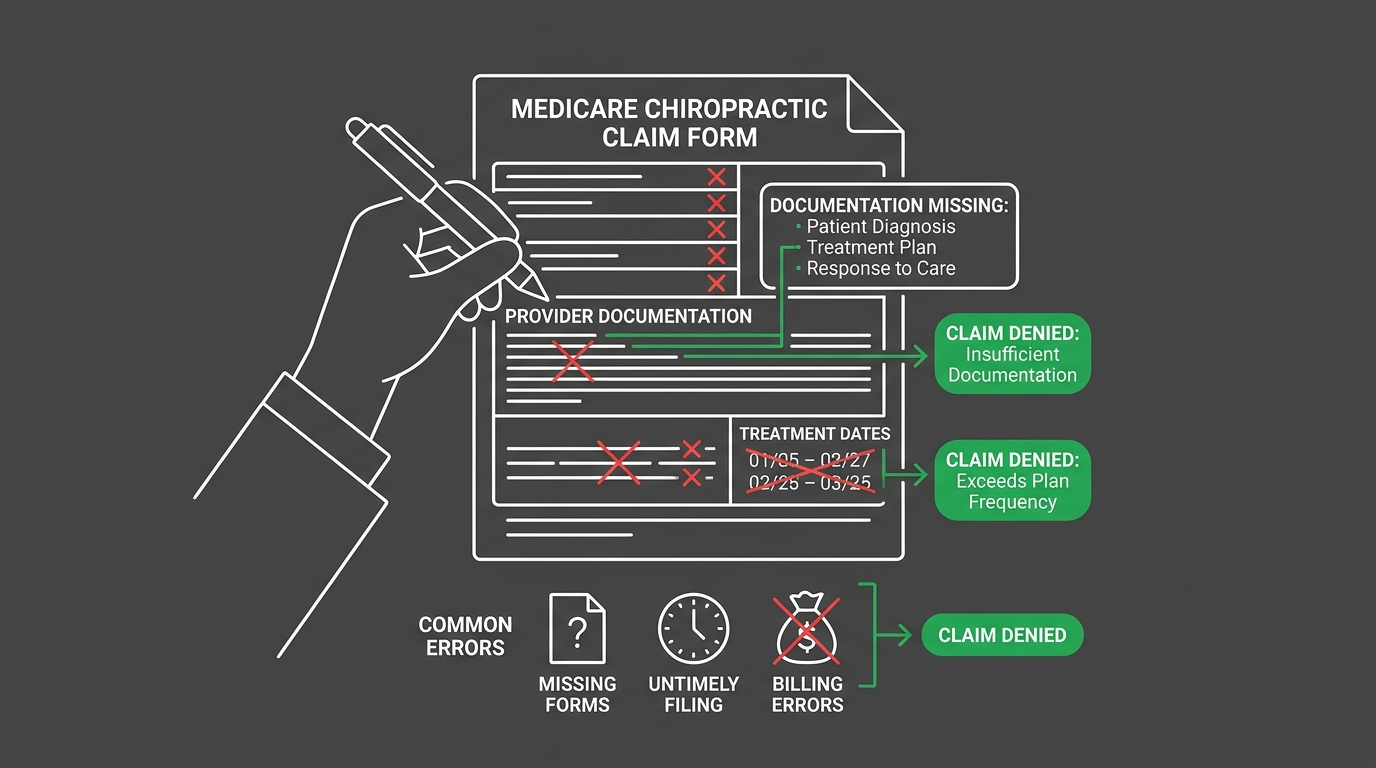
Start with the documentation and claim errors Medicare names itself.
The CMS Medicare Learning Network says that when you send claim records, you should include any other documents that back up the medical need for the services you billed. You also send whatever an additional documentation request (ADR) letter asks for. Not responding to that letter is a major reason claims get denied.
The same source lists other common reasons. They are a missing or weak treatment plan, an unclear main complaint from the patient, and not writing down all the spinal regions that were treated.
Some denials come from Medicare’s own rules about what it pays. The CMS Medicare Learning Network says Medicare typically pays for only 1 chiropractic manipulation for a patient each day. CGS Administrators, LLC says Medicare does not cover chiropractic treatments to areas outside the spine (extraspinal regions, CPT 98943). That includes the head, the arms and legs (upper and lower extremities), the rib cage and the abdomen.
CMS also names the items a claim must report. These are the symptom or condition or secondary diagnosis code(s), the subluxation or primary diagnosis code(s), the date of service, the place of service, and the procedure code. Failure to report these items will result in claim denial or delay.
Noridian Healthcare Solutions (JE Part B) says all claims you submit to Noridian are subject to prepayment or post payment medical review. Their page, Chiropractic Documentation Guidelines – Initial vs. Subsequent Visits, shows what your notes should hold. CMS also offers the Medicare Documentation Checklist for Chiropractic Doctors (MLN1232664, April 2025).
Here are those triggers side by side with what Medicare’s rule says.
| Denial trigger | What Medicare’s rule says |
|---|---|
| Unanswered additional documentation request (ADR) | Failure to respond is a major reason for claim denials |
| Weak treatment plan, unclear chief complaint, treated spinal regions not all documented | Listed among other common claim denial reasons |
| More than one manipulation per day | Medicare typically reimburses only 1 chiropractic manipulation for a patient each day |
| Extraspinal treatment (CPT 98943) | Not covered by Medicare |
| Missing required claim items (diagnosis codes, date of service, place of service, procedure code) | Results in claim denial or delay |
Step 1: Read the Denial Reason Before You Respond
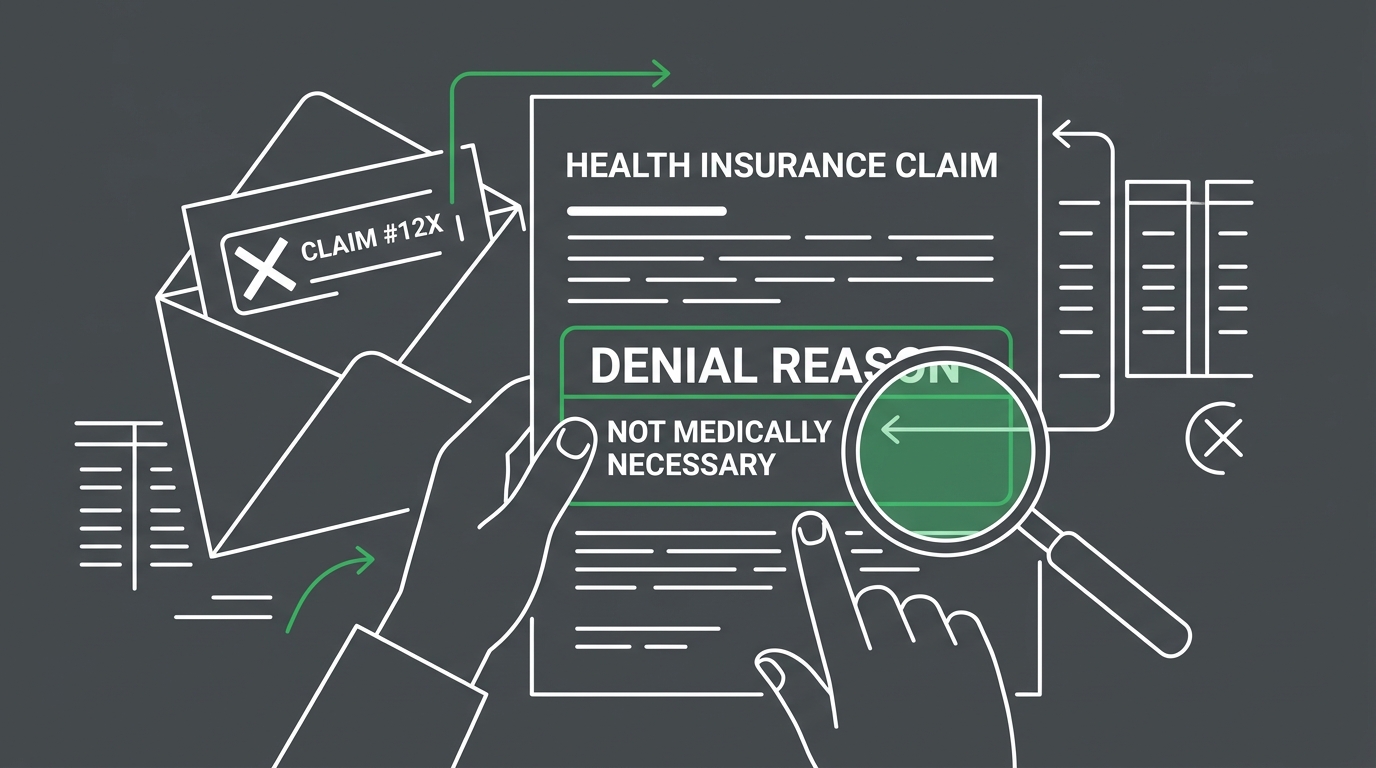
A denied claim is one the health insurance plan has received and processed, and then made a negative decision on. The denial reason tells you why. Read it before you do anything else.
KFF’s numbers on denials are worth a look. Nine percent (9%) of denials were for lack of prior authorization or referral. Only 5% were for lack of medical necessity.
KFF also describes denials for administrative reasons. Those include claims that were duplicated, missing information, filed too late, or sent for a provider the plan has not approved. They also include claims that met other criteria.
I don’t count electronic health record (EHR) software as a full billing operation. It gets claims out the door. For reading a denial reason, working out what went wrong, and chasing the money, I put a person on it. I don’t know a tool that does that well alone.
Two guides go deeper on this step. See How to Find the Root Cause Behind Recurring Payer Denials. Also see Why Resubmitting an Identical Claim Rarely Overturns a Denial.
Step 2: Gather the Records That Show Medical Necessity

Before any appeal goes out, your record has to show the care was needed. Here’s what to look for.
- Notes that are not copies. Noridian says records that look the same from one visit to the next, or from one patient to another, may not properly support medical necessity. They may lead to the claim being denied.
- The exact segment. Noridian also says you must write down the exact spinal segment you manipulated on the date of service. Writing down only a spinal region is not enough.
- X-ray timing. CGS says an x-ray is reasonably proximate (close enough in time) if it was taken no more than 12 months before, or 3 months after, the start of a course of chiropractic treatment.
- Plan of care. CGS says your notes should show how the day’s treatment fits within the plan of care, for example “visit 4 of planned 7 treatments,” and any way the treatment plan is being changed.
- No added signatures later. Noridian says doctors and other non-doctor practitioners should not add retroactive signatures or orders to medical records. Retroactive means added after the fact.
I let automation handle routine claims that have no errors. When a record has to argue why care was medically necessary, or a denial needs a tailored appeal, I put a skilled person on it. Technology gets a real role, but a limited one.
For the full source, read the Chiropractic Services (L37254) Fact Sheet (J15) from CGS Administrators, LLC. Two more guides help here: How to Build a Defensible Appeal File Before You Submit It and How Should Staff Respond to a ‘Not Medically Necessary’ Denial?.
Step 3: File the Appeal: Who Can File and What If You Are Late
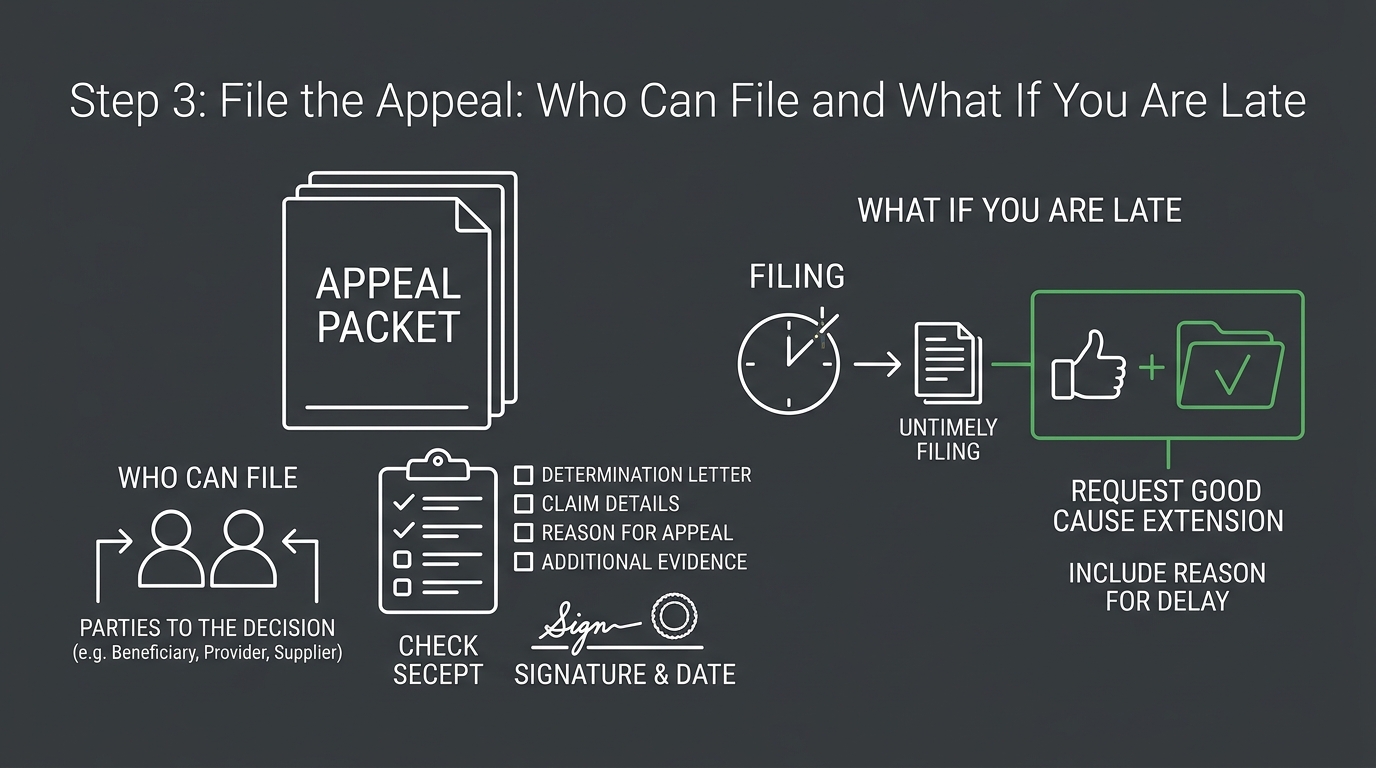
After Medicare makes its first decision on a claim, any party to that decision has the right to appeal. CMS.gov lists patients, providers and suppliers, or the people they appoint to act for them.
Late doesn’t always mean shut out. Medicare.gov says that if you miss the deadline for appealing, you may still file an appeal and get a decision if you can show good cause for missing it.
The level-by-level path lives in these guides:
- What Are the Formal Steps to Appeal a Spinal Adjustment Denial?
- First-Level vs. Second-Level Appeals: What Is the Difference?
- How Long Do Payers Have to Respond to a Written Appeal?
The official pages are worth a read too: Original Medicare (Fee-for-service) Appeals from CMS.gov and Medicare Appeals (official guide) from Medicare.gov.
Commercial and Marketplace Plans: How Often They Deny and How Rarely Denials Are Appealed
KFF looked at plans sold on HealthCare.gov. In 2024, insurers of qualified health plans (QHPs) denied 19% of in-network claims, about one in five. For out-of-network claims it was 37%, more than one in three. Put the two together and the average was 20% of all claims. All of it was similar to 2023.
Few of those denials get appealed. KFF says consumers rarely appeal denied claims. Fewer than 1% of denied claims were appealed. When they do appeal, insurers usually stand by their first decision. Two out of three appeals (66%) were upheld.
Read the full report, Claims Denials and Appeals in ACA Marketplace Plans in 2024.
Two guides cover the next questions. See What Records Overturn a Commercial Payer Claim Rejection? and Is It Worth Appealing a Denied Claim, or Should You Write It Off?
If the Appeal Is Upheld: Further Levels and Independent Review
An upheld denial isn’t always the end. KFF says that if an insurer upholds a denial on internal appeal, the consumer may have the right to an independent external appeal, also called external review, for certain types of claims.
More detail is in What to Do After a Payer Upholds a Denial on Appeal and How an External Review Differs From a Standard Payer Appeal. The KFF source is Claims Denials and Appeals in ACA Marketplace Plans in 2024.
What a Specialist Billing Partner Does With Denials
Bushido Billing says it works as an embedded billing partner, a partner built into your practice. It treats denial management, appeals, and accounts receivable recovery as the core of the work, not as optional add-ons. Bushido Billing specializes in billing for chiropractic and allied health. You can see how the work is done on the Medical Billing Services page.
For chiropractic denials, we’d pick a specialist over a biller who covers every specialty. From a generalist, we expect middling, uneven results. Chiropractic has its own demands, and we count on specialists to meet them.
Medicare’s Active Treatment (AT) modifier rules, personal injury lien workflows, and documenting maintenance care versus active care are specialty knowledge. We don’t accept that any billing firm can do chiropractic. That’s why we put chiropractic experience behind every denial we work, rather than rely on a generalist to supply it.
Frequently Asked Questions
What should an ABN say when Medicare may not cover a service?
It should explain why Medicare may not pay. It should also carry the patient’s acknowledgement that the patient is responsible for the cost if Medicare denies the claim. The CMS Medicare Learning Network lists both parts. Check that your notice form has both before a patient signs it.
How long does a provider have to submit a Medicare claim in the first place?
As the provider, you have up to one year from the date a patient got an item or service to send in a claim, says Medicare.gov.
Is ‘pain’ alone enough to support medical necessity on a Medicare chiropractic claim?
No. CGS Administrators, LLC says just stating or diagnosing “pain” is not enough to support medical necessity for the treatments.
Which manipulation codes need the AT modifier, and when must it be left off?
Billing codes 98940, 98941 and 98942 need the Active Treatment (AT) modifier when the care is active or corrective treatment of acute or chronic subluxation. Leave it off for maintenance therapy. The CMS Medicare Learning Network says Medicare requires the modifier to pay for those codes. Check the type of care on each claim before you add it.
Start to Finish, Denials Are Part of the Job
The work runs in order: read the denial reason, gather records that show medical necessity, file the appeal, and look at independent review if the denial is upheld. Sending a claim isn’t the finish line for us. The job counts when money lands in your practice’s account, so we judge billing by collections, not by activity or claims sent.
Bushido Billing offers full-service insurance billing, also called revenue cycle management (RCM), for chiropractic practices, and denial work is part of that job. Want to talk through your denials with us? Book a Call